First step towards school autonomy in Sindh
Updated 1 hour ago

Echoes of Suez: Trump’s Iran move may hasten US decline and shift global power toward China

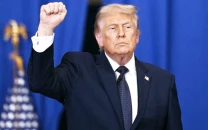
Analysts and historians are finding parallels between Britain's Prime Minister Anthony Eden's Suez crisis in October 1956 and the US President Donald Trump's February 28, 2026, move on Iran. Then, Britain and France attacked Egypt to open the Suez Canal for foreign ships.
The 1956 move was by the US President Dwight D Eisenhower, who faced elections a few days later. The move turned out to be disastrous for Britain; Prime Minister Anthony Eden resigned while Egypt's President Gamal Abdel Nasser became a hero of anti-colonialism.
Suez became shorthand for the moment that Britain, exhausted by the Second World War (1939-1945), gave way as a global power to the United States. This time around, China may replace America as the most important global power.
The two-week ceasefire brokered by China and Pakistan leaves the Islamic Republic of Iran in place and still in command of the future of the Strait of Hormuz, with the country's nuclear stockpile and ballistic missile programme unresolved.
"The Iran war had challenged Washington's argument that its global primacy was vital to the safety of international trade and the world order that was built after the end of the Second World War," wrote Steven Erlandserr in an assessment of the situation published by The New York Times on April 10, 2016.
Quoting from an assessment by Bruno Mcaeas, former secretary of state for European Affairs for Portugal, he wrote that for the rest of the world, the war is "starting to look like a military defeat more serious than Iraq and Afghanistan" and "the myth of America as all-powerful important, and it is the basic requirement of a global hegemon to keep the oil flowing, to open up the strait and keep it open. This belief in an all-powerful America that can solve anything is disappearing."
"The strategic rationale for the American military presence in the region has taken a huge hit," said Stephen Wertheim, a senior fellow at the Carnegie Endowment in Washington. The Suez analogy works for him since the war in Iran demonstrated "in a single incident the danger of American misgovernance and poor judgment".
The war itself and its uncertain outcome "just accelerates an existing worry shared by countries around the world about America's declining quality of governance. The war has challenged Washington's argument that only it has the power to keep the old world order, fashioned after the end of the Second World War, going.
The war itself, as well as its uncertain outcome, accelerates an existing worry shared by the countries around the world about America's declining quality of governance. The world does not know where America is going under the leadership of its maverick President, Donald Trump.
"By engaging in a war of choice in a critical region for the probable consequences for the economies of its closest allies, the Trump administration has destroyed the legitimacy of American power," asserted Anatol Lieven, of the Quincy Institute for Responsible Statecraft in Washington.
When future historians look at the performance by the two administrations headed by Donald Trump – the first one from 2017 to 2021 and the second from 2025 to 2029 – they will conclude that he did not make America great again (MAGA).
He had turned MAGA into a powerful political slogan which drew a large number of people into his orbit and sent him twice to the White House, the residence of the American President. If anything, Trump made America small, surrendering various aspects of global leadership to Western Europe or China.
Climate change was the area of policymaking in which the United States had led the world during the presidencies of Barack Obama and Joseph Biden. Under Trump, the United States pulled back, leaving the field to other countries. China was the main beneficiary of the American withdrawal.
According to one account authored by Brad Plumer for The New York Times, "Since returning to office, President Trump has dismantled federal efforts to fight climate change and vowed to stop new wind turbines from going up. His administration has cancelled billions of dollars in funding for technologies that might one day help reduce planet-warming emissions, and it has instead pushed to expand domestic oil and gas drilling."
At one point in his campaign for the presidency, he shouted "drill, baby drill, encouraging oil and coal companies to draw climate-polluting fuels from the ground. He has also cancelled wind turbine projects off the coasts of the United States since they spoiled the view from his golf courses.
Continued Plumer: "Yet many clean energy executives say they are finding ways to adapt, and some promising technologies that might help slow global warming are moving forward." Start-ups that could help reduce emissions are figuring out how to survive without government support.
Others, such as battery-makers, are hoping to be supported by the emerging artificial intelligence ventures. Some industries, such as geothermal energy or nuclear power start-ups, are looking at other sources of support.
More than 300 start-ups attended a major annual meeting devoted to energy issues. The meeting was held in Houston, Texas and was attended by investors and policymakers. "We have just gone through an era of radical uncertainty," for clean energy, said Alex Kizer, an executive vice president at the Energy Futures Initiative, a Washington-based nonprofit organisation. "And for a lot of companies, there are big questions on how they'll evolve going forward.
Going back to the Suez analogy, while the United States was the main beneficiary of the wrong policy choices made by Britain and France, this time, China is likely to emerge strong and become the world leader.
To quote from Rajan Menon, political science professor at City University of New York, "China is looking on with great glee, and when Trump goes there for a summit meeting with Xi Jinping, he will be much diminished."









This material may not be published, broadcast, rewritten, redistributed or derived from. Unless otherwise stated, all content is copyrighted © 2026 The Express Tribune.






COMMENTS
Comments are moderated and generally will be posted if they are on-topic and not abusive.
For more information, please see our Comments FAQ