Grand welcome in Gilgit as Prince Rahim Aga Khan V arrives on visit
Updated 1 hour ago

Delegation also includes Defence Council secretary, Central Bank chief, some members of parliament
As senior figures from the United States and Iran are set to hold historic talks in Islamabad on Saturday, Prime Minister Shehbaz Sharif described the high-stakes negotiations as "make or break moment" for peace.
Despite earlier uncertainty and competing claims over the ceasefire terms, talks are going ahead as scheduled amid an unprecedented security lockdown in the federal capital.
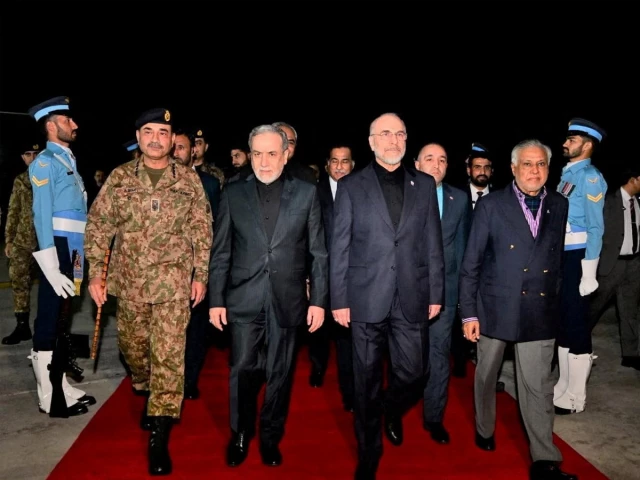
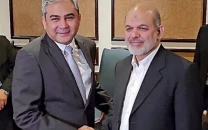
Iranian Foreign Minister Abbas Araghchi and Parliament Speaker Mohammad-Bagher Ghalibaf landed in Pakistan late on Friday night, the Foreign Office said.
The delegation was received by Deputy Prime Minister/Foreign Minister Ishaq Dar along with National Assembly Speaker Sardar Ayaz Sadiq, Chief of Defence Forces & Chief of Army Staff Field Marshall Syed Asim Munir and Minister for Interior Syed Mohsin Raza Naqvi, the statement added.
Iran's Tasnim news agency reported that Ghalibaf is leading the delegation, which includes FM Araghchi, Defence Council Secretary Ali Akbar Ahmadian, Central Bank Chief Abdolnaser Hemmati and some members of parliament.
Prime Minister Shehbaz Sharif addressed the nation in a televised speech, describing the upcoming talks as a "make-or-break moment" for peace.
"I ask all of you to pray that these talks are successful and countless lives are saved and the world shall see peace," the prime minister said, underlining the gravity of the situation and Pakistan's role as a mediator at a critical juncture.
Pakistan has been working behind the scenes for weeks to bring both sides to the negotiating table.
Officials familiar with the diplomatic efforts say Islamabad leveraged its ties with Washington as well as backchannel contacts with Tehran to create conditions conducive to dialogue.
In his address, Shehbaz singled out Field Marshal Asim Munir and Foreign Minister Ishaq Dar for their role in defusing tensions and facilitating engagement between the two adversaries.
He credited them with helping "put out the flames of war," a public acknowledgment of civil-military coordination in sensitive diplomatic initiatives.
The talks will formally begin on Saturday, with both delegations arriving under tight security in Islamabad.
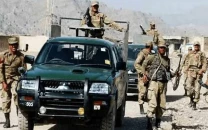
The capital has witnessed heightened security measures over the past 48 hours, with limited movement in key areas and an increased presence of law enforcement personnel, reflecting the high-profile nature of the visit.
From the United States, Vice President JD Vance is leading the delegation.
Speaking before departing for Pakistan, Vance struck a cautiously optimistic tone, saying Washington was open to dialogue if Iran demonstrated sincerity.
"If the Iranians are willing to negotiate in good faith, we're certainly willing to extend the open hand," he told reporters, echoing a broader US position that leaves the door open for diplomacy while maintaining pressure.
However, the messaging from Washington has been far from uniform. President Donald Trump has coupled calls for negotiations with stark warnings of renewed military action if talks fail.
In an interview with an American media outlet, Trump said the United States was prepared to escalate if necessary.
"We're going to find out in about 24 hours. We're going to know soon," he said, adding that Washington had already begun preparations for a potential military response.
Trump also expressed skepticism about Iran's intentions, suggesting that conflicting signals from Tehran raised doubts about its willingness to compromise, particularly on the contentious issue of nuclear enrichment.
On the Iranian side, expectations are tempered by clear preconditions.
Parliament Speaker Mohammad Bagher Ghalibaf has publicly stated that negotiations cannot proceed unless certain demands are met, including a ceasefire in Lebanon and the release of Iran's frozen financial assets.
Diplomatic observers note that both sides seem to be hardening their stances as a tactic and public posturing.
Nonetheless, analysts believe even preliminary engagement would mark a significant breakthrough given the current level of hostility.
For Pakistan, hosting the talks represents both an opportunity and a challenge.
Islamabad has long sought to position itself as a credible mediator in regional and global conflicts, and the success of these negotiations could significantly enhance its diplomatic standing.
At the same time, failure could expose the limits of its influence and underscore the deep mistrust that continues to define US-Iran relations.
Officials remain cautious and were not willing to divulge any details. There has been an unprecedented level of secrecy shrouding the talks.
The prime minister, meanwhile, in his address, said that Pakistan would "make sure these talks are successful by putting in their best efforts", while acknowledging that the ultimate outcome remains uncertain.







This material may not be published, broadcast, rewritten, redistributed or derived from. Unless otherwise stated, all content is copyrighted © 2026 The Express Tribune.




COMMENTS
Comments are moderated and generally will be posted if they are on-topic and not abusive.
For more information, please see our Comments FAQ