Pakistan, seven other Muslim states condemn Israeli minister's 'disgraceful' actions against flotilla detainees
Updated 2 hours ago

Beirut says death toll from Israeli strikes rises to 357 over past 48 hours
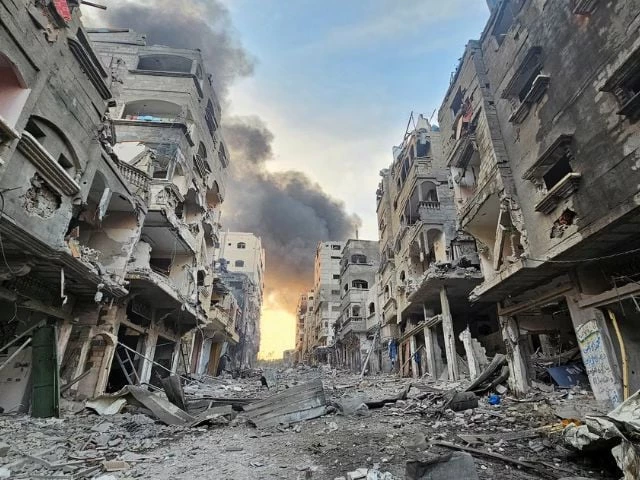
Lebanon's health ministry says the death toll from Israeli strikes across the country over the past 48 hours has risen to 357, up from a previous count of 303, while it says 1,223 more people have been wounded.
"The toll is still not final, due to the ongoing removal of rubble and the presence of a large amount of human remains" requiring DNA testing, the ministry statement said after Israel's massive strikes on Wednesday.
The ministry has also raised the overall toll in Lebanon since fighting erupted between Israel and Hezbollah on March 2 to 1,953 dead and 6,303 wounded.
Lebanon is facing a food security crisis as the Iran war disrupts supplies of goods inside the country, the United Nations World Food Programme said on Friday.
A fragile two-day-old ceasefire has halted the campaign of US and Israeli airstrikes on Iran, but it has not so far calmed a parallel war waged by Israel against Iran's Hezbollah allies in Lebanon.
"What we're witnessing is not just a displacement crisis; it is rapidly becoming a food security crisis," said World Food Programme country director Allison Oman, speaking via video link from Beirut.
She warned that food was becoming increasingly unaffordable due to rising prices and demand among displaced families.
The price of vegetables has soared by more than 20% and bread prices have increased by 17% since March 2, the WFP said.
"What we're now seeing is a very worrying combination: prices are rising, incomes are disrupted, and demand is increasing as displacement continues for many families," Oman stated.
Lebanon faces a two-layered crisis, in which some markets have fully collapsed - especially in the south, where more than 80% of markets are no longer functioning - while those in Beirut are under increasing strain, Oman said.
Many traders in conflict-affected areas in southern Lebanon are reporting that less than one week of essential food stocks remain, she added. The ability to deliver food aid into hard-to-reach areas in the south, which has faced heavy bombardment by Israeli airstrikes since March 2, was becoming increasingly difficult.
While the Qasmiyeh bridge, which was previously struck, is now operational, movement remains difficult. Ten WFP convoys have reached the south to provide aid to some of the estimated 50,000 to 150,000 in need of humanitarian support in that part of the country.
"This escalation is pushing vulnerable communities even closer to the edge," said Oman, adding that, due to this latest escalation, about 900,000 people across Lebanon were facing food insecurity - a number that was set to rise.
Israel's military chief said on Friday that the country's forces are "still in a state of war" in southern Lebanon and are not observing a ceasefire on the northern front, according to an army statement.
Israeli chief
"The army continues to operate here in Lebanon," Chief of General Staff Lt Gen Eyal Zamir said while visiting areas near Bint Jbeil in southern Lebanon, where he spoke with commanders, according to the statement.
He stated that the army "is in a state of war" and is "not in a ceasefire on the northern front." "In Iran, we are in a ceasefire, but we can return to operating there at any moment, and with great intensity," he added.
The speech came as the Israeli army continued its widened assault on Lebanon since Wednesday, killing over 303 people and injuring 1,150 others, according to Lebanese Civil Defence.
Israel also threatened to attack ambulances in Lebanon directly if the Lebanese group Hezbollah's alleged use of them "for military purposes" does not stop. "Hezbollah is widely using ambulances for military purposes."





This material may not be published, broadcast, rewritten, redistributed or derived from. Unless otherwise stated, all content is copyrighted © 2026 The Express Tribune.











COMMENTS
Comments are moderated and generally will be posted if they are on-topic and not abusive.
For more information, please see our Comments FAQ