Rain havoc claims two lives in K-P
Updated 9 minutes ago

In case Pakistan accepts the US offer, it may also help fast-track the installation of these systems

President Donald Trump's administration has backed a $2.4 billion investment offer by an American firm to install advanced security systems at major Pakistani airports to detect criminals and transnational threats.
US Chargé d'Affaires to Pakistan Natalie A Baker has recently supported an investment proposal by Securiport — an American firm — to install Advanced Passenger Information (API) and Passenger Name Record (PNR) capability systems, according to the official documents. She urged the Pakistani authorities to consider the proposal.
The proposed solution guarantees data transport from the airline to the government while allowing Pakistan to retain full ownership and custody of all the data, with 24/7 support and training, showed these details.
In case Pakistan accepts the US offer, it may also help fast-track the installation of these systems. A separate move by the Pakistan Airports Authority (PAA) to install such systems has recently become controversial due to transparency concerns raised by the Senate Standing Committee on Defence.
Securiport has proposed funding all upfront investment related to the deployment of its system and offered to recover its costs over the contract term via a government-mandated passenger security surcharge model, showed the details.
The company has offered to invest $2.4b over the proposed 25-year life of the contract. The company would also establish a subsidiary in Pakistan through which it will train over 1,000 Pakistani citizens in these modern technologies, according to the proposal.
Natalie extended the “support” of the US government for the Securiport investment proposal in a communication with the Ministry of Defence, which is the PAA's administrative division.
Natalie supported the proposal of deploying the API and PNR capability systems by the US firm.
“We appreciate your consideration of Securiport’s proposal and continued partnership with the US in advancing Pakistan’s security and our efforts to achieve safe, secure and efficient travel”, said Natalie, in a correspondence with Pakistani authorities.
According to the offer, the API and the PNR systems would be operated by the Federal Investigation Agency (FIA), which would provide the government with an integrated biometric-enabled border management plan.
In her support letter for the investment offer, Natalie wrote that Securiport has more than two decades of experience in numerous countries and adheres to a stringent compliance framework.
When contacted, the spokesperson of the US embassy in Islamabad said, “We do not comment on private diplomatic correspondence. We would direct you to the Pakistani government”.
Defence Minister Khawaja Asif also did not comment on whether Pakistan plans to accept the US offer for investment.
Securiport provides border security, biometric technology, and threat assessment solutions to governments globally.
Securiport’s installed system can “detect and interdict criminal and transnational threats in real-time at the border", stated the US chargé d’affaires in her support letter. She added that the proposed solution guaranteed data transport from the airline to the government while allowing Pakistan to retain full ownership and custody of all the data with 24/7 support and training.
The proposal is in line with Pakistan's efforts to install the automated border control system, known as E-gates. However, these efforts have recently become controversial due to the decision to award the contract to the state-owned enterprise by invoking the Public Procurement Regulatory Authority (PPRA) direct contracting rules.
The International Monetary Fund has already asked Pakistan to withdraw the PPRA rules that allow direct contracting to the state-owned enterprises as part of its conditions under the Governance and Corruption Diagnostic Assessment report.
In 2020, the PAA had initiated a global competitive request for proposal for the deployment of E-gates, API and PNR systems. Again in 2024, a fresh EOI was issued to invite experienced international firms. But subsequently, both these EOIs were ignored.
In January this year, the Senate Standing Committee on Defence took a briefing from the airport authority on the automated project.
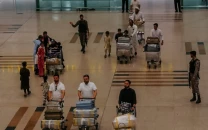
The committee had been informed by the authority that under the proposed system, e-gates equipped with biometric passport scanners and facial recognition technology were planned to be deployed, which were expected to reduce average immigration clearance time from three to five minutes to under 45 seconds per passenger.
The committee was further apprised that these e-gates would be integrated with the FIA's exit control list, passenger name record systems, and Interpol databases to enable real-time identification of high-risk travellers.
However, the chairman of the Senate Standing Committee on Defence raised concerns regarding reports that the bidding process for the procurement of e-gates was not carried out in accordance with the relevant PPRA Rules, the record showed.
The committee directed the Ministry of Defence to furnish all relevant procurement records and documentation to enable a thorough examination of the matter and to ascertain whether any procedural irregularities or violations had occurred.
This week, Transparency International Pakistan approached the Prime Minister’s Office over alleged serious violations of the PPRA Rules 2004 in the award of the E-Gate project by the PAA, according to a media report.












This material may not be published, broadcast, rewritten, redistributed or derived from. Unless otherwise stated, all content is copyrighted © 2026 The Express Tribune.




COMMENTS (10)
Comments are moderated and generally will be posted if they are on-topic and not abusive.
For more information, please see our Comments FAQ