
Should you trust AI for everything?
Updated 1 hour ago

Trump issues expletive-laden threat of 'hell' over Hormuz IRGC claims downing two C-130s, two Black Hawks, two
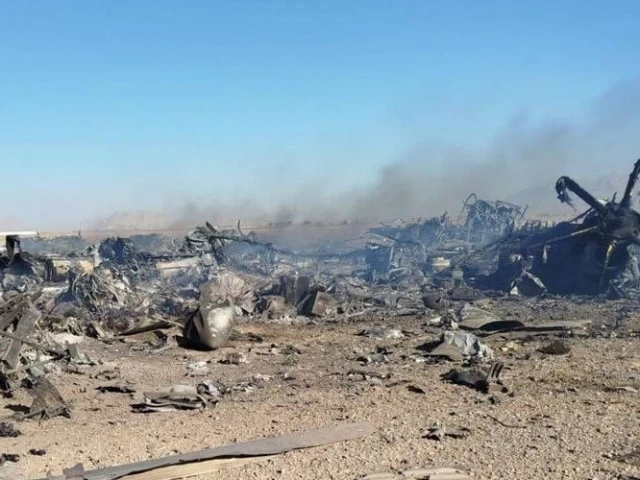
Iran's Islamic Revolutionary Guard Corps (IRGC) claimed on Sunday that its forces had destroyed two American C-130 military transport planes and two Black Hawk helicopters in southern Isfahan province following a US rescue operation.
The announcements came amid mounting threats from the United States. President Donald Trump, in a series of expletive-laden social media posts, warned Tehran that it would be "living in Hell" if it failed to reopen the Strait of Hormuz by Tuesday (today).
The Iranian army also said it had downed two MQ-9 Reaper drones and an unspecified number of Israeli Hermes 900 drones, part of a broader effort to retaliate against air strikes in the past 24 hours.
Footage aired on Iranian state television showed burnt wreckage, which authorities said were US aircraft involved in the operation to rescue a US F-15 airman downed by Iranian forces late last week.
The Strait of Hormuz, a vital waterway for global oil flows, has been effectively closed since the war began over five weeks ago, spurring a sharp rise in crude prices. Trump had given Iran until April 6 to reopen the strait.
Earlier, a US special forces mission rescued an American airman whose F-15 jet was downed behind Iranian lines, described by Trump as "one of the most daring" operations in US history. Another crew member was already rescued in broad daylight within hours.
While the Pentagon reported technical malfunctions in two transport planes during the rescue, all personnel were evacuated safely, highlighting both the risks of the conflict and Iran's ability to strike back.
Trump's warnings went beyond mere rhetoric. In social media posts, he vowed to strike Iran's power plants and bridges if the strait remained closed, emphasising the country's exposure to devastating attacks on critical infrastructure.
Critics have called his threats a potential violation of international law, coinciding with Israeli strikes on Iranian petrochemical plants and preparations for further operations targeting energy facilities, reportedly awaiting US approval.
Iranian officials dismissed Trump's threats as incoherent and incendiary. Foreign Ministry spokesman Esmaeil Baghaei labelled them "incitement for war crimes and crimes against humanity."
Iranian parliament speaker Mohammad Bagher Ghalibaf warned that the region could "burn" as a result of what he described as reckless US actions under the influence of Israeli Prime Minister Benjamin Netanyahu.
The war, now entering its sixth week, has seen targeting of civilian infrastructure in a tit-for-tat escalation. Iran launched missile and drone attacks on Gulf Arab countries, hitting power plants, desalination facilities, and petrochemical sites in Kuwait, Bahrain, and Abu Dhabi.
Authorities reported fires and significant material damage, though casualties were limited. In Kuwait, 13 missiles and 31 drones targeted energy and water facilities, forcing two power generation units offline.
Bahrain reported fires at oil storage and petrochemical facilities, while in the UAE, operations at Borouge's petrochemical plant were suspended following debris-caused fires. Iranian forces said they targeted an Israeli-linked ship off Dubai's Jebel Ali port.
Israel, meanwhile, struck Iranian petrochemical facilities, and killed Brigadier General Masoud Zare, commander of Iran's Air Defence College in air strikes.
The downing of the F-15 was the first known US aircraft to crash in Iranian territory since the conflict began. Another A-10 attack plane was also shot down, underscoring the dangers faced by US and Israeli aircrews despite Trump's assertions of air dominance.
The rescue removed the immediate threat of a hostage crisis that could have exacerbated domestic scepticism in the US over the war. A senior administration official revealed that a CIA deception campaign misled Iranian forces during the operation.
The mission involved dozens of aircraft and reportedly Israeli assistance, while the rescued weapons officer had climbed 7,000 feet up an Iranian mountain to reach an evacuation point, the official said.
Efforts to mediate the conflict continue but remain fragile. Oman has facilitated talks with Iranian officials to ensure safe transit through the Strait of Hormuz. Iranian officials have signalled that the strait can reopen only if transit revenues compensate for war-related damages.
China and Russia have called for ceasefires. Chinese Foreign Minister Wang Yi described a ceasefire as "the fundamental way to resolve navigation issues," while Russian Foreign Minister Sergey Lavrov urged the US to abandon "the language of ultimatums" and prioritise diplomacy.
Iranian leaders have repeatedly emphasised their determination to defend sovereignty. Foreign Ministry spokesman Baghaei said Iranians are "prepared to fight back" and highlighted the nation's historical readiness to defend itself over decades of regional tensions.
The Iranian military also maintains a posture of defiance. The IRGC has threatened waves of retaliatory strikes if civilian infrastructure continues to be targeted. Its military joint command has warned of stepped-up attacks on regional oil and civilian facilities if its sites are attacked.
In addition to the Strait of Hormuz, Tehran has threatened to restrict passage through the Bab el-Mandeb Strait off the Arabian Peninsula. Control over these chokepoints carries significant global economic implications, with crude prices spiking to near $120 per barrel.



This material may not be published, broadcast, rewritten, redistributed or derived from. Unless otherwise stated, all content is copyrighted © 2026 The Express Tribune.











COMMENTS
Comments are moderated and generally will be posted if they are on-topic and not abusive.
For more information, please see our Comments FAQ