
Louie dies, and they stop. But not for long. The ER never allows long. But long enough.
In The Pitt, Louie is what we would call a “frequent flier” in our ER lingo. Chronic illness. In and out. Uninsured. System-worn. The kind of patient whose name is familiar before his face comes into view. And yet, when he dies, the team does not reduce him to utilisation metrics or comorbidities. They remember him. They speak about his cheerfulness. The way he always had something kind to say to the nurses. The way he made their night shifts lighter. They celebrate his life.
That pause was the most accurate thing I have seen on medical television in years.
A lot has been written about The Pitt. It feels like a spiritual successor to ER, stripped of the orchestral swell and early-2000s heroics. It stands in quiet contrast to the romance and entanglements of Grey's Anatomy. People call it grittier. More grounded. Less interested in saviours and more attentive to institutional realities.
I have worked in two emergency departments, one in Houston, one in Karachi. Watching The Pitt felt like looking into a mirror that reflected both, though unevenly.
What it gets right is the strain. The boarding. The moral fatigue. The violence against healthcare workers. The medical misinformation. The patient who is both vulnerable and angry. Ditto where the staff is concerned. And in tandem, the staff who survive by staying aligned.
But that moment when Louie is pronounced dead lingered with me. In the US, I have stood in rooms after codes were called. There is a choreography to it. The pronouncement. The silence. Sometimes a debrief. Social workers who step in. Mandated processes that kick in. There is, at least, some acknowledgment that something human has just ended. It is imperfect. Bureaucratic at times. But it exists.
In Karachi, it often did not in the same structured way. We had Dead On Arrivals. We had phosphine-poisoned siblings laid side by side under white sheets. We had children whose rigor mortis had already declared what we could not undo. I remember pulling a curtain across the resuscitation bay, not for them but for us, because the ER does not stop. There were other patients waiting.
There was rarely a formal debrief. No routine counselor presence. No structured reflection we could rely on. We moved on because we had to. I wrote about that weight years later, trying to give it shape in words we never had time to say.
Some systems make more space for grief. Others are forced toward throughput. This is not a moral judgment. It’s structural. Emergency medicine swings like a pendulum. Between pause and pressure. Between systems that allow ritual and systems that demand endurance. Between visibility and silence. Between belonging and foreignness. The pendulum does not stop.
These differences are not limited to death alone. The Pitt also shows violence: the raised voices, the entitlement, the fraying civility toward exhausted clinicians. I recognised that too.
In Texas, I was once “fired” by a patient’s mother who told me she wanted a “real American doctor.” A complaint later described me as “dark-skinned… sounded Pakistani.” I was American. Board-certified. Fully trained. And still foreign. Belonging, I learned, is not guaranteed by a passport. I wrote about that encounter in a piece called “Margarita,” where the person who ultimately steadied me was not a senior physician but a hospital cleaning lady from the housekeeping department who whispered reassurance when my daughter lay in the NICU of the same children’s hospital where I practiced.
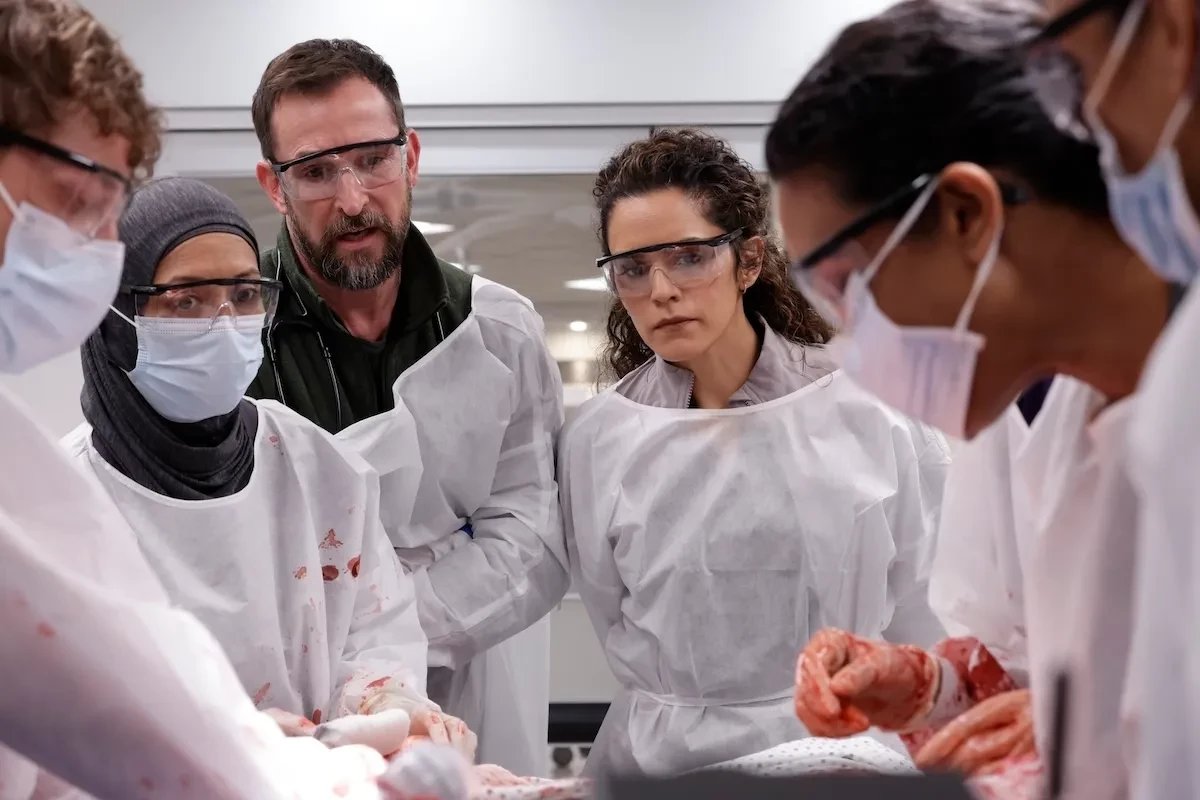
In Karachi, the aggression felt different. Less legalistic. More physical, shaped by different constraints. Parents arguing with each other at the bedside. Entitlement layered not only with expectation but with scarcity. Violence exists in every emergency department. It just sounds different.
Child abuse is another place where the mirror doesn’t reflect evenly. In the US, even in a children’s hospital emergency department, we saw rape cases frequently. Mandated reporting. Sealed forensic kits opened only by SANE nurses, Sexual Assault Nurse Examiners. Social workers, chaplains, security personnel, and child protective services were embedded in the pediatric emergency department. The process was uncomfortable, procedural, sometimes retraumatizing, but it did bring the harm into the open. The system demanded visibility.
In Pakistan, far fewer cases reached us in formal channels. That does not mean abuse occurred less. It often meant silence was stronger. Stigma heavier. Medicolegal pathways less consistently accessible. The child who has been broken does not always arrive under fluorescent lights with a social worker waiting. I have written about those children too, the ones whose stories were carried in fragments, if at all.
Watching The Pitt, I appreciated that it allows abuse to be named. That it shows systems trying, however imperfectly. That it does not trivialise the moral injury of standing in those rooms.
And yet television, by necessity, contains chaos. It gives it edges. What it cannot fully show is what follows the shift. The numbness in the car ride home. The irritability that shows up at family dinner. The way unprocessed grief calcifies into cynicism if left unattended. In Karachi, we had no routine debrief. In the US, we had more structure, but even structure does not guarantee healing.
Across continents, one thing stayed constant: team is oxygen. In Texas, it was the residents and nurses who caught each other before collapse. In Karachi, it was colleagues who held the line when ICU beds were unavailable and more children kept arriving. I named them once in a farewell letter after thirteen years in the ER in Karachi because without them, the weight would not have been carryable. The Pitt understands that too. It does not portray lone heroes. It portrays interdependence.
So yes, I admire this show.
I admire that it pauses for Louie.
I admire that it honours the homeless and the uninsured. I admire that it shows healthcare workers as strained but still human.
But watching Louie’s memorial, I also felt something else: a quiet ache for the pauses we rarely took in Karachi. For the curtains we pulled instead. For the words we never spoke because another ambulance had already arrived.
Emergency medicine is not drama. It is bearing witness.
Sometimes with ritual. Sometimes without it.
I am grateful The Pitt shows the pause.
Because in many emergency departments, the pause is the first thing we lose.
The writer is a physician, researcher, innovator, and freelance writer.
All facts are information are the sole responsibility of the writer