KSE-100 Index falls 609 points amid selling pressure, geopolitical uncertainty
Updated 8 hours ago

ECC approves food ministry's proposal of building strategic reserves amid regional situation
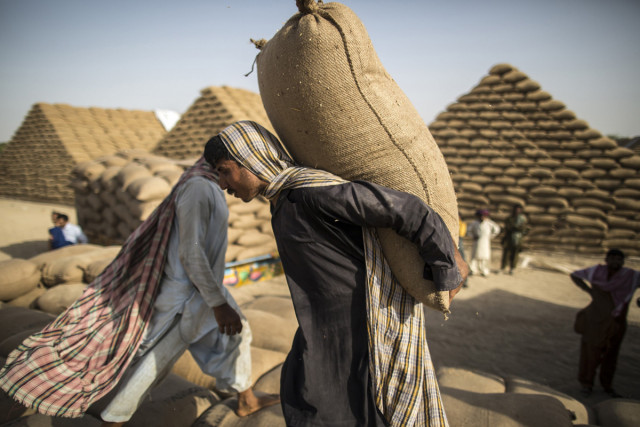
Pakistan's economic managers have underscored the need for maintaining strategic reserves of wheat with an expenditure of Rs31 billion to ward off the threat posed by the Middle East conflict to the country's food security.
In addition to building the wheat buffer, they have also proposed incentives for wheat farmers to encourage them to invest in local plantations and reduce the need for imports.
During discussions in a recent meeting of the Economic Coordination Committee (ECC), the Ministry of National Food Security and Research presented the wheat stock position in provinces and at the federal level and called for procuring the commodity to keep strategic reserves to meet future consumption needs, particularly in line with the National Wheat Policy.
The economic decision-making body highlighted the significance of achieving the objectives of the roadmap by purchasing additional wheat stocks. The food ministry stressed the importance of maintaining reserves based on best practices, including incentivising farmers to invest in wheat cultivation and avoiding imports.
The committee asked the food ministry to prioritise the utilisation of wheat available with the Pakistan Agricultural Storage and Supplies Corporation (Passco) and commercial reserves before considering imports. It approved the procurement of one million metric tons of wheat to maintain federal strategic reserves, including the annual requirement of Azad Jammu & Kashmir (AJK) and Gilgit-Baltistan (G-B), through transparent competitive bidding among private sector stakeholders.
The food ministry briefed the ECC that wheat, being a staple food, plays a critical role in national food security, rural livelihoods and economic stability. It is cultivated on an average area of 22 million acres with average annual production of 28-30 million metric tons.
The ministry mentioned that, in pursuance of the wheat policy, the federal and provincial governments had been mandated to procure 6.5 million tons for strategic reserves through private sector participation. The federal government will procure 1.5 million tons, including the annual requirement of AJK and G-B, while the remaining 4.75 million tons will be procured by the provincial governments. Punjab will procure 2.5 million tons, Sindh one million tons, Khyber-Pakhtunkhwa 0.75 million tons and Balochistan 0.5 million tons.
The food ministry said that in order to ensure a transparent, competitive and market-driven procurement process, it had prepared the Request for Proposal (RFP) by adopting the single-stage, single-envelope procedure. It was noted that since there was no policy framework for that process, the RFP terms and conditions would provide the necessary framework.
The quantity of 1.5 million tons will be divided into 150 lots of 10,000 metric tons each and will be geographically dispersed. A bidder can bid for a minimum of one lot and a maximum of 25 lots, except where there are lots that have received no bids. Bidders must have a minimum annual turnover of Rs1 billion, calculated as an average over the last three financial years. Each bid will comprise procurement services, storage services and associated financial costs.
If any lot receives no bid, the ministry may, without initiating fresh bidding, offer such lots to successful bidders subject to their operational capacity and the maximum cap of 25 lots per bidder. Among the successful bidders who express the willingness and have not reached the maximum cap of 25 lots, these lots will be allocated based on the lowest evaluated rate.
The ECC approved the procurement of one million metric tons of wheat for federal strategic reserves, including the annual requirement of AJK and G-B, through a transparent competitive bidding process. Regarding funding of Rs31 billion, it gave the directive to hold detailed consultations between the food ministry and the Finance Division with input from the coordinator to the PM on food security for refining the proposal and resubmission to the ECC by mid-May.














This material may not be published, broadcast, rewritten, redistributed or derived from. Unless otherwise stated, all content is copyrighted © 2026 The Express Tribune.






COMMENTS (1)
Comments are moderated and generally will be posted if they are on-topic and not abusive.
For more information, please see our Comments FAQ