Oil falls more than 1% on reports of possible US-Iran ceasefire deal
Updated 2 hours ago

SEZs become critical, yet despite years of policy focus, most of these zones have not reached meaningful operational s

Why Pakistan's next economic test lies in turning strategic partnership into industrial performance? Pakistan's economic engagement with China is among the most stable and strategically significant pillars of its external relations. As the largest trading partner, a key investor, and a consistent source of financial support through loans and rollovers, China occupies a central place in Pakistan's external economic architecture.
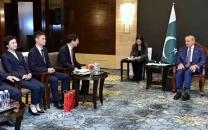
Recent diplomatic and commercial engagements, including high-level investment forums in Beijing and the expected participation of dozens of Chinese enterprises, signal sustained interest in Pakistan as a potential regional production and connectivity hub. At the same time, China's evolving global investment strategy – shifting from infrastructure-led expansion toward industrial relocation, digital integration, and supply chain diversification – creates a natural opening under the next phase of the China-Pakistan Economic Corridor (CPEC).
Yet Pakistan's challenge today is no longer access to opportunity, but the ability to convert that opportunity into credible domestic outcomes. It is within this context that CPEC Phase II must be understood; not as an extension of infrastructure, but as a test of industrial competitiveness.
The first phase of CPEC was largely defined by infrastructure development. Energy generation projects, transport corridors, and connectivity networks addressed critical bottlenecks that had constrained growth for decades. This phase created physical capacity and reduced immediate supply-side constraints. However, infrastructure was never intended to be the final outcome. It was a foundation for industrial transformation.
CPEC Phase II is now positioned around that shift – towards Special Economic Zones (SEZs), industrial clusters, export-oriented production, agriculture modernisation, and deeper integration into regional value chains. The ambition is to move from transit geography to production geography. But infrastructure enables industry; it does not automatically generate it. This is where Pakistan's real challenge begins.
CPEC Phase II and the SEZ question
Special Economic Zones have been central to Pakistan's industrial strategy under CPEC. More than three dozen zones have been approved across provinces, including five priority SEZs identified under bilateral cooperation. At the centre of this transition are SEZs; not as policy symbols, but as execution platforms.
Yet despite years of policy focus, most of these zones have not reached meaningful operational scale. Recent legislative and administrative efforts – ranging from accelerated land allocation frameworks to revised institutional arrangements – reflect renewed urgency to revive momentum and reduce investor friction. However, the fundamental question remains unchanged: why have SEZs not delivered industrial outcomes at scale? The answer lies less in policy design and more in the execution environment.
SEZ strategies have traditionally relied on incentives – tax concessions, subsidised land, regulatory facilitation, and public-private partnerships. Pakistan's model has followed a similar path. But global experience suggests a consistent pattern: incentives attract attention, not necessarily investment durability. Land availability or fiscal concessions may initiate interest, but they do not anchor long-term industrial investment.
Investors evaluate deeper structural conditions – policy predictability, contract enforcement, regulatory consistency, logistics efficiency, and financial system reliability. In their absence, SEZs risk evolving into real estate ventures rather than industrial ecosystems. This helps explain why many CPEC-linked zones have struggled to move beyond initial planning stages.
A parallel constraint lies in institutional fragmentation. Pakistan operates multiple layers of governance for industrial development - the Board of Investment, provincial SEZ authorities, CPEC coordination mechanisms, and newer facilitation platforms.
While each is intended to improve coordination, the cumulative effect has often been overlap rather than clarity. The issue is not the absence of institutions, but multiplicity without integration. For investors, this translates into uncertainty: overlapping mandates, multiple approval channels, and inconsistent implementation timelines. Industrial policy requires not just intent, but institutional coherence.
China as strategic anchor, not substitute
China remains Pakistan's most significant long-term economic partner – spanning trade, investment, financing support, and strategic alignment. From infrastructure financing to repeated rollovers, the relationship has provided both development capital and macroeconomic stability at critical moments. As this engagement evolves toward industrial cooperation, its limits also become clearer. Strategic partnership can create opportunity; it cannot substitute for domestic competitiveness. This distinction is central to understanding the stakes of CPEC Phase II.
The next phase of CPEC is often described as a transition from infrastructure corridors to industrial corridors. In reality, it is a transition from physical connectivity to economic credibility. This requires more than infrastructure. It demands industrial production integrated with local supply chains, export capacity that is globally competitive, energy systems that are reliable and cost-predictable, and regulatory frameworks that are stable and enforceable. Without these, corridors remain corridors – movement without transformation, connectivity without competitiveness.
Pakistan's core limitation is not the absence of external interest, but the weakness of domestic absorption capacity. The country has repeatedly demonstrated its ability to attract external engagement.
The constraint lies in converting that engagement into sustained industrial growth. This is where SEZs become critical; not as isolated enclaves, but as embedded components of a national production system. If they remain disconnected from domestic value chains, their impact will remain limited. If not anchored in domestic capacity, CPEC risks reinforcing a familiar pattern; what may be described as rented resilience. External capital, imported inputs, and policy concessions may generate activity, but without institutional depth, they do not create sustainability.
The real test
CPEC Phase II is not merely an economic programme; it is a credibility test in motion. The infrastructure has been built, the partnerships are intact, and investor interest is visible. What remains uncertain is whether Pakistan can create the domestic conditions necessary to convert this opportunity into sustained industrial growth. The question is no longer whether corridors can be built. It is whether they can be made economically alive – through production, exports, and integration into the domestic economy. The real transition is not from corridors to industry, but from opportunity to execution, and ultimately, from connectivity to competitiveness
The writer is a PhD, former executive director general, Board of Investment, PM Office; public policy & corporate law expert










This material may not be published, broadcast, rewritten, redistributed or derived from. Unless otherwise stated, all content is copyrighted © 2026 The Express Tribune.








COMMENTS (1)
Comments are moderated and generally will be posted if they are on-topic and not abusive.
For more information, please see our Comments FAQ