Punjab approves Rs50,000 fine for illegal dumping of animal waste during Eidul Azha
Updated 2 hours ago

Sources tell Reuters initial talks focused on reopening Strait of Hormuz
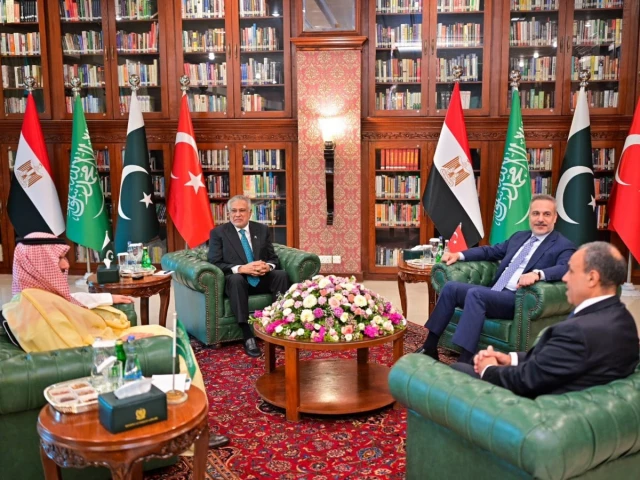
Pakistan hosted talks with Turkiye, Egypt and Saudi Arabia on Sunday as part of its efforts to broker an end to the Iran war, with initial discussions focused on proposals to reopen the Strait of Hormuz to shipping, sources familiar with the matter said.
Foreign ministers from the three regional powers landed in Islamabad for the talks as Iran warned the US against launching a ground attack and global oil prices surged amid continued fighting between Iran, the US and Israel.
The countries meeting in Pakistan have floated proposals to Washington tied to maritime traffic and reopening the Strait of Hormuz, five sources familiar with the matter told Reuters, as part of wider efforts to stabilise shipping flows.
The Strait of Hormuz was previously a conduit for about a fifth of global oil and liquefied natural gas supplies, but Iran has effectively halted shipping flows through it in response to the US and Israeli air strikes that began a month ago.
Proposals on reopening Hormuz
Pakistan, which like Turkiye borders Iran, has leveraged its close ties to both Tehran and Washington to emerge as a key diplomatic channel in the conflict, while Ankara and Cairo have also played a role.
A source from Pakistan said proposals, including from Egypt, had been forwarded to the White House by the countries before Sunday's meeting and that they included Suez Canal-style fee structures.
Two other Pakistani sources said Turkiye, Egypt and Saudi Arabia could form a consortium to manage oil flows through the waterway, and had asked Pakistan to participate. The first Pakistani source said Islamabad had not been formally asked to join and maintains that it will not.
The proposal for a management consortium had been discussed with the US and Iran, the sources said.
A Turkish diplomatic source said Ankara's priority was securing a ceasefire. "Ensuring the safe passage of ships could serve as an important confidence-building measure in this regard," the person said, requesting anonymity.
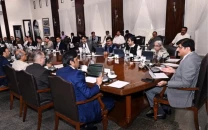
According to a statement issued by the Ministry of Foreign Affairs (MOFA) on X earlier today, consultations among the foreign ministers of Pakistan, Saudi Arabia, Turkiye, and Egypt commenced in Islamabad. "Foreign ministers during the consultations will review the evolving regional situation and discuss issues of mutual interest," it said.
The Consultations among the Foreign Ministers of Pakistan, Saudi Arabia, Türkiye, and Egypt have commenced in Islamabad on 29 March 2026.
— Ministry of Foreign Affairs - Pakistan (@ForeignOfficePk) March 29, 2026
Convened at the invitation of Deputy Prime Minister / Foreign Minister Senator Mohammad Ishaq Dar @MIshaqDar50, the Foreign Ministers during… pic.twitter.com/5capTCXUNO
The four-nation meeting's next round of talks would take place tomorrow with the Egyptian, Turkish, and Saudi foreign ministers in attendance.
Earlier, in a tweet on X, the foreign ministry announced the arrival of Egyptian Foreign Minister Dr Badr Abdelatty at the ministry, where he was received by Dar. "The two sides will hold bilateral consultations on regional developments and matters of mutual interest,' the ministry wrote.
Egyptian Foreign Minister Dr. Badr Abdelatty arrived at the Ministry of Foreign Affairs and was received by Deputy Prime Minister/Minister for Foreign Affairs Senator Mohammad Ishaq Dar. The two sides will hold bilateral consultations on regional developments and matters of… pic.twitter.com/SMQiTVyeoZ
— Ministry of Foreign Affairs - Pakistan (@ForeignOfficePk) March 29, 2026
The Foreign Office announced that Turkish Foreign Minister Hakan Fidan arrived at the ministry, where he was also received by the deputy prime minister. "The two leaders will hold bilateral consultations on all issues of mutual interest, including regional developments," the tweet concluded.
FM of Türkiye Hakan Fidan @HakanFidan arrived at MoFA Islamabad today and was received by the Deputy Prime Minister/Foreign Minister Muhammad Ishaq Dar @MIshaqDar50. The two leaders will hold bilateral consultations on all issues of mutual interest including regional… pic.twitter.com/ylrXFYSaqQ
— Ministry of Foreign Affairs - Pakistan (@ForeignOfficePk) March 29, 2026
Abdelatty arrived in Islamabad last night to participate in the meeting, where Additional Foreign Secretary Syed Ahmed Maroof accorded him a warm welcome. Fidan was received by Additional Foreign Secretary Syed Ali Asad Gillani at Nur Khan Airbase.
Read: Iran's president tells PM Shehbaz trust needed for talks to end Middle East conflict
Saudi Arabia's Foreign Minister Faisal bin Farhan al Saud arrived in Islamabad midday Sunday, the Foreign Office announced on X.
Saudi Foreign Minister Faisal bin Farhan al Saud @FaisalbinFarhan arrived in Islamabad on an official visit at the invitation of Deputy Prime Minister/Minister for Foreign Affairs Senator Mohammad Ishaq Dar @MIshaqDar50. He was recieved by Additional Secretary Middle East Syed… pic.twitter.com/ioms75ZPl7
— Ministry of Foreign Affairs - Pakistan (@ForeignOfficePk) March 29, 2026
Al Saud was received by Additional Secretary Middle East Syed Ahmad Maroof. According to the ministry, during al Saud's visit, "he will hold consultations on regional developments."
The ministry added, "The visit reflects the close and brotherly relations between Pakistan and Saudi Arabia and their continued coordination on regional and international issues."
Deputy Prime Minister/Foreign Minister Senator Mohammad Ishaq Dar @MIshaqDar50 received H.H. Prince Faisal bin Farhan Al Saud @FaisalbinFarhan , Foreign Minister of the Kingdom of Saudi Arabia, at the Ministry of Foreign Affairs today. The two sides will engage in comprehensive… pic.twitter.com/sBr15NLp8u
— Ministry of Foreign Affairs - Pakistan (@ForeignOfficePk) March 29, 2026
Dar received the Saudi foreign minister at the Ministry of Foreign Affairs, which stated, "The two sides will engage in comprehensive consultations on the evolving regional situation.'
It added, "The visit reflects the shared commitment of Pakistan and Saudi Arabia to sustained dialogue, close coordination and enhanced cooperation in addressing evolving regional developments."
Prior to the commencement of the joint discussion, the DPM held bilateral talks with all three foreign ministers.
The Foreign Office took to X, saying that Dar "held productive discussions on Pakistan-Egypt bilateral relations" with Abdelatty.
Deputy Prime Minister/Foreign Minister, Senator Mohammad Ishaq Dar and His Excellency Dr. Badr Abdelatty, Foreign Minister of the Arab Republic of Egypt, held productive discussions on Pakistan-Egypt bilateral relations, reaffirming their commitment to further strengthening ties,… pic.twitter.com/wbN80CgtYQ
— Ministry of Foreign Affairs - Pakistan (@ForeignOfficePk) March 29, 2026
It added that both sides reaffirmed their commitment to further strengthening ties, enhancing economic cooperation, and coordinating on regional and global issues of mutual interest.
Similarly, Dar held talks with Fidan. "Both leaders reaffirmed strong Pakistan–Turkiye ties, discussed regional developments incl. Iran, and stressed dialogue, de-escalation, diplomacy & coordination for peace and stability," the Foreign Office tweeted.
Deputy PM/FM Ishaq Dar @MIshaqDar50 met Türkiye FM Hakan Fidan @HakanFidan in Islamabad. Both leaders reaffirmed strong Pakistan–Türkiye ties, discussed regional developments incl. Iran, and stressed dialogue, de-escalation, diplomacy & coordination for peace and stability. pic.twitter.com/oAsQ0Tk5O8
— Ministry of Foreign Affairs - Pakistan (@ForeignOfficePk) March 29, 2026
The Foreign Office also announced that Dar and the Saudi foreign minister "held in-depth discussions on evolving regional developments, emphasising the importance of dialogue, de-escalation, and coordinated efforts for peace and stability in the region."
The Deputy Prime Minister/Foreign Minister Senator Mohammad Ishaq Dar @MIshaqDar50 met H.H. Prince Faisal bin Farhan Al Saud @FaisalbinFarhan , Foreign Minister of the Kingdom of Saudi Arabia, during latter’s visit to Pakistan for consultations on efforts aimed at de-escalation… pic.twitter.com/rkqGZRax7H
— Ministry of Foreign Affairs - Pakistan (@ForeignOfficePk) March 29, 2026
The tweet added that the two dignitaries reaffirmed their commitment to further strengthening Pakistan-Saudi Arabia ties.
The meeting of the foreign ministers will include detailed deliberations on the regional security situation, tensions in the Middle East, and matters of mutual cooperation. The diplomatic consultations will include discussions on regional stability, the promotion of peace, and a joint strategy.
It is expected that a joint course of action for peace and stability in the region will emerge from the discussions.
Pakistan has emerged as a key mediator between the United States and Iran in their ongoing conflict which has spread across the Gulf region.
On Tuesday, Prime Minister Shehbaz Sharif publicly offered Pakistan as a venue for US-Iran peace talks, an offer that received an extraordinary boost when Trump reposted it on his Truth Social platform, a move widely seen in Islamabad as Washington's tacit endorsement of Pakistan's emerging role as a mediator.
On Thursday, Dar confirmed that indirect communication between the US and Iran was underway through messages being relayed by Pakistan, with Turkiye and Egypt also assisting diplomatic efforts aimed at easing the tensions in the Middle East.
The DPM has engaged with various political figures as Pakistan continues to call for de-escalation of the conflict; these include discussions with British High Commissioner Jane Marriott, Chinese Ambassador Jiang Zaidong, Deputy Prime Minister of the United Arab Emirates Sheikh Abdullah bin Zayed Al Nahyan, and Iranian Foreign Minister Abbas Araghchi.








This material may not be published, broadcast, rewritten, redistributed or derived from. Unless otherwise stated, all content is copyrighted © 2026 The Express Tribune.






COMMENTS (3)
Comments are moderated and generally will be posted if they are on-topic and not abusive.
For more information, please see our Comments FAQ