Former Punjab governor laid to rest
Updated 16 hours ago

Sales drop 80% across markets; high prices drive customers to cheaper alternatives
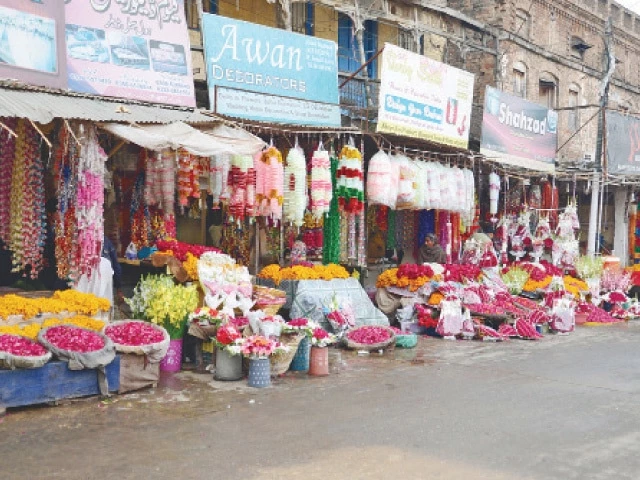
The crippling inflation witnessed this year, alongside a dramatic surge in the prices of all commodities, has had far-reaching negative effects, now engulfing even the flower markets.
In the twin cities of Rawalpindi and Islamabad, all four major flower markets have experienced an estimated 80 per cent downturn, resulting in losses amounting to hundreds of thousands of rupees for traders and shopkeepers.
Due to poor sales of bouquets, floral arrangements, and decorative baskets, dozens of varieties of fresh flowers lying unsold in shops have begun to wither. This year, a standard bouquet was priced at approximately Rs2,500, while premium flower baskets reached up to Rs7,000. In previous years, however, similar items typically ranged between Rs1,000 and Rs4,0004,500.
In the twin cities, prominent flower markets located in F-6 Super Market, Chaklala Scheme III, Banni Flower Market, and Raja Bazaar traditionally catered to high-profile clients, including senior officials, major institutions, hotels, restaurants, and clubs. These markets specialised in crafting elaborate bouquets and floral baskets composed of dozens of flower varieties.
The flowers were sourced internationally from the Middle East, Europe, the United States, Russia, Azerbaijan, India, and domestically from Pakistan. Their transportation and presentation in the markets were handled with exceptional care and aesthetic precision.
Expert florists would meticulously arrange each individual bloom into bouquets and baskets, which were then attractively displayed in showcases and on counters to capture customers' attention. The markets were once filled with a delicate, lingering fragrance that drew in buyers throughout the day and night.
Local businessmen and bureaucrats from Rawalpindi had also invested significantly in this trade. Typically, flowers would arrive in these markets about a week prior to Eid, after which skilled florists would prepare bouquets, baskets, garlands, and wreaths. In previous years, these items were not only fully sold out but were also prepared on special order.
However, this year, despite flowers arriving at nearly double the usual prices, sales in Rawalpindi and Islamabad have been severely disappointing.
During the first three days of Eid, between 65 and 80 per cent of bouquets and baskets remained unsold. Instead, customers opted for more affordable, locally sourced floral arrangements.
Ismat Abbasi, a shopkeeper at F-6 Super Market, and Ihtesham Ali from Chaklala Scheme III Flower Market, say soaring inflation has drastically impacted sales. They noted that customer footfall was significantly lower this year, and even those who visited often left upon hearing the high prices. Many chose instead to purchase cheaper, locally produced flower bouquets.
Responding to a query, Ali further explained that if these floral arrangements remain unsold for another two to three days, they will inevitably begin to wilt, especially as temperatures continue to rise. He added that traders may attempt to minimise losses by selling the flowers at reduced prices to large hotels.












This material may not be published, broadcast, rewritten, redistributed or derived from. Unless otherwise stated, all content is copyrighted © 2026 The Express Tribune.








COMMENTS
Comments are moderated and generally will be posted if they are on-topic and not abusive.
For more information, please see our Comments FAQ