Saudi Arabia turns to drones to shield pilgrims from extreme heat
Updated 1 hour ago

'Only reason for restraint was respect for requested de-escalation,' says Iranian FM
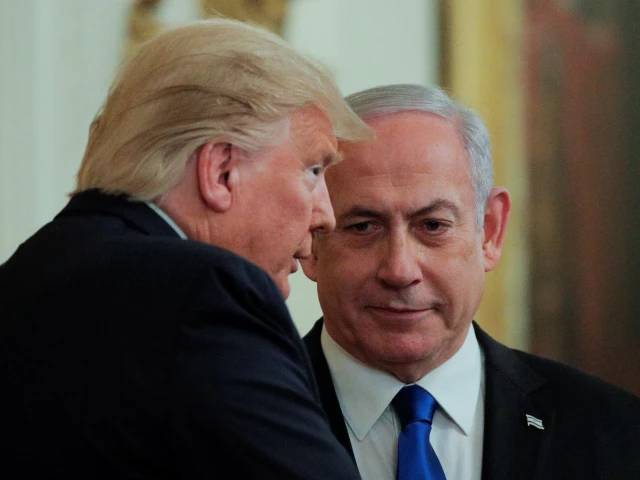
United States President Donald Trump said on Thursday that he told Israeli Prime Minister Benjamin Netanyahu not to repeat the kind of attack Israel carried out on a major Iranian gas field, while saying the two countries coordinate their actions.
In a social media post on Wednesday night, Trump said Washington "knew nothing about this particular attack", even as three Israeli officials told Reuters the strike was coordinated with the US.
The attack on Iran's South Pars gas field prompted an Iranian aerial assault on energy infrastructure in Qatar and across the Middle East, marking the biggest escalation in the US-Israeli war on Iran.
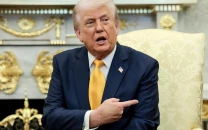
Speaking to reporters in the Oval Office on Thursday during his meeting with Japanese Prime Minister Sanae Takaichi, Trump did not say whether he had prior knowledge of the strike or approved it in advance, nor did he make clear when he had spoken to Netanyahu.
"I told him, don't do that and he won't do that," Trump said.
"We didn't discuss, you know, we do independent, but get along great. It's coordinated," Trump said. "But on occasion, he'll do something. And if I don't like it. And so we're not doing that anymore."
The three Israeli officials, who spoke on condition of anonymity to discuss private deliberations, said that Israel was not surprised by Trump's comments on social media.
They described the dynamic as similar to one that played out after Israel struck fuel depots in Iran several weeks ago. After those attacks, Pentagon Chief Pete Hegseth said that in "that particular case, those weren't our strikes".
The White House declined to comment further beyond Trump's post when asked about the information from the three Israeli officials' remarks. Netanyahu's office did not respond to a request for comment.
Since the Israeli attack on South Pars, Iranian attacks have caused extensive damage to the world's largest gas plant in Qatar, targeted a refinery in Saudi Arabia and forced the United Arab Emirates to shut gas facilities.
After Iran's attacks, Gulf Arab countries sought explanations from the Trump administration, with one country contacting US Central Command, a regional source familiar with the matter said.
The Pentagon's Middle East command told that country that it was not informed in advance of the Israeli strike, the source said. The person spoke on condition of anonymity and declined to name the country involved.
That country then contacted Trump's special envoy Steve Witkoff, who said that while the strike was not a joint US-Israeli operation, Washington was informed about it ahead of time, the source said.
Israel has not publicly acknowledged responsibility for the strike.
The US and Israel have repeatedly sought to highlight their close coordination in their joint air assault on Iran, but officials on both sides have acknowledged that their objectives were not the same.
US Director of National Intelligence Tulsi Gabbard told a House Intelligence Committee hearing that while Israel focused on "disabling the Iranian leadership", the US focused on destroying Iran's ballistic missile programme and its navy.
Meanwhile, Iran warned it would show “zero restraint” if its infrastructure was targeted again following the Israeli strike on the Iranian side of the South Pars gas field that halted production at two major refineries.
Iran’s response to Israeli strikes on its infrastructure had so far used only a “fraction” of its capabilities, Foreign Minister Abbas Araghchi wrote on X.
“The only reason for restraint was respect for requested de-escalation,” he added. “Zero restraint if our infrastructures are struck again.”
Araghchi stressed that any end to the war must address damage inflicted on Iran’s civilian sites.
Our response to Israel's attack on our infrastructure employed FRACTION of our power. The ONLY reason for restraint was respect for requested de-escalation.
— Seyed Abbas Araghchi (@araghchi) March 19, 2026
ZERO restraint if our infrastructures are struck again.
Any end to this war must address damage to our civilian sites.
No 'definitive time frame' for ending Iran war: Pentagon
United States Defence Secretary Pete Hegseth said on Thursday there was no "time frame" for ending the US-Israeli war against Iran, which was launched three weeks ago.
"We wouldn't want to set a definitive time frame," Hegseth told a news conference, adding that "we're very much on track" and that President Donald Trump will be the one to decide when to stop.
"It will be at the president's choosing, ultimately, where we say, 'Hey, we've achieved what we need to.'"
Hegseth also addressed a report that the Pentagon has requested more than $200 billion in additional funding from Congress to pay for the conflict.
"As far as $200b, I think that number could move. Obviously it takes money to kill bad guys," Hegseth said.
"We're going back to Congress and folks there to ensure that we're properly funded for what's been done, for what we may have to do in the future," he said.
Top US military officer General Dan Caine, who spoke alongside Hegseth, provided details on weapons being used against Iran and its allied forces in the region.
Caine said A-10 Warthogs, a type of aircraft designed for providing close air support, are "hunting and killing fast-attack watercraft" in the key Strait of Hormuz waterway, which Iran effectively closed to maritime traffic following the start of the war.
He also said AH-64 Apaches are being used in Iraq to target Iran-aligned militia groups there, and that some US allies have begun using the attack helicopters to counter one-way drones launched by Tehran's forces.
UN chief urges US, Israel to end Iran war that could 'get completely out of control'
UN Secretary General Antonio Guterres called on the United States and Israel to end the ongoing war against Iran, warning it could spiral "completely out of control" and lead to widespread civilian suffering.
Speaking alongside European Council President Antonio Costa at an EU leaders' summit in Brussels, Guterres delivered what he described as "two clear messages" to key actors in the conflict.
"First, to the United States and to Israel, it's high time to end this war that is risking to get completely out of control, causing immense suffering on civilians," he said.
The UN chief also warned of broader global consequences, saying the conflict was having "dramatic" ripple effects on the global economy, with potentially "tragic consequences, especially for the least developed countries."
Guterres issued a second message directed at Iran, urged it to halt attacks on neighboring countries. "Stop attacking your neighbors. They were never parties to the conflict," he said, noting that the UN Security Council had condemned such actions and had called for them to cease.
He also stressed the importance of keeping vital global trade routes open, warning that any prolonged disruption to the Strait of Hormuz would inflict "enormous pain" on people worldwide.
"It's time for the force of the law to prevail over the law of the force. It's time for diplomacy to prevail over war," Guterres stressed.
Costa, for his part, said that although "many international actors were challenging the international order," there was "no alternative" to multilateralism in addressing global crises.
"Because the alternative is chaos, the alternative is the war in Ukraine, the alternative is the war in the Middle East, the alternative is the dramatic humanitarian situation in Gaza, the alternative is war in several countries in Africa," he said.
Greek-operated air defence system shoots down Iranian missiles over Saudi Arabia
Separately, Greece's defence minister said an air defence system operated by Greek military personnel in Saudi Arabia intercepted two ballistic missiles launched from Iran.
Nikos Dendias said a Greek-operated Patriot air defence system had intercepted Iranian missiles targeting oil refineries in Saudi Arabia, without specifying where in the kingdom.
"The protection of refineries and oil units is of great importance," he said in a televised statement.
Greece has deployed a US-made Patriot air defense battery, operated by Greek personnel, in Saudi Arabia since 2021 under an agreement to help protect the kingdom's energy infrastructure.
Thursday's interception was the first time that Greek personnel had operated the system, a Greek defence ministry official told Reuters.
Other outside states have also offered assistance in defending the Gulf against Iranian attacks launched in response to US-Israeli strikes on Iran that began on February 28.
France has assisted the United Arab Emirates in defending against Iranian attacks, under a longstanding defence agreement between the two countries. Australia has also said it would send a surveillance aircraft and missiles to help bolster UAE defences.
Earlier on Thursday, Saudi Arabia's defence ministry said that a ballistic missile targeting the Red Sea port city of Yanbu, where there is an oil refinery, had been intercepted.
It was unclear whether the missile was one of those intercepted by the Greek-operated system.
Iran calls for regional coordination in calls with Pakistan, Turkiye, Egypt
Iran's foreign minister Abbas Araghchi called for vigilance and regional coordination in separate calls with counterparts in Turkiye, Egypt and Pakistan as the military warned of a tougher response to any further attacks on its energy infrastructure, state media reported on Thursday.
After its energy facilities in South Pars gas field and Asaluyeh were targeted on Wednesday, Iran retaliated against what it said were US-linked energy sites in Gulf countries, including Ras Laffan Industrial City in Qatar, the world’s largest LNG complex.
"In the calls to foreign counterparts, Araghchi assessed the US and Zionist regime's (Israel) attack on Iranian infrastructure as an act aimed at escalating tensions and destabilising the region, and urged for vigilance and coordination among regional countries in response to these threats," state media reported on Thursday.
A spokesman for the unified command of Iran's armed forces said recent strikes on the country's energy infrastructure led to "a new stage in the war" in which Iran targeted energy facilities linked to the US and American investors in the region.
"If strikes (on Iran's energy infrastructure) happen again, further attacks on your energy infrastructure and that of your allies will not stop until it is completely destroyed, and our response will be much more severe," Ebrahim Zolfaqari said according to state media.
Iran strikes Gulf energy hubs
Iranian aerial attacks since Wednesday have caused extensive damage to the world's largest gas plant in Qatar, targeted a refinery in Saudi Arabia, forced the UAE to shut gas facilities and set off fires at two Kuwaiti refineries.
Tehran's retaliation against Israeli attacks on its own gas facilities marks a further escalation of the nearly three-week war.
On Thursday, a drone fell on the Aramco-Exxon refinery, SAMREF, the Saudi defence ministry said, adding damage was being assessed. It also intercepted a ballistic missile launched towards Yanbu, the port city that is currently Saudi Arabia's only outlet for crude exports and where the refinery is located.
Also on Thursday, one of the operational units at Kuwait Petroleum Corporation's Mina al-Ahmadi and Mina Abdullah refineries was targeted by drones, resulting in fires at both sites, Kuwait's state news agency said.
Read: US war on Iran and its larger consequences
Qatar's state oil giant QatarEnergy said on Wednesday that Iranian missile attacks on Ras Laffan, the site of the country's core LNG processing operations, caused "extensive damage", while the UAE shut gas facilities after intercepting missiles early on Thursday.
The Iranian attacks, which drew a furious response from US President Donald Trump, came hours after Tehran issued evacuation warnings for several oil facilities across Saudi Arabia, the UAE and Qatar, following strikes on its own energy infrastructure in South Pars and Asaluyeh.
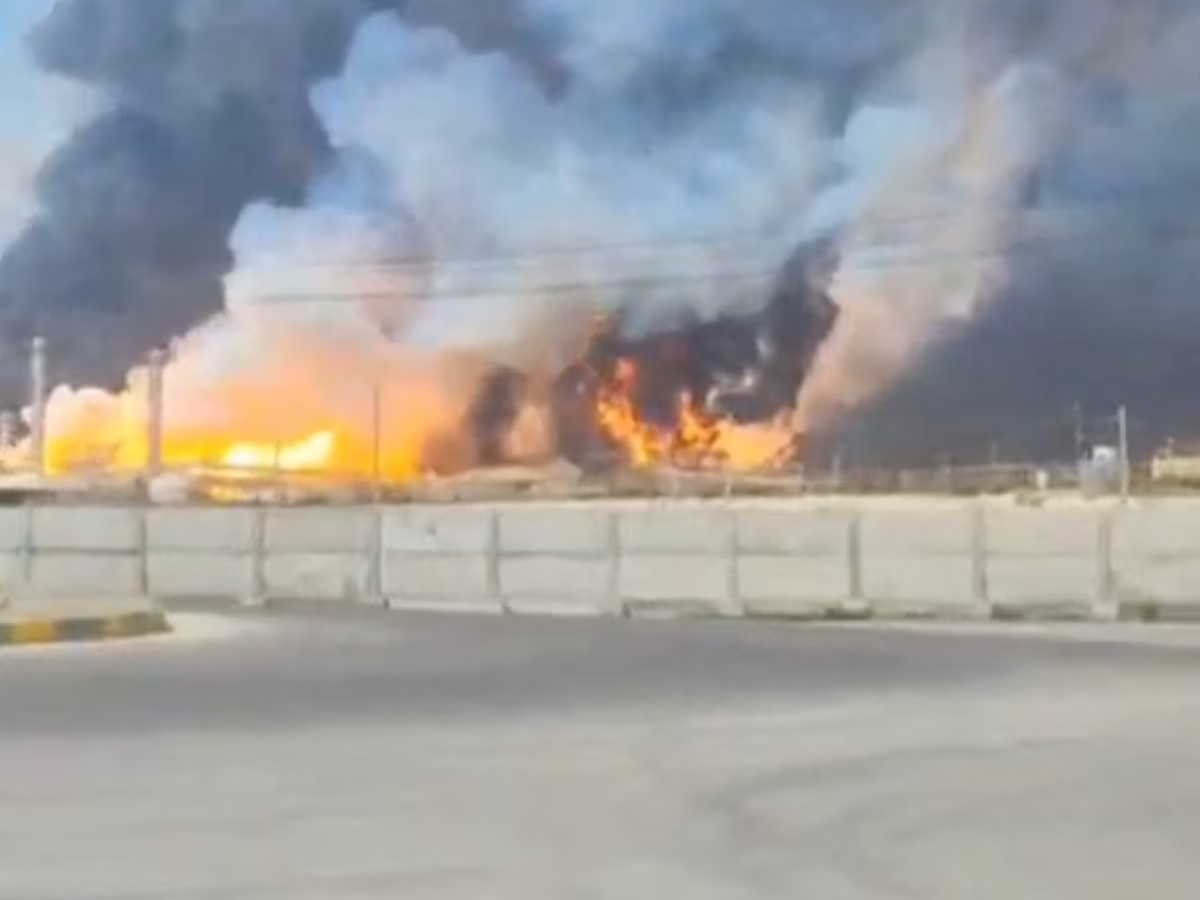
Smoke and fire rise near the South Pars gas field following an attack, amid the U.S.-Israeli conflict with Iran, in Bushehr Province, Iran, March 18, 2026, in this screengrab obtained from a social media video. Social Media/via REUTERS
Major LNG operations disrupted in Qatar
QatarEnergy, the world's second-largest LNG exporter, said in a statement that its emergency response team was deployed immediately to contain fires caused by the attack. By early Thursday, all fires at Ras Laffan had been brought under control, with no injuries reported, Qatar's interior ministry said.
Ras Laffan, located 80 km (50 miles) north of Doha, is an energy-industry hub and hosts several international companies including Shell, opens new tab, the world's biggest LNG trader.
"We are currently assessing any potential impact on any asset operated or utilised by Shell in Ras Laffan Industrial City and will provide further information in due course," a Shell spokesperson said.
The energy major has a 30% stake in a 7.8 million-metric-tons-a-year LNG facility and investments in yet-to-produce LNG plants at Ras Laffan. It also fully owns the Pearl gas-to-liquids plant in the hub, with capacity to process up to 1.6 billion cubic feet per day of wellhead gas.
QatarEnergy said the Pearl gas-to-liquids facility had suffered extensive damage. Several LNG facilities were hit by missile attacks in the early hours of Thursday, causing "sizeable fires" and further damage, it said.
Shell later said the Pearl GTL facility had sustained damage, saying a fire was quickly put out and it was now in a safe state and that damage was being assessed in close coordination with authorities and QatarEnergy.
Trump threatens response
Qatar produces 77 million metric tons annually of LNG, which is used in power generation and industries. The Laffan refinery primarily processes condensate into refined products including aviation fuel.
In a statement on social media, Trump warned Iran not to attack Qatari LNG facilities again and threatened to "massively blow up the entirety of the South Pars Gas Field" if it did so. He said Israel had attacked South Pars without informing Qatar or the United States.
Qatar's foreign ministry told Iran's security and military attaches to leave the country within 24 hours and declared them "persona non grata".
Read More: Israel says killed Iran intel chief, tells military to hunt down officials
In a statement, the ministry condemned the attack on Ras Laffan as a "direct threat" to Qatar's national security and accused Iran of taking an "irresponsible approach."
Saul Kavonic, head of research at Australia's MST Marquee, said attacks on Ras Laffan "could cause a lasting global gas shortage, but this won't pressure the Trump administration because the US benefits economically from high global gas prices".
Gas facilities shut down in UAE
In the UAE, authorities said they were responding to incidents at the Habshan gas facilities and at the Bab oil field caused by falling debris from intercepted missiles.
The gas facilities were shut down and no injuries were reported, the Abu Dhabi Media Office said.
The Habshan complex, operated by Abu Dhabi state oil giant ADNOC, is one of the world's largest gas processing facilities, comprising five plants with a total capacity of 6.1 billion standard cubic feet per day (bscfd), according to ADNOC.





This material may not be published, broadcast, rewritten, redistributed or derived from. Unless otherwise stated, all content is copyrighted © 2026 The Express Tribune.







COMMENTS
Comments are moderated and generally will be posted if they are on-topic and not abusive.
For more information, please see our Comments FAQ