Brand reliability fetches demanded price
Updated 7 hours ago

Unconditional compensation may deepen fiscal burden in flood-prone regions
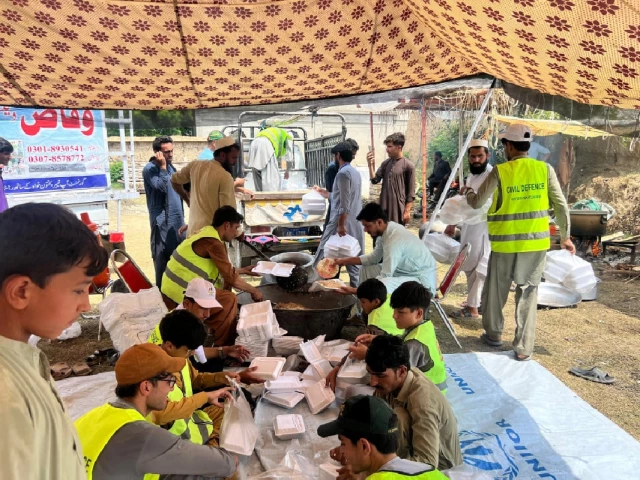
Pakistan suffered a devastating flood season last year, prompting massive state compensation. While the compassion behind this response is unquestionable, the way relief is structured may unintentionally deepen long-term vulnerabilities.
This reflects what Nobel laureate James Buchanan termed the Samaritan's dilemma – a situation in which unconditional aid reduces the recipient's incentive to prevent harm, thereby reinforcing the very problem it seeks to solve.
The Punjab government's recent flood relief programme is a striking example. It offered immediate, unconditional cash compensation to fully cover damages to homes, property, and livestock. The intention was both humane and political: to help households recover quickly from the shock and to secure public support. Nearly Rs500 billion was spent – one of the largest provincial relief efforts.
However, such blanket compensation – if repeated flood after flood – creates expectations that the state will always act as the ultimate insurer of private risk. This is when incentives shift counterproductively.
When aid is unconditional, risk-taking behaviour increases. It produces four predictable responses: First, households have less incentive to invest in resilient housing – such as elevated foundations or sturdier structures – because they expect the government to pay for rebuilding. Second, families continue living in high-risk floodplains, since relocation – though costly and disruptive – feels unnecessary when losses are reimbursed. Third, communities underinvest in collective mitigation measures, including strengthening levees or enforcing basic building standards. Fourth, the government's fiscal burden grows. Each flood triggers another round of massive payouts.
This cycle is the essence of the Samaritan's dilemma: generous state intervention weakens the very behaviours – self-protection, risk mitigation, and community preparedness – that reduce long-term losses.
Risk is a choice and choices must have consequences. The riverine belt attracts settlers for its fertile land and economic benefits, and many families have lived there for generations. But staying in a flood-prone area is still a conscious decision, and it carries responsibilities.
Households that invest in safer construction, elevated housing, or community-based mitigation efforts should be rewarded. Those who repeatedly ignore well-known risks should not expect bailouts every time a flood strikes. Yet Pakistan is a democracy. The state cannot abandon citizens during crises. The challenge, therefore, is to protect people without encouraging dependency.
Conditional aid is a smarter and fairer approach, linking relief to risk-reducing behaviour. Before the next monsoon season, the government should announce that future compensation will be conditional on following basic safety guidelines – simple, actionable measures that materially reduce vulnerability.
The government should issue these guidelines as soon as possible. Not only would this reduce material losses, but it would also significantly reduce casualties and injuries during floods. It would further reduce the scale and frequency of emergency rescue operations, which are costly, dangerous, and often involve displacement and loss of life.
Conditional aid, therefore, is the most responsible way for the government to intervene and create the conditions for better long-term flood management.
Based on our field visits in flood-affected areas, we identified three practical measures that significantly reduce flood losses and should be included in these guidelines.
First, mandatory elevation of houses. Homes raised 15-20 feet above ground remained relatively safe during the 2025 floods, while low-lying and scattered structures suffered the worst damage. Elevation remains the most effective protection measure.
Second, organised village layouts. Scattered settlements expose each household to risk, whereas clusters of homes built together on a shared elevated platform protect the entire community.
Third, introducing a government-supported crop insurance scheme. Private insurers cannot offer affordable flood-prone agriculture coverage. A subsidised public-private model – where farmers and the government share costs – would reduce reliance on emergency relief while strengthening financial resilience.
Under this system, households that ignore the guidelines – after receiving adequate notice and support – would not qualify for full compensation in future disasters. Conditionality is not punishment; it is the sustainable way to encourage long-term safety.
Some officials advocate relocating entire riverine populations, but this approach is both unrealistic and counterproductive. People will resist; costs would be prohibitive; agricultural productivity would decline; and Punjab's cities cannot absorb a sudden influx of people seeking housing and employment.
Thus, evacuation is neither feasible nor desirable. Resilient adaptation must guide future policy, and it is far easier to implement and monitor. By pairing compassion with responsibility – through conditional aid and safer settlement guidelines – we can begin transforming vulnerable communities into resilient ones. Monsoon 2026 is only months away. The time to redesign our relief policy is now.
The writer is a postdoctoral research fellow at the ERC-London and the European Research University, and a senior research fellow at the PRISA Institute.









This material may not be published, broadcast, rewritten, redistributed or derived from. Unless otherwise stated, all content is copyrighted © 2026 The Express Tribune.











COMMENTS
Comments are moderated and generally will be posted if they are on-topic and not abusive.
For more information, please see our Comments FAQ