Sindh govt warns cheating students will be barred from future board exams
Updated 3 hours ago

Markets bustle after iftar as shoppers rush to buy stitched and ready-made garments
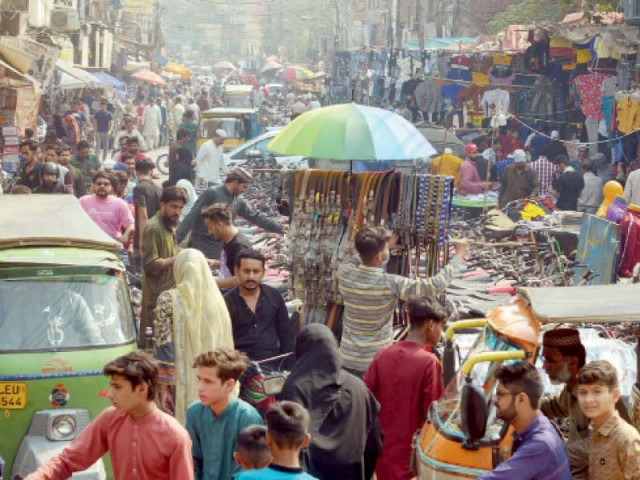
With the disbursement of salaries to public and private sector employees, Eidul Fitr shopping has gathered momentum across the twin cities of Rawalpindi and Islamabad.
All major commercial centres, bazaars, shopping plazas and markets are witnessing a surge of customers after iftar, while tailors are experiencing a seasonal windfall amid soaring demand for stitched garments.
This year, tailoring rates for men's and women's shalwar kameez have been set between Rs1,800 and Rs2,000. Several well-known tailors in the twin cities stopped accepting bookings from the 12th of Ramazan, and are now taking limited orders at increased rates of up to Rs2,200 per suit.
To cope with demand, tailoring shops have hired additional staff, while some have outsourced work to women operating home-based stitching services in residential neighbourhoods.
Female home tailors are charging between Rs1,400 and Rs1,500 for men's suits and Rs1,200 to Rs1,500 for women's outfits, with additional fees for fancy designs, buttons and interfacing.
Tailors maintain that price increases during the Eid season are routine, noting that such demand peaks occur only twice a year. Stitching charges for children's shalwar kameez have also risen to match adult rates.
Meanwhile, sales of unstitched fabric in the open market have declined, as families increasingly opt for ready-made garments.
Shopping activity across city markets begins after iftar and continues until 1am or 1:30am. Owing to Ramazan, commercial centres now open around 11am and close between 1am and 2am.
Traffic congestion intensifies from around 7pm onwards, as families head to markets in large numbers. Limited parking space has led to vehicles being parked along roadsides, frequently paralysing traffic flow. Traffic wardens, overwhelmed by the volume of vehicles, often struggle to maintain order.
Traders, including Ghulam Qadir Mir, Naveed Kanwal and Sajid Qureshi, said the rush traditionally increases as Eid approaches. They urged the authorities to introduce temporary one-way traffic arrangements in busy markets, deploy officers at key intersections, prevent roadside parking in commercial areas and remove encroachments to keep roads clear.
The traders further appealed to traffic police to focus solely on maintaining smooth flow between 7pm and midnight, and to avoid stopping vehicles for challans during peak hours, arguing that enforcement drives at that time only exacerbate congestion.















This material may not be published, broadcast, rewritten, redistributed or derived from. Unless otherwise stated, all content is copyrighted © 2026 The Express Tribune.





COMMENTS
Comments are moderated and generally will be posted if they are on-topic and not abusive.
For more information, please see our Comments FAQ