PM reiterates responsible nuclear posture
Updated 4 hours ago

Shehbaz describes Turkiye as his 'second home' and terms it a pleasure to visit the country
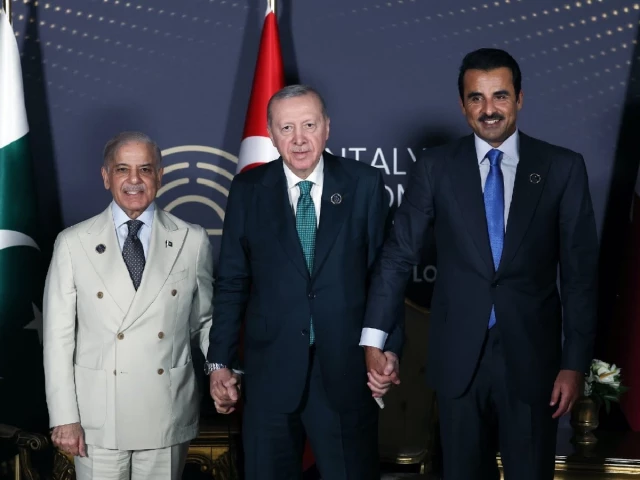
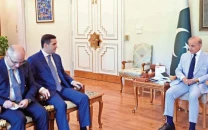
Prime Minister Shehbaz Sharif took stock of regional developments and ongoing peace efforts in a trilateral meeting with the leaders of Turkiye and Qatar at the Antalya Diplomacy Forum on Friday.
The prime minister arrived in Turkiye a day ago to attend the Antalya Diplomacy Forum.
The premier held a trilateral meeting with Turkish President Recep Tayyip Erdoğan of the Republic of Turkiye and Qatar's Emir Sheikh Tamim bin Hamad Al Thani on the sidelines of the 5th Antalya Diplomacy Forum.
"The three leaders exchanged views on recent regional developments and ongoing peace efforts. The worrying situation in Gaza and Palestine was also discussed. They agreed to continue close cooperation to further advance dialogue and diplomacy for lasting regional peace and stability," said the Prime Minister's Office (PMO).
Antalya: 17 April, 2026.
— Prime Minister's Office (@PakPMO) April 17, 2026
The Prime Minister of the Islamic Republic of Pakistan participated in a trilateral meeting with His Excellency President Recep Tayyip Erdoğan of the Republic of Turkiye and His Highness Sheikh Tamim bin Hamad Al Thani, Amir of the State of Qatar… pic.twitter.com/SH5yawy9jw
Before that, the prime minister held a meeting with Erdogan on the forum's sidelines.
Thanking PM Shehbaz for attending, he praised the premier’s peace efforts and said Türkiye would continue to support Pakistan’s diplomatic initiative to bring peace to the region.
PM Shehbaz congratulated the Turkish president on the success of the 5th Antalya Diplomacy Forum, which he said had transformed into an "important global event."
"The two leaders exchanged views on recent regional developments, particularly the evolving situation in the Middle East. The prime minister thanked President Erdoğan for his strong support and encouragement of Pakistan’s peace efforts and shared with him the updates on how to extend the ceasefire and resume talks so that a peace agreement could be reached.
"The two leaders emphasised the importance of effectively utilising the current window of opportunity to advance a durable and lasting regional peace. While reaffirming the deep-rooted, historic, and brotherly ties between Pakistan and Türkiye, both leaders expressed satisfaction at the positive trajectory of bilateral relations," the PMO said.
It added that they agreed to convene the 8th High-Level Strategic Cooperation Council (HLSCC) meeting in Ankara later this year.
Both also emphasised the importance of expediting the implementation of ongoing initiatives and exploring new opportunities to further deepen economic engagement.
The PMO said the meeting concluded with both leaders reaffirming their resolve to further strengthen the strategic partnership between Pakistan and Türkiye, building on fraternal ties, and a shared vision for peace and prosperity.
Antalya: 17 April 2026.
— Prime Minister's Office (@PakPMO) April 17, 2026
Prime Minister meets President Erdoğan on sidelines of Antalya Diplomacy Forum.
This afternoon, Prime Minister Muhammad Shehbaz Sharif held a bilateral meeting with President Recep Tayyip Erdoğan of Türkiye on the sidelines of the 5th Antalya Diplomacy… pic.twitter.com/Tr5ci7dgHV
PM Shehbaz said he thanked the Turkish president for his "warm welcome and generous hospitality".
He further said: "I also congratulated President Erdoğan on the continued success of the Antalya Diplomacy Forum as an important global platform for dialogue. We had a substantive exchange on regional developments, particularly the evolving situation in the Middle East. I deeply appreciate Türkiye’s steadfast support for Pakistan’s peace efforts.
"We reaffirmed our shared commitment to further strengthen our deep-rooted, brotherly ties and agreed to enhance our strategic partnership, expand economic cooperation, and continue to work together for peace and prosperity in the region and beyond."
Had the pleasure of meeting my dear brother, President Recep Tayyip Erdoğan, on the sidelines of the Antalya Diplomacy Forum today.
— Shehbaz Sharif (@CMShehbaz) April 17, 2026
Thanked him for the warm welcome and generous hospitality extended to me and my delegation. I also congratulated President Erdoğan on the continued… pic.twitter.com/LcdxtgN1pE
The prime minister also held informal meetings with many world leaders.
"The meetings took place in a cordial atmosphere. During the meetings, the prime minister remained the centre of attention for the global leaders. The meetings also involved an exchange of views on the global situation and regional developments," the PMO said
انطالیہ: 17 اپریل 2026.
— Prime Minister's Office (@PakPMO) April 17, 2026
وزیرِ اعظم کی انطالیہ ڈپلومیسی فورم کے موقع پر فورم میں شریک عالمی رہنماؤں سے غیر رسمی ملاقاتیں ہوئیں.
وزیرِ اعظم کی ترک صدر رجب طیب ایردوان، میر قطر شیخ تمیم بن حمد آلثانی قازقستان کے صدر قاسم جومارت توکائیف، آذربائیجان کے صدر الہام علیئف، شامی صدر… pic.twitter.com/Mpi03Hyt04
Earlier in the day, an aide to United States President Donald Trump expressed appreciation for Pakistan's role in regional stability during a meeting with PM Shehbaz.
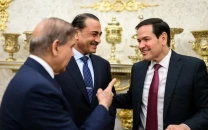
The meeting with Senior Adviser to the US President for Arab and African Affairs Massad Boulos was held on the event's sidelines.
"Massad Boulos conveyed greetings to the Prime Minister from President Donald Trump and appreciated Pakistan’s constructive contributions to regional stability. He also reiterated the United States’ interest in deepening engagement with Pakistan on shared priorities, including counter-terrorism, economic development and addressing global challenges," said a statement from the Prime Minister's Office.
It said PM Shehbaz conveyed his "warm regards" for Trump, while "fondly recalling his own warm and cordial interactions" with him. The PMO said he "reiterated deep appreciation for President Trump’s bold and decisive leadership" that had led to the ceasefire between Pakistan and India last year.
"The prime minister lauded President Trump for his leadership that led to the successful conclusion of the ceasefire in Lebanon. The two sides also discussed current regional developments, including Pakistan’s peace efforts that led to the ceasefire as well as the historic Islamabad Talks. The prime minister emphasised the importance of strengthening Pakistan-US bilateral relations, especially economic and trade cooperation, as well as matters of mutual interest in multilateral diplomacy."
Antalya: 17 April 2026.
— Prime Minister's Office (@PakPMO) April 17, 2026
Senior Advisor to the U.S. President for Arab and African Affairs, H.E. Mr. Massad Boulos, paid a courtesy call on Prime Minister Muhammad Shehbaz Sharif, on the sidelines of the 5th Antalya Diplomacy Forum (ADF 2026) in Antalya, Türkiye, today.
During… pic.twitter.com/UttBxzZwoD
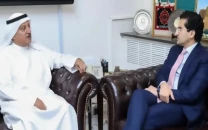
The premier earlier met Turkish Foreign Minister Hakan Fidan shortly after landing in Antalya, who thanked him for participating in the forum, saying President Recep Tayyip Erdoğan looked forward to meeting PM Shehbaz on the sidelines of the event, according to the PMO.
Deputy PM and FM Ishaq Dar, along with Special Assistant to the Prime Minister (SAPM) Syed Tariq Fatemi, were also present during the meeting.
My brother, Türkiye’s Foreign Minister @HakanFidan called on Prime Minister @CMShehbaz last night upon our arrival at Antalya.
— Ishaq Dar (@MIshaqDar50) April 17, 2026
We had good conversations ahead of a busy day today at the #AntalyaDiplomacyForum. pic.twitter.com/NUfBBacsVv
PM Shehbaz expressed gratitude for the hospitality extended by the Turkish leadership, describing Turkiye as his “second home” and terming it a pleasure to visit the country.
Meanwhile, FM Dar said it was a pleasure to meet Elmedin Konakovic, the foreign minister of Bosnia and Herzegovina, on the sidelines of the Antalya Diplomacy Forum.
He said both sides reaffirmed the strong historical bonds between Pakistan and Bosnia and Herzegovina, noting that the two countries had stood by each other in times of hardship and crisis.
Dar added that they also exchanged views on the latest regional developments and expressed his intention to work closely with Konakovic to further strengthen bilateral ties.
It was a pleasure to meet Elmedin Konaković, Foreign Minister of Bosnia and Herzegovina, on sidelines of #ADF2026 in Antalya.
— Ishaq Dar (@MIshaqDar50) April 17, 2026
We reaffirmed the strong historical bonds between Pakistan and Bosnia & Herzegovina, having stood by each other in times of hardship and crisis. Also… pic.twitter.com/TZyAwyIwrk
Dar similarly said he was pleased to meet Dr Khalilur Rahman, foreign minister of Bangladesh, on the sidelines of the Antalya Diplomacy Forum.
The two sides discussed ways to strengthen Pakistan–Bangladesh ties and exchanged views on regional developments, including Pakistan’s role in facilitating dialogue.
FM Dar added that he looked forward to continued positive and forward-looking engagement between the two countries.
Pleased to meet Dr. Khalilur Rahman, Foreign Minister of Bangladesh, on the sidelines of #ADF2026 today.
— Ishaq Dar (@MIshaqDar50) April 17, 2026
We discussed strengthening Pakistan–Bangladesh ties and exchanged views on regional developments, including Pakistan’s role in facilitating dialogue. I look forward to our… pic.twitter.com/mlgZnjq34d
Dar also met with Tahsin Ertugruloglu, foreign minister of the Turkish Republic of Northern Cyprus (TRNC), on the sidelines of the Antalya Diplomacy Forum.
DPM / FM Senator Mohammad Ishaq Dar @MIshaqDar50 met with Tahsin Ertuğruloğlu, Foreign Minister of the Turkish Republic of Northern Cyprus (TRNC), on sidelines of #AntalyaDiplomacyForum, @AntalyaDF.
— Ministry of Foreign Affairs - Pakistan (@ForeignOfficePk) April 17, 2026
Both sides reaffirmed their commitment to strengthening bilateral cooperation… pic.twitter.com/AmUsQj5H5J
Both sides reaffirmed their commitment to strengthening bilateral cooperation across various sectors, particularly for education and welfare of the Pakistani diaspora in the TRNC. They also agreed to maintain close engagement and continue working together to promote the mutual benefit of their peoples.
FM Dar met Vice Minister for Strategy and Intelligence at the Ministry of Foreign Affairs of the Republic of Korea, Jeong Yeondoo, Radio Pakistan reported.
The two sides exchanged views on matters of mutual interest and recent regional developments.
The vice minister appreciated Pakistan’s role in sustained diplomatic efforts aimed at promoting peace and stability in the region and beyond.
DPM/FM Senator Mohammad Ishaq Dar @MIshaqDar met last evening with H.E. Jeong Yeondoo, Vice Minister for Strategy and Intelligence at the Ministry of Foreign Affairs of the Republic of Korea, on the sidelines of the #AntalyaDiplomacyForum. They exchanged views on matters of… pic.twitter.com/iANbcgAb2s
— Ministry of Foreign Affairs - Pakistan (@ForeignOfficePk) April 17, 2026
The prime minister had earlier announced his arrival in the “beautiful and vibrant city of Antalya” at the invitation of President Erdoğan, adding that he looked forward to “meaningful engagements with fellow leaders as we work together to promote dialogue, deepen understanding, and advance lasting peace”.
At the gracious invitation of my dear brother, President Recep Tayyip Erdoğan, I have arrived in the beautiful and vibrant city of Antalya among dear friends to attend the Antalya Diplomacy Forum.
— Shehbaz Sharif (@CMShehbaz) April 16, 2026
I look forward to meaningful engagements with fellow leaders as we work together… pic.twitter.com/FLezHI2MqK
The prime minister is scheduled to participate in the fifth Antalya Diplomacy Forum, including a leaders’ panel titled “Mapping Tomorrow, Managing Uncertainties,” where he will present Pakistan’s perspective on key global challenges.
Read More: Solar net metering helps avert daytime outages
The prime minister is on a three-country tour until Friday, having earlier visited Saudi Arabia and Qatar as Pakistan continues diplomatic engagement amid efforts to help address the Middle East crisis affecting the wider region.
According to a statement from the PMO, upon arrival in Antalya, he was warmly received by Governor Hulusi Şahin, who welcomed the premier and his delegation at the airport.
انطالیہ: 17 اپریل، 2026۔
— Prime Minister's Office (@PakPMO) April 17, 2026
وزیرِ اعظم محمد شہباز شریف ترک صدر رجب طیب ایردوان کی دعوت پر انطالیہ ڈپلومیسی فورم میں شرکت کیلئے ترکیہ میں موجود ہیں.
وزیرِ اعظم آج انطالیہ میں منعقدہ پانچویں ڈپلومیسی فورم میں "آئندہ کل کے لائحہ عمل و غیر یقینی صورتحال کے انتظام" (Mapping Tomorrow,… pic.twitter.com/ek4BqvleTS
He will also attend the forum’s opening ceremony and is expected to meet President Erdoğan and other world leaders during the event, which brings together policymakers to discuss pressing international issues.
A day earlier, the premier had reached Saudi Arabia, where he met Crown Prince Mohammed bin Salman in Jeddah and expressed deep appreciation for Saudi Arabia’s continued support in strengthening Pakistan’s economic stability.
“The two sides reaffirmed their commitment to further strengthening what was described as an ‘enduring partnership’ between Islamabad and Riyadh,” read a statement from the PMO.
The premier then made a stopover in Qatar as part of his three-nation tour, where he met Qatar’s Emir Sheikh Tamim bin Hamad Al Thani and urged de-escalation and dialogue for peace in the Middle East.
Also Read: PM Shehbaz lauds Saudi economic backing, highlights strong defence partnership
The PMO said the two leaders also reviewed bilateral relations and explored ways to further strengthen ties, particularly in the fields of security, defence and energy, in a manner that enhances partnership and opens new avenues for cooperation.
The premier's meeting with the Qatari emir came four days after the US and Iran were unable to reach an agreement to end their war despite marathon negotiations lasting around 21 hours. The prolonged talks, aimed at halting hostilities that have killed thousands and driven global oil prices higher over the past six weeks, ended with both sides blaming each other for the impasse.
On April 11, US and Iranian delegations arrived in Pakistan for conclusive talks following a two-week immediate ceasefire "everywhere, including Lebanon", announced by PM Shehbaz, who later invited delegations from both countries to Islamabad.
The US and Israel launched a joint offensive on Iran on February 28, killing thousands of people in Iran, including then-supreme leader Ayatollah Ali Khamenei and leaving tens of thousands injured, with civilian areas, including residential buildings and religious sites, among those hit.
The conflict also expanded geographically. Iran retaliated with drone and missile strikes targeting Israel as well as Jordan, Iraq, and Gulf countries hosting US military assets. It also restricted the movement of ships through the Strait of Hormuz.




This material may not be published, broadcast, rewritten, redistributed or derived from. Unless otherwise stated, all content is copyrighted © 2026 The Express Tribune.





COMMENTS
Comments are moderated and generally will be posted if they are on-topic and not abusive.
For more information, please see our Comments FAQ