Dar warns UNSC over Middle East tensions
Updated 1 hour ago

Trump says no timeframe, won't rule out boots on ground, Hezbollah missile hits UK base in Cyprus 3 US warplanes do
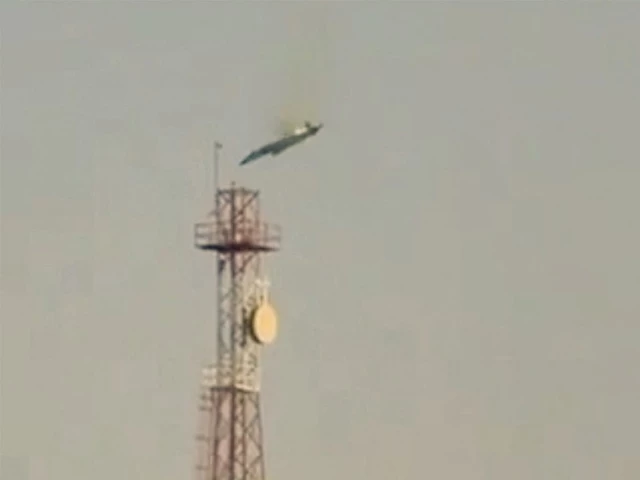
The war against Iran launched by the United States and Israel widened beyond Middle East on the third day on Monday, with no end in sight, with more attacks by both sides, putting the entire region as well as the energy consumers world-wide on edge.
The US and Israel pressed ahead with an expanding air campaign against Iran, while Tehran and struck back across the Gulf and its major ally into the eastern Mediterranean, deepening a conflict that has already claimed scores of lives.
In Washington, President Donald Trump warned that the war could last longer than first projected, though he insisted at a White House event that the campaign was "substantially ahead of our time projections".
In his first public remarks about the strikes, Trump laid out four objectives: destroying Iran's missile capabilities, "annihilating" its navy, preventing it from obtaining a nuclear weapon, and ensuring the regime can no longer arm or direct militant groups abroad.
"The big wave hasn't even happened," Trump told CNN earlier, signalling further escalation. He refused to rule out deploying ground troops, telling the New York Post: "I don't have the yips with respect to boots on the ground."
At the Pentagon's first formal briefing, US Gen Dan Caine said more than 1,000 targets had been struck in the first 24 hours and that operations would take "some time" and involve "difficult and gritty work". Defence Secretary Pete Hegseth added: "This is not Iraq. This is not endless."
Israel said fresh strikes had dealt a "severe blow" to Iran's command-and-control centres, including headquarters linked to the Islamic Revolutionary Guard Corps. General Caine said US strikes had established "local air superiority", enabling continued operations.
However, Iran's Revolutionary Guard signalled that their missile and drone capabilities remained intact despite the strikes, insisting command structures had been swiftly reorganised and that "continuity of resistance" would define the next phase of confrontation.
Iranian President Masoud Pezeshkian warned that Iran "will not remain silent" after the US and Israel of striking a school and a Tehran hospital. Tehran said 168 people were killed at the school in the south, while "scores" of civilians have died in other air strikes.
Among the dead is Supreme Leader Ayatollah Ali Khamenei, assassinated in the opening wave, and his wife, 79-year-old Mansoureh Khojasteh Bagherzadeh, who died of her wounds on Monday.
Iran has fired missiles at Israel, US bases and targets in Bahrain, Jordan, Kuwait, Qatar and the United Arab Emirates (UAE). Four US service personnel have been killed so far. In Kuwait, three American F-15E jets were mistakenly shot down by air defences during an Iranian attack; all six crew members survived.
The conflict spilled further when Iranian Shahed missile that Cypriot officials said was most likely fired by Hezbollah struck the British air force base at Akrotiri in Cyprus, marking the first hit on a US ally in Europe.
Across the Gulf, Qatar shot down two Iranian Sukhoi Su-24 jets and halted LNG production after drone strikes on energy facilities. Six people have been killed and dozens injured in the Gulf states since the bombardment began.
Saudi Arabia raised its military readiness to "full alert" after a drone strike on Aramco's Ras Tanura refinery, warning that a concerted Iranian attack could trigger retaliation against Iranian oil facilities. The refinery has been shut after a fire.
As blasts echoed from Dubai to Doha and Manama, Russia's President Vladimir Putin offered to mediate and called for an immediate ceasefire. NATO said it had "absolutely no plans" to become involved. Turkey's President Recep Tayyip Erdogan urged "an end to the bloodbath".
For now, both sides show no sign of backing down. Trump insists the campaign is the "last, best chance" to neutralise a long-time adversary. Tehran says it is defending itself against aggression. With each passing day, the war is widening - geographically, militarily and politically.





This material may not be published, broadcast, rewritten, redistributed or derived from. Unless otherwise stated, all content is copyrighted © 2026 The Express Tribune.









COMMENTS
Comments are moderated and generally will be posted if they are on-topic and not abusive.
For more information, please see our Comments FAQ