UN chief condemns Quetta train blast
Updated 6 hours ago

Modi’s public allegiance to Netanyahu puts him at odds with widespread contempt over the ongoing war in Gaza
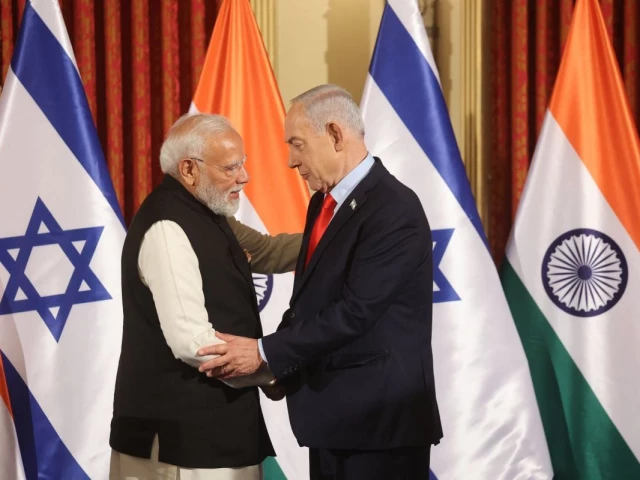
In Israel, Narendra Modi was crowned with the Knesset Medal, becoming the first foreign leader to receive the country’s highest parliamentary honour.
The award is more than a diplomatic showpiece — it recognises the Indian premier’s steadfast support for Benjamin Netanyahu. As the saying goes, “birds of a feather flock together.” Modi’s allegiance is entirely in keeping with his record at home — from the suppression in contested territories to a widening appetite for Islamophobia — the two leaders share much in common.
What makes it striking, however, is the timing. Modi has once again sworn, in full view of the world, to support Israel — in effect endorsing the scale of violence that UN experts and human rights organizations have described as amounting to genocide in Gaza.
In doing so, the far-right Hindu leader has positioned himself squarely at odds with much of the Global South — the very bloc he claims to be courting for alliances, where public contempt for Israel’s assault on Palestinians runs deep.
While Netanyahu, wanted by the International Criminal Court, has little to lose in reputation, Modi is still not a persona non grata — even as his actions in occupied Kashmir and efforts to suppress genuine human rights concerns in the occupied valley have been flagged as the early stages of a possible genocide, not by Pakistan, but by Dr. Gregory Stanton, the world’s foremost expert on genocide, whose model of the ten stages of genocide remains the global yardstick for such atrocities.
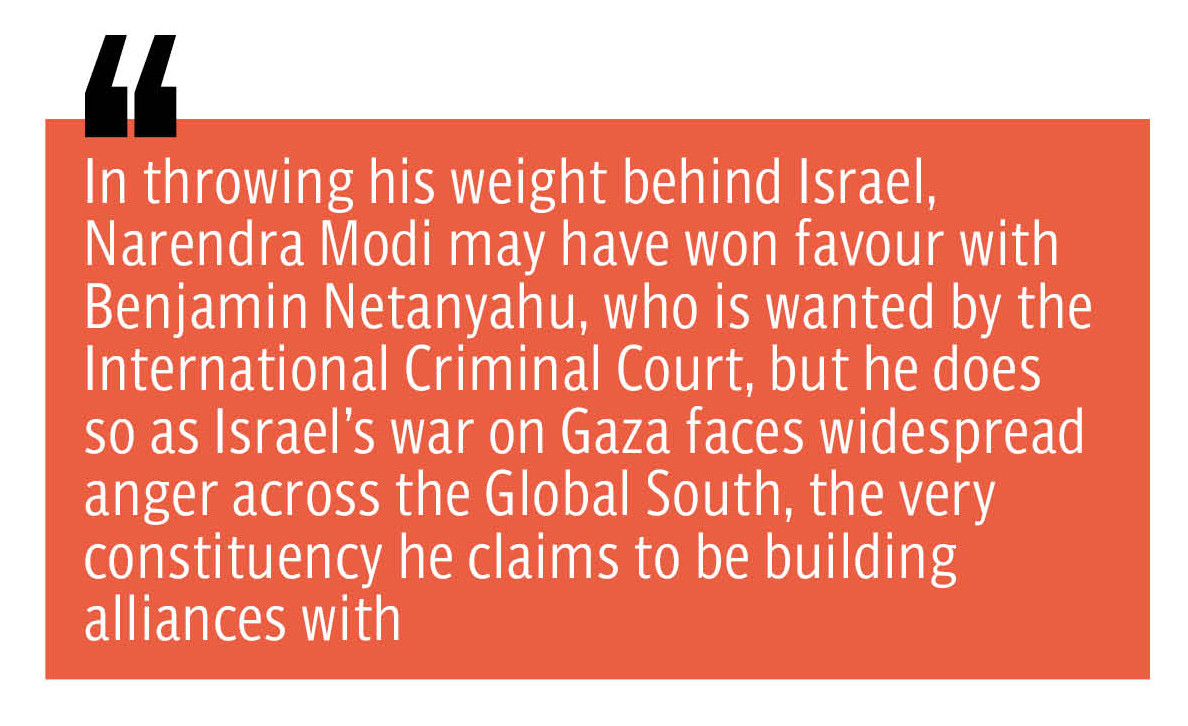
By throwing his weight behind the Israeli leader against the backdrop of an ongoing genocide in Gaza, Modi has laid bare not only a sinister desire to justify what is quietly unfolding in occupied Kashmir on his watch, but also the striking similarities that, in many ways, cast him as an ideological twin of Bibi Netanyahu.
Both he and his Israeli counterpart, according to leading advocacy groups from Amnesty International to Human Rights Watch, have been identified as leaders actively suppressing populations, denying basic human rights, and occupying territories against the will of the people who live there.
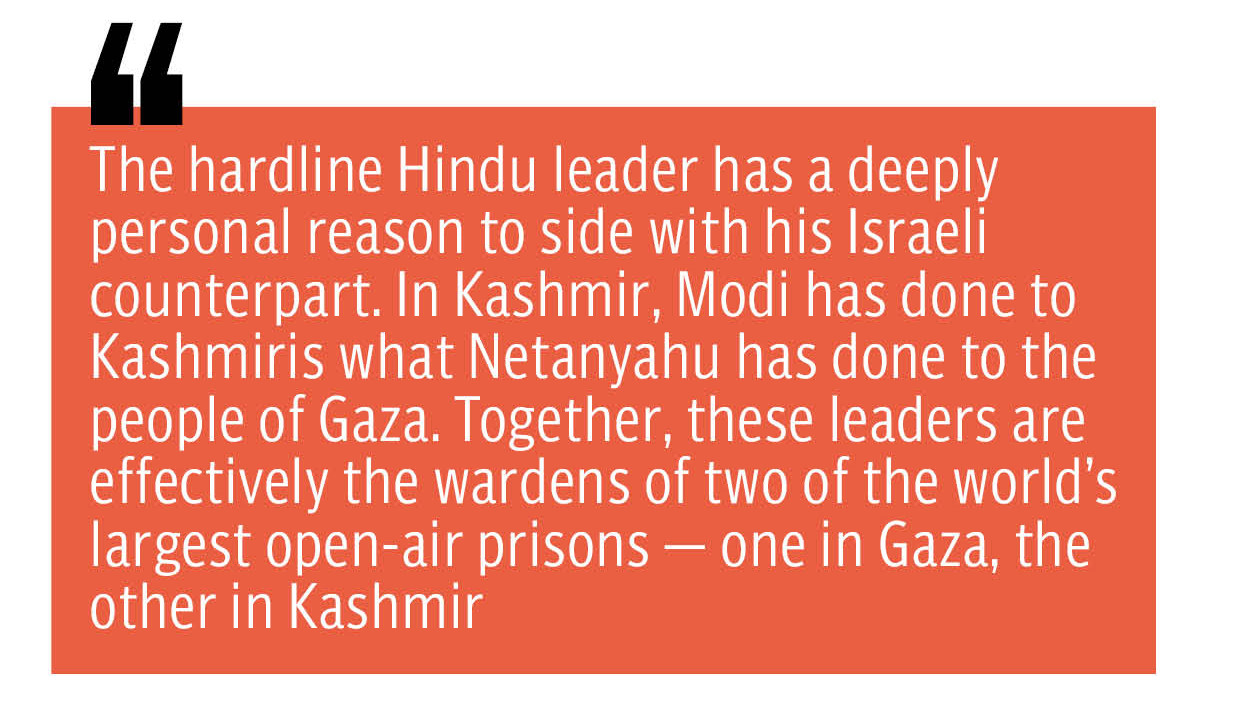
In short, for years, Narendra Modi and Benjamin Netanyahu have followed a familiar playbook, to varying degrees, and it would not be a stretch to say that in Kashmir, Modi is doing to Kashmiris what Netanyahu has openly done to the people of Gaza. Together, these leaders are effectively the wardens of two of the world’s largest open-air prisons — one in Gaza, the other in Kashmir.
One facet of this nexus between India and Israel first surfaced in the wake of October 7, 2023. As the Israel Defense Forces flattened Gaza, maiming civilians and slaughtering the young and old, India’s right-wing base, comprising Modi’s most devoted followers, was busy crafting anti-Palestinian disinformation, amplifying anything that painted Palestinians as the villains.
Marc Owen Jones, associate professor of media analytics at Northwestern University in Qatar, exposed much of this in an Al Jazeera analysis published the same year. BOOM, one of India’s leading fact-checking organizations, went a step further, identifying several verified Indian X users at the heart of the campaign. These “disinfluencers” — influencers who routinely spread disinformation — were “mostly targeting Palestine negatively, or being supportive of Israel,” according to BOOM.
Here, as in other areas, New Delhi’s nefarious designs intersect neatly with Tel Aviv’s expertise in influence operations. Israel has long demonstrated its capacity for such campaigns; more recently, its disinformation efforts helped spark protests in Iran.
The credibility of this claim was reinforced last year when Haaretz reported that during Israel’s airstrikes on Tehran’s Evin Prison, an online network circulated deepfake videos — campaigns later revealed by TheMarker and Haaretz to have been indirectly funded by Israel.
It’s no overstatement to suggest that India is tempted to follow a similar playbook in its neighborhood, particularly in Pakistan, his country’s only nuclear-armed rival. Adopting Israeli-style influence campaigns in Pakistan’s information space would only serve his insatiable desire to sow chaos, discord, and unrest across the country.
More broadly in the region, Modi and Netanyahu share another common ambition. In subtle — and not-so-subtle — ways, New Delhi has also signaled support for regime change in Iran that has long been advanced by Netanyahu’s far-right government.
India’s deep pivot toward Israel is no surprise — it has been years in the making. Between 2020 and 2024, Israel emerged as one of India’s top defence suppliers, accounting for 13% of the country’s military imports at a cost of over $20.5 billion.
The partnership dates back to the 1999 Kargil conflict and has expanded significantly since, with New Delhi acquiring advanced air-defence systems and missile platforms. In his most recent visit, according to the Jerusalem Post, Modi signed defence agreements worth up to $10 billion, covering drones, missiles, and artificial intelligence.
Beyond hardware and other areas of cooperation, the two countries have also agreed on a more sympathetic posture toward Afghanistan under Taliban rule — a group that, not long ago, was widely recognized as terrorists.
With all that knowledge, Modi continues to receive a warm reception across capitals in the Middle East, from Riyadh to Doha. Even as he openly supports Netanyahu — who, since the Gaza war began, has carried out strikes in Lebanon, Syria, Yemen, Qatar, and Iran — Middle Eastern leaders continue to welcome the Indian premier, a close ally of Bibi, with red carpets, strategic deals, and their highest honours.
It exposes a serious contradiction: how does the region reconcile this Modi-Bibi nexus with the ongoing devastation in Gaza? And why is India’s full-throttle support for Israel being treated as cost-free in a region that claims to stand with the Palestinians?
All that said, Narendra Modi’s “unwavering support” for Israel must not be seen as routine diplomatic lip service, rather than a window into the many potentially sinister projects the two sides might pursue — on top of decades of atrocities carried out in plain view in Gaza and Kashmir.
If anything, the real alarm bells ring when the two self-proclaimed democratic leaders signal support for the Taliban in Afghanistan, a country the UN has described as a graveyard of human rights.










This material may not be published, broadcast, rewritten, redistributed or derived from. Unless otherwise stated, all content is copyrighted © 2026 The Express Tribune.









COMMENTS
Comments are moderated and generally will be posted if they are on-topic and not abusive.
For more information, please see our Comments FAQ