From laws to lived reality - ending violence against women
Updated 21 hours ago

Neuroroyalism focuses on making public policy that does not necessarily aim to bring about national gain
Neuroroyalism is a new word that has gained currency in recent times. It focuses on making public policy that does not necessarily aim to bring about national gain. A line of thinking that has emerged in recent years among political scientists places a lot of emphasis on the pursuit of personal gain and gain of close associates. Among the leading exponents of this point of view are two political scientists who work at the institutions based in or near Washington. Abraham L Newman teaches in Georgetown University in downtown Washington while Stacie Goddard is at Wellesley College.
While their work is focused on policymaking in the era of President Donald Trump, what they have focused on applies to other countries that look at Washington for guidance. Later in this article I will apply their thinking to the case of today's Pakistan.
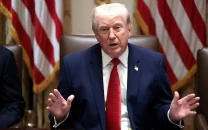
In the United States, "foreign policy has become a tool to channel money and status to Mr. Trump and his closest associates," the two academics wrote in an opinion piece they contributed to The New York Times. "Rather than compete with rivals, Mr. Trump is willing to collude with them in order to advance his court's parochial interests." The royalist reference has drawn attention because it captures the president's imperious style of governing, his frequent policy reversals and his contempt for longstanding international rules that govern the current world order.
Filipe Campante of Johns Hopkins University argues that Trump's approach to governance is bad for the economy. "Policymaking is no longer about being more competitive in the marketplace, but about connections. The winners are not necessarily the people who would have the best ideas or the best projects," he said, "a situation that impairs growth and productivity and prosperity. Those who are no longer part of the president's coterie, or who oppose him, are threatened with punishment and exclusion from government contracts, regulatory approvals and other bounty."
Policy decisions driven primarily by personal profit or pique undermine growth. The Nobel Prize in Economics in 2024 was awarded for research that showed how concentrating power, resources and opportunities in the hands of a small political elite limits development and prosperity.
There are several examples of how public policy originating from the Trump's White House have benefited him and his family. This personalised economic policy extends beyond business. President Trump acknowledged that he had raised Switzerland's tariff to 30 per cent because its former president Karin Keller-Sutter "just rubbed me the wrong way". Pakistan's decision to promote Trump's candidacy for the Nobel Peace Prize no doubt contributed to the warm reception received by Field Marshal Syed Asim Munir in the late 2025 visit to Washington. The Field Marshal was invited to lunch in the White House, a gesture usually limited to visiting heads of state. Trump said he imposed 50 per cent tariff on Brazil because the country's government refused to halt the prosecution of his political ally, the former Brazilian president, Jair Bolsonaro, who was found guilty of plotting a coup. The former Brazilian president had endeared himself to Trump by openly expressing admiration for the latter's style of governance.
Personalisation of policymaking is one reason why Pakistan has not been able to develop a style of governance that would promote overall development. In this context I should quote from a conversation I had with former President Field Marshal Ayub Khan after he had retired and was living in a house he had built at the base of the Margalla Hills in Islamabad. He invited me to discuss the substance of a book on Pakistan's economic history that I was then working on. He asked me whether the book I was writing covered his period of eleven years, from 1958 to 1969.
I said that my book described his period as the country's "golden age". He was obviously pleased with my response. "But Zulfi doesn't think so," he said, referring to Zulfikar Ali Bhutto, who had served his government first as Commerce Minister and then as Foreign Minister. Bhutto was not in favour of developing close relations with the United States, believing that Washington only pursued its own interests and was not mindful of looking after the countries it was associating with. Instead, Bhutto, while working in Islamabad's foreign office, reached out to Beijing.
I told Ayub Khan that I had spent several years at Harvard University, first as a graduate student and then as a member of the faculty. I had come in touch with several members of the Harvard faculty who, as members of the Harvard Development Advisory Service, had worked as advisers of the Planning Commission and also as advisers to the Planning and Development Departments in Lahore and Dhaka, capitals of what were then the two wings of Pakistan. Several of them had written books on Pakistan, most notably late Gus Papane,k whose book Pakistan's Development: Social Goals and Private Incentives held Ayub Khan's Pakistan as a model of development that could be followed by other developing nations. I asked the former president whether he agreed with that assessment. His response was very revealing, and I will go into it in some detail:
"When I forced the civilian leaders out and established what was to be Pakistan's first military-led government, I told my associates that I will not act as a dictator. Instead, I will follow expert advice on both policies and projects on which my government would be spending precious resources. This meant creating a well-staffed Planning Commission whose advice I would follow. However, we didn't have good economists who could bring the needed expertise to the Commission. So, when President Eisenhower sent an American delegation to discuss our needs, I asked for American economists to man the Commission in Karachi, then the capital of Pakistan, and the Planning and Development Departments in the two provinces. This led to an agreement with Harvard University's Development Advisory Service who sent a couple of dozen development experts. Papanek was a prominent member of this group.
The American team also went to New Delhi and met with Prime Minister Jawaharlal Nehru who asked the Americans to set up science and technology institutions patterned after the Massachusetts Institute of Technology, the MIT. I wish I had done the same. It does not take long to produce economists but creating MIT type of institutions is a time-intensive task. The fact that India has taken such a lead in technology can be traced back to that one decision by Nehru."









This material may not be published, broadcast, rewritten, redistributed or derived from. Unless otherwise stated, all content is copyrighted © 2026 The Express Tribune.



COMMENTS
Comments are moderated and generally will be posted if they are on-topic and not abusive.
For more information, please see our Comments FAQ