Turkiye calls Netanyahu 'Hitler of our times'
Updated 7 hours ago

Inter-Services Public Relations says suicide bomber intercepted, major attack on civilians averted
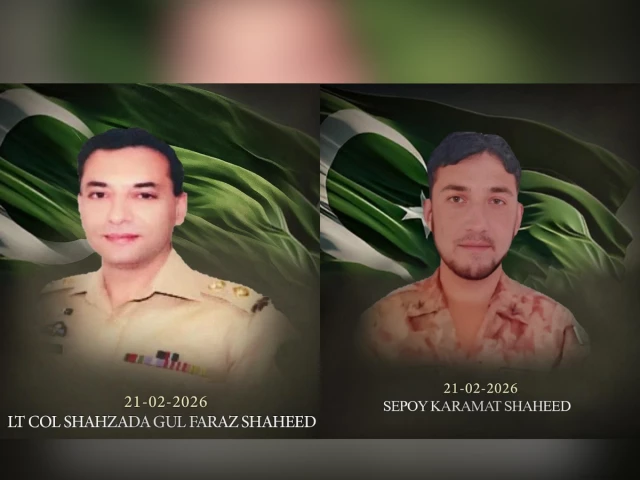
Two Pakistani security personnel, including Lt Col Shahzada Gul Faraz and Sepoy Karamat Shah, were martyred on Saturday during a counter-terror operation in Khyber-Pakhtunkhwa’s Bannu district, the military said.
According to military’s media wing, the ISPR, the operation targeted the reported presence of terrorists from the Indian-backed group “Fitna al Khwarij,” a term authorities use for the banned Tehreek-e-Taliban Pakistan, including a vehicle-borne suicide bomber. Security forces intercepted the bomber, preventing what it described as a major attack on civilians and law enforcement personnel in Bannu city.
The state uses “Fitna al-Khawarij” for terrorists affiliated with the TTP, while “Fitna al-Hindustan” refers to Indian-backed extremist proxies in Balochistan.
On 21 February, in a cowardly attack, Security Forces convoy was targeted by Indian proxy Fitna al Khwarij in Bannu District while an intelligence based operation was being conducted on reported presence of Khwarij including a suicide bomber.
— PTV News (@PTVNewsOfficial) February 21, 2026
A vehicle borne suicide bomber was… pic.twitter.com/80A2aQ4lA5
During the ensuing firefight, five terrorists were killed. However, the attackers rammed an explosives-laden vehicle into one of the lead convoy vehicles, killing Lt Col Shahzada, 43, a resident of Mansehra, and Sepoy Karamat Shah, 28, from Peshawar.
The military said terrorists continue to use Afghan soil to launch attacks inside Pakistan, criticising Afghan Taliban for failing to prevent cross-border assaults during Ramazan.
It added that Pakistan’s counter-terror campaign under the “Azm-e-Istehkam” vision, approved by the National Action Plan’s federal apex committee, would continue until foreign-backed terrorism is eliminated.
Also read: At least two killed, 17 injured in IED blast in Bannu
President Asif Ali Zardari condemned what he called a “cowardly terrorist attack” and expressed “deep sorrow and grief” over the martyrdom of the two soldiers. “The great sacrifice of the martyrs is the nation’s asset,” he said, offering condolences and prayers for the families.
صدرِ مملکت آصف علی زرداری کی بنوں میں سیکیورٹی فورسز کے قافلے پر بزدلانہ دہشت گرد حملے کی شدید مذمت۔
— PPP (@MediaCellPPP) February 21, 2026
صدر زرداری کا لیفٹیننٹ کرنل شہزادہ گل فراز اور سپاہی کرامت شاہ کی شہادت پر گہرے رنج و غم کا اظہار۔
شہداء کی عظیم قربانی قوم کا سرمایہ ہے: صدرِ مملکت
صدرِ پاکستان کا شہداء کے…
He added, “Operations against Fitna al Khawarij will continue without discrimination and with full force; there will be no compromise on the protection of the nation,” and said terrorists who violate the sanctity of Ramazan “have nothing to do with Islam.”
Prime Minister Shehbaz Sharif also condemned the attack and expressed grief over the deaths. He prayed for the departed souls and conveyed condolences to their families. Praising the troops for killing five terrorists and foiling their plans, he said, “The attempt by Fitna al Khawarij terrorists to carry out terrorism in the blessed month of Ramazan proves that terrorists have no religion.”
وزیراعظم محمد شہباز شریف کی ضلع بنوں میں فتنہ الخوارج کے دہشت گردوں کی جانب سے سیکیورٹی فورسز کے قافلے پر حملے کی شدید مذمت۔
— Government of Pakistan (@GovtofPakistan) February 21, 2026
وزیراعظم کا دہشت گردوں کے حملے میں پاکستان فوج کے لیفٹیننٹ کرنل شہزادہ گل فراز اور سپاہی کرامت شاہ کی شہادت پر افسوس کا اظہار۔
وزیراعظم کی شہداء کی… pic.twitter.com/SCuKrJCsgq
He added that security forces’ timely action saved the city from major destruction and said, “Under the vision of Azm-e-Istehkam, security forces are achieving major successes against terrorism. The entire nation stands with Pakistan’s armed forces in this war. We are determined to completely eradicate every form of terrorism from the country.”
Interior Minister Mohsin Naqvi paid tribute to the fallen soldiers, saying Lt Col Shahzada “wrote a history of courage and bravery,” and added, “Salute to Shaheed Colonel Shahzada Gul Faraz and Sepoy Karamat Shah.” He said the officer sacrificed his life to foil the terrorists’ “nefarious designs” and that the nation would always remember his “great sacrifice,” adding that the country would remain indebted to its martyrs.
Ittehad-ul-Mujahideen claims responsibility
Security sources said that the responsibility for the recent suicide attack in Bannu had been claimed by Ittehad-ul-Mujahideen, a sub-group of Fitna al-Khawarij.
In a statement posted on X, state broadcaster PTV News, quoting security sources, said that Ittehad-ul-Mujahideen — affiliated with the Hafiz Gul Bahadur group of Fitna al-Khawarij — had claimed responsibility for the attack.
According to the sources, the group’s central ringleader, Gul Bahadur, along with his key commanders, is taking shelter in Afghanistan. They alleged that the Gul Bahadur group has been involved in terrorism and subversive activities in Pakistan while using Afghan soil.
بنوں خودکش حملے کی ذمہ داری فتنہ الخوارج کے ذیلی گروہ اتحاد المجاہدین نے قبول کر لی، سیکیورٹی ذرائع
— PTV News (@PTVNewsOfficial) February 21, 2026
اتحاد المجاہدین کا تعلق فتنہ الخوارج کے حافظ گل بہادر گروپ سے ہے
اس گروہ کا مرکزی سرغنہ گل بہادر اور اس کے اہم کمانڈر افغانستان میں پناہ لیے ہوئے ہیں
حافظ گل بہادر گروپ… pic.twitter.com/81tCCxyPTO
The same group had carried out an attack on Bannu Cantt on March 4, 2025, during the holy month of Ramazan, which was planned from Afghanistan, the sources said.
On September 2, 2025, during a Fitna al-Khawarij attack on the Federal Constabulary in Bannu, Major Adnan embraced martyrdom after fighting bravely, the statement added.
Security sources further said the group had claimed responsibility for multiple attacks in Mir Ali as well as in North and South Waziristan. It was later established that the planning and facilitation of those attacks were also carried out from Afghanistan.
They maintained that the presence of central ringleaders of Fitna al-Khawarij, including Gul Bahadur, in Afghanistan was evidence that Afghan soil was being used for terrorism.
The Afghan Taliban regime’s backing of terrorist organisations clearly indicated that terrorists were being provided safe havens in Afghanistan, the sources alleged.
They added that evidence had established that more than 70 per cent of elements involved in terrorist incidents in Pakistan were of Afghan origin or linked to networks connected to Afghanistan.
The Afghan Taliban regime’s patronage of terrorists continued to sabotage efforts for peace in the region, the security sources said.
Pakistan has long accused the Afghan Taliban of providing sanctuary to the TTP leaders and fighters, who regrouped across the border after Pakistan's military operations in the former tribal areas. While the Taliban have publicly denied giving the group a free hand, Islamabad insists that the TTP safe havens in Afghanistan remain intact.
Tensions worsened last year after a string of deadly attacks in Khyber-Pakhtunkhwa, which Pakistan directly linked to militants operating from Afghanistan.
In August last year, Afghan officials claimed that two drone strikes had hit the house of a man in Shinwar district, Nangarhar province. The Afghan government had summoned Pakistan’s Ambassador in Kabul to lodge a formal protest against what it had claimed were Pakistani military strikes in Nangarhar and Khost provinces.
In November, the Afghan Taliban regime had again accused Pakistan of launching air strikes. Taliban spokesperson Zabihullah Mujahid said that Pakistan had "bombed" Afghanistan's Khost province and carried out air strikes in Kunar and Paktika. In response, Pakistan had vehemently dismissed Kabul's allegations, insisting that Islamabad neither carried out covert cross-border operations nor targeted civilians.
The same month, ISPR Director-General Lieutenant General Ahmed Sharif Chaudhry had issued a warning that the Afghan regime was a threat not just to Pakistan but to the entire region and the world, citing the abandonment of $7.2 billion worth of American military equipment during the US withdrawal.
Lt Gen Chaudhry reiterated that the Afghan regime was harbouring “Non-State Actors” who posed a threat to various countries in the region, noting the Taliban’s failure to establish an inclusive state and government post-2021. He stressed that Pakistan's issue was with the Afghan Taliban regime, not the Afghan people.
Most recently, after terrorist attacks in Balochistan, Naqvi had once again blamed India for a coordinated terror campaign in the province.
“These were not ordinary terrorists. India is behind these attacks. I can tell you for certain that India planned these attacks along with these terrorists,” he said.
He added that authorities would pursue every individual involved, as well as those directing them from behind the scenes.
Naqvi further claimed that India was the “main country” behind terrorism, saying it not only provides financial support to terrorists but also assists them in planning and strategising.
In 2023, a UN report also revealed that the TTP had established a new base in K-P in mid-2023. The report shed light on close ties not only between the TTP and the Afghan Taliban but also with anti-Pakistani groups and al Qaeda.
Read This: The breeding ground for terror
The report further revealed that some Taliban members had also joined the TTP, perceiving it as a religious obligation to provide support.
Interlocutors reported that TTP members and their families received regular aid packages from the Taliban.
Importantly, the UN report noted a significant increase in Afghan nationals in the TTP ranks. This supported Pakistan’s stance that a growing number of Afghan nationals were involved in suicide attacks in the country.
More recently, a UNSC report said that attacks on Pakistan by the TTP from Afghanistan have increased, endorsing Islamabad's long-running complaints about militant sanctuaries across the border. The 37th report by the Analytical Support and Sanctions Monitoring Team, dated February 4, not only endorsed Islamabad's stance that Afghanistan had become a sanctuary for militants who used its territory to launch attacks on Pakistan, but also came at a time when the country is facing a renewed spate of violence.










This material may not be published, broadcast, rewritten, redistributed or derived from. Unless otherwise stated, all content is copyrighted © 2026 The Express Tribune.







COMMENTS (2)
Comments are moderated and generally will be posted if they are on-topic and not abusive.
For more information, please see our Comments FAQ