Nationwide heatwave warning issued
Updated 3 hours ago

Gallup survey finds strong support tied to conditions, with caution over risks and preference for legitimacy
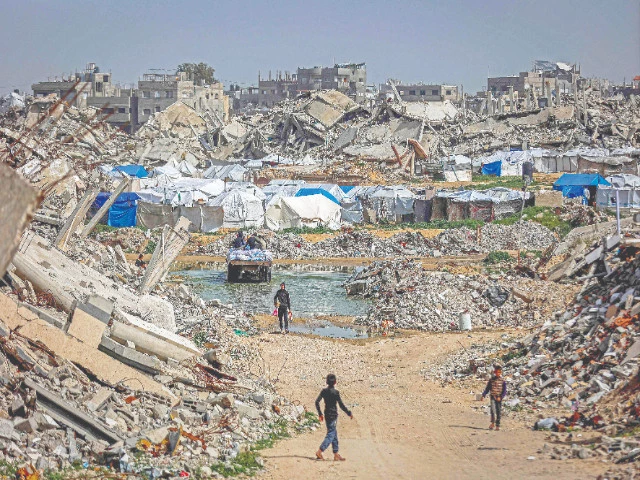
Nearly three-quarters of Pakistanis surveyed support sending Pakistani troops to Gaza as part of a peace-monitoring mission involving Muslim countries, but only under strict conditions, according to a new national survey by Gallup Pakistan.
The poll, conducted between Jan. 15 and Feb. 3, 2026, surveyed 1,600 people using Computer-Assisted Telephone Interviews. Gallup said the margin of error is about ±2–3% at a 95% confidence level. This means that if 73% supported troop deployment, the “true” figure could range between 70% and 76%.
Public engagement with Gaza remains high. About 54% of respondents said they actively follow developments related to Palestine and Gaza. Views on post-ceasefire conditions were mixed, with 43% saying food and security had improved to some extent, while 26% said there was no change.
On deploying Pakistani forces to Gaza, 73% expressed support, including 55% who said they strongly support the idea. Support was higher among men at 78% compared with 68% among women. Urban backing stood at 84%, while 67% of rural respondents supported the proposal.
Read: Muslim bloc warns Israel against West Bank annexation
women. Urban backing stood at 84%, while 67% of rural respondents supported the proposal.
Among supporters, 64% said deployment should be under a joint alliance of Muslim countries, 60% said it should follow a formal request from Palestinian leadership, and 57% said it should have United Nations approval. Endorsement by major powers ranked lowest, with 47% citing approval from the United States or China as important, pointing to a preference for Muslim and UN-based legitimacy.
Concerns over risks were mixed. About 27% believed there would be a high risk to Pakistani soldiers’ lives, while 32% said the risk would be low. On financial costs, 26% expected high risks and 30% assessed them as low. Only 20% said such a mission could draw Pakistan into a wider war.
Read more: PM Shehbaz to attend Trump-led Board of Peace meeting in Washington
Views on how Pakistan should respond also varied. About 44% said military action is necessary, while 33% favoured diplomacy and humanitarian aid. Another 7% said Pakistan should stay out of the issue altogether.
On Pakistan’s participation in the Gaza “Board of Peace,” formed under the initiative and control of US President Donald Trump, 34% said they were happy with Pakistan’s inclusion, 23% were unhappy, and 39% were unsure. Gallup said this suggests limited public familiarity with the board’s mandate or doubts about its effectiveness.
Gallup concluded that sympathy for Gaza remains strong and that there is broad support for a Pakistani role, including military involvement, as long as it is legitimate, multilateral, and anchored in Muslim and UN institutions. At the same time, significant backing for diplomacy and humanitarian aid shows continued public caution.











This material may not be published, broadcast, rewritten, redistributed or derived from. Unless otherwise stated, all content is copyrighted © 2026 The Express Tribune.






COMMENTS (2)
Comments are moderated and generally will be posted if they are on-topic and not abusive.
For more information, please see our Comments FAQ