No US-Iran peace talks in sight, but Islamabad maintains security lockdown
Updated 1 hour ago

Former England captain says cricket is being harmed by growing political interference
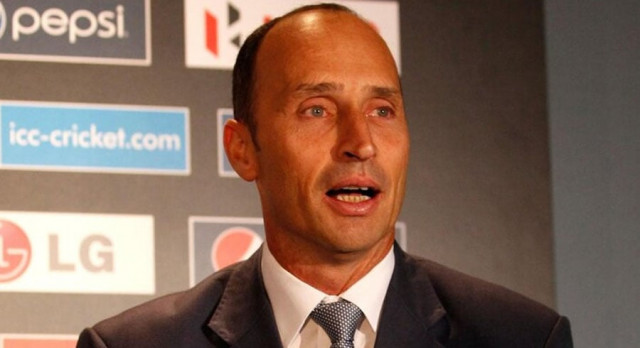
Former England captain Nasser Hussain has backed Bangladesh and Pakistan for maintaining their positions amid growing uncertainty over the International Cricket Council Men’s T20 World Cup 2026, saying international cricket has reached a point where politics is overshadowing the sport.
The tournament is scheduled to be held in India and Sri Lanka from February 7 to March 8. Still, controversy has intensified after Bangladesh were excluded from the competition for refusing to travel to India, citing security concerns. Pakistan later followed suit by declining to play their fixture against India, casting doubt over whether the high-profile match will take place on February 15 in Colombo.
Bangladesh’s decision came after fast bowler Mustafizur Rahman was removed from Kolkata Knight Riders’ squad for the Indian Premier League, despite being bought at the auction. The Bangladesh Cricket Board described the episode as a key factor in its stance.
Read: Bangladesh boycott T20 World Cup after ICC rejects venue shift: report
Speaking on the Sky Cricket Podcast alongside Michael Atherton, Hussain said he respected both Bangladesh and Pakistan for taking a firm position.
“If India, a month before a tournament, said their government didn't want them to play in a country for a World Cup, would ICC really be so firm?” - Nasser Hussain
— Kh4N PCT (@Kh4N_PCT) February 4, 2026
Calling out India & ICC's double standards, while praising Bangladesh and Pakistan for stepping up. pic.twitter.com/jn6IT79HmD
“I quite like Bangladesh sticking to their guns. They stood up for their player,” he said. “And I quite like Pakistan sticking up for Bangladesh...at some stage someone has got to say enough is enough -- can we just get back to playing cricket?”
Pakistan’s position has been reinforced at the political level, with Prime Minister Shehbaz Sharif confirming that Islamabad would not alter its stance, despite ongoing back-channel discussions between cricketing authorities.
Hussain acknowledged the situation was deeply political but said that the sport had become increasingly entangled in disputes that once lay outside the boundary rope. He described the current climate as “fairly depressing”, pointing to recent incidents during the Asia Cup, where Indian players declined to shake hands with Pakistan players and later refused to accept the trophy from Pakistan Cricket Board Chairman Mohsin Naqvi.
Read more: ICC mulls relocating Bangladesh T20 WC matches from India after BCB request
“Cricket used to unite nations that were struggling politically,” Hussain said. “Now it feels like it’s pushing people further apart. What used to be the exception has become the norm -- and it’s not just politicians anymore, it’s players as well.”
He also said that Pakistan’s influence in the standoff was limited, noting that the financial value of an India-Pakistan match remained one of the few levers available.
“The only way Pakistan can really hurt the ICC, or even India, is through the money and the finances of that game,” he said.
Hussain said he had some sympathy for the International Cricket Council (ICC), arguing that Bangladesh’s late decision not to travel would have posed logistical challenges. However, he questioned whether the governing body would have taken the same approach had a similar request come from India.
“The real question is one of consistency,” Hussain said. “If India said a month before a World Cup that their government didn’t want them to travel, would the ICC have been as firm and knocked them out? That’s the question only the ICC can answer.”
He added that unequal treatment risked weakening international competition. “With power comes responsibility. If Bangladesh or Pakistan are continually marginalised, their cricket suffers -- and the contests that once defined the game become increasingly one-sided.”








This material may not be published, broadcast, rewritten, redistributed or derived from. Unless otherwise stated, all content is copyrighted © 2026 The Express Tribune.


COMMENTS (6)
Comments are moderated and generally will be posted if they are on-topic and not abusive.
For more information, please see our Comments FAQ