Gold rates retreat after three-day rise
Updated 6 hours ago

Why Pakistan's flood resilience depends on recognising local collective action
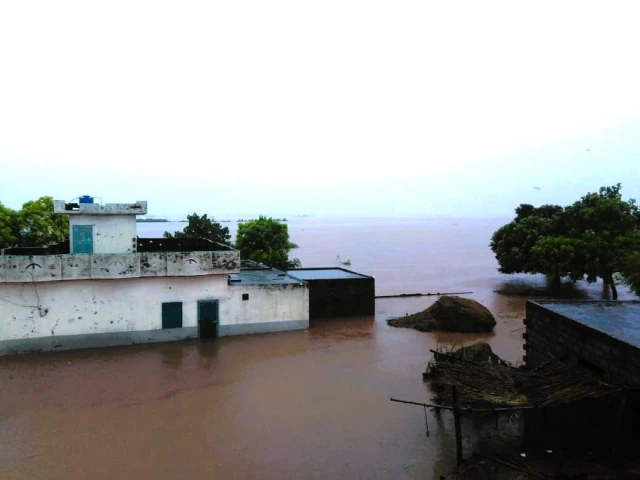
At around 3:00 am, Muhammad Bilal was asleep when his phone began to buzz. On the other end, a friend laughed and asked, "Are you dead?" Without waiting for an answer, he added that floodwater had reached the levee near Bilal's village. Startled awake, Bilal rushed to the levee at dawn.
Bilal does not live in the river belt. His home is 2.5 kilometres away, protected — at least in theory by a decades-old levee (or bund, as locals call it). But when he reached it, he was stunned. The water level had surpassed the historical peak within just six hours. For half an hour, he wandered along the levee, speechless. Everyone he met whispered the same thing: "This time, we are not safe. The water will rise above our rooftops."
Many were preparing to abandon the village. As a financially stable man, Bilal could have done the same. Instead, he did something he had never done before.
He mounted a woofer speaker on his motorbike and began making announcements across every street of his village, Miran Mallah — a settlement of nearly 28,000 people — calling all men to gather at the levee to defend it. Some villagers laughed at him, calling him foolish. He ignored them. A few like-minded men joined him, and together they returned to the levee.
When they arrived, they found that other nearby villages had done the same. Groups of men stood with their local leaders, ready for action.
What they were doing was not new. Their parents and grandparents had done it. Whenever the river swelled, communities would defend the levee themselves. "This duty is inherited," one villager told me. "Our elders protected this bund, and we must pass this responsibility to our children." In a moment when many were paralysed by fear, Bilal displayed leadership.
During an impromptu meeting, the villagers established a simple but effective system of collective action. They divided the levee in their area into five sectors and set three rules.
First, each group would protect its designated territory, ensuring there were no breaches or holes.
Second, any member who abandoned duty without informing others would face social sanctions.
Third, the government and politicians could not be trusted — they might intentionally breach the levee elsewhere to protect their own interests.
People began to join them because they saw hope. In Miran Mallah alone, residents collectively donated nearly Rs2 million, offered labour, and took turns keeping vigil at night.
Across the eight-kilometre stretch under their care, there were several points where minor breaches could have evolved into catastrophic failures. Without this community-led effort, the entire area could have been submerged.
This is not an isolated story.
In my field research on community collective action between Shujaabad and Jalalpur Pirwala, I found similar examples across multiple villages. Where levee breaches did occur — such as Moza Dhundho in Shujaabad and Pharerin and Sheikh Ismail in Jalalpur Pirwala — communities lacked this kind of organisation. Even Jalalpur Pirwala city, according to residents I surveyed, would not have survived had local communities not mobilised.
Yet leaders like Muhammad Bilal remain unrecognised by the administration. Pakistan's disaster management system has also failed to acknowledge the effectiveness of these community-driven protective models.
Had these communities not defended the levee, the resulting losses — in lives, crops, livestock, infrastructure, and government compensation — would have been astronomical.
Climate change is no longer a distant threat to Pakistan. Its economic and human cost is already devastating. Extreme rainfall, melting glaciers, and the weaponisation of water in the India-Pakistan conflict will only worsen future floods. Pakistan simply cannot afford a disaster on the scale of 2025 every single year — nor can it sustain the financial burden of repeated compensation.
It is time for the government to rethink its strategy. One practical, cost-effective approach is to institutionalise and support community-led collective action, providing training, resources, and coordination mechanisms for the very people who stand on the front lines when disaster strikes.
Pakistan's resilience does not lie only in its bureaucracy — it lives in its villages, in leaders like Muhammad Bilal, and in communities that refuse to abandon their land. It is high time we recognised them.
The writer is a postdoctoral research fellow at the ERC and the European Research University, and a senior research fellow at the Prisa Institute














This material may not be published, broadcast, rewritten, redistributed or derived from. Unless otherwise stated, all content is copyrighted © 2026 The Express Tribune.







COMMENTS
Comments are moderated and generally will be posted if they are on-topic and not abusive.
For more information, please see our Comments FAQ