Forces kill terrorists' ringleader in Bannu
Updated 7 hours ago

NIH data shows sharp dip in pollen-related illnesses amid ecological restoration drive
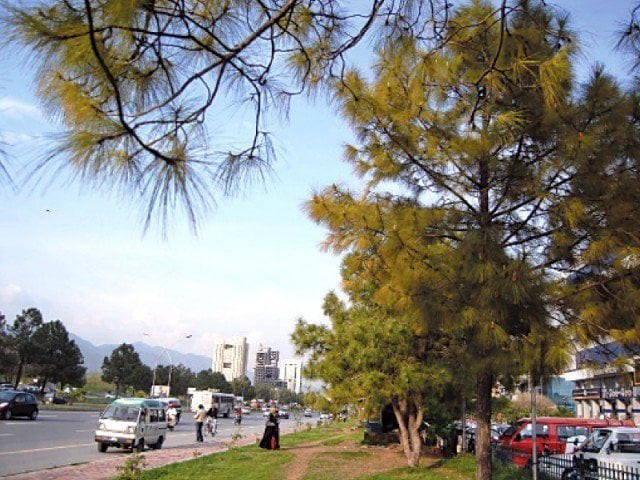
A Senate standing committee was told on Thursday that Islamabad has faced a critical pollen crisis for more than two decades, with total pollen counts reaching an unprecedented 82,000 grains per cubic metre in 2022.
Minister of State for National Health Services, Regulations and Coordination (NHSR&C) Dr Mukhtar Ahmad Malik briefed the panel on Paper Mulberry Management and Ecological Restoration in the Islamabad Capital Territory, terming it a major public health and environmental intervention aimed at mitigating the city's severe seasonal pollen crisis.
The minister highlighted that the invasive paper mulberry (Broussonetia papyrifera), a non-native species introduced between the 1960s and 1980s, now accounts for approximately 94 per cent of Islamabad's total pollen burden.
He informed the committee that paper mulberry pollen poses exceptional health risks due to its lightweight particles, which penetrate deep into the lungs and trigger severe allergic rhinitis, acute asthma exacerbations, and life-threatening status asthmaticus.
Terming the initiative a vital public health intervention, Dr Mukhtar said the ecological restoration programme was projected to reduce respiratory allergies in the capital by over 40 per cent, significantly easing the seasonal burden on hospitals and emergency departments.
Data from the NIH Allergy Centre was shared with the committee, showing measurable progress. Late-year allergy cases declined from over 2,300 in 2023 to 1,031 in 2025 following targeted uprooting, while overall allergy prevalence dropped from 45.8 per cent in 2023 to 33.3 per cent in 2025, indicating a reduced per-capita risk despite population growth.
Dr Mukhtar explained that, to prevent aggressive resprouting, the ministry, in coordination with the Capital Development Authority (CDA), is implementing a strict three-step eradication protocol involving cutting, complete uprooting of the root system, and soil compaction.
Of the approximately 80,000 paper mulberry trees identified for removal across Islamabad, 29,115 have been cleared to date, with priority given to high-density areas including F-9 Park and Shakarparian.
The committee was further informed that ecological restoration remains central to the initiative. Under a 3:1 restoration policy, three indigenous trees are being planted for every paper mulberry removed. By April 2026, around 90,000 native trees, including Kachnar, Amaltas, Desi Toot, and drought-resilient Pilkan, will have been planted to restore the capital's natural ecosystem.
The initiative is being supported through public-private partnerships, with contributions from OGDCL, MIRA Power, and Beaconhouse.
The minister concluded by noting that the initiative aligns Islamabad with international best practices in urban environmental health governance, as adopted in countries such as the United States and Australia. He expressed hope that by April 2026 the project would be completed in accordance with approved technical protocols, resulting in sustained control of seasonal pollen levels and a measurable reduction in pollen-related allergic and respiratory illnesses in the federal capital.














This material may not be published, broadcast, rewritten, redistributed or derived from. Unless otherwise stated, all content is copyrighted © 2026 The Express Tribune.








COMMENTS
Comments are moderated and generally will be posted if they are on-topic and not abusive.
For more information, please see our Comments FAQ