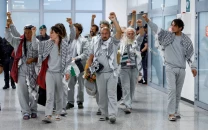
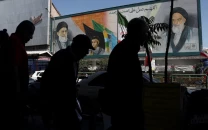
Hajj climaxes with call for unity
Updated 2 hours ago

Maduro faces cocaine-trafficking charges linked to cartels, FARC rebels, and Tren de Aragua gang
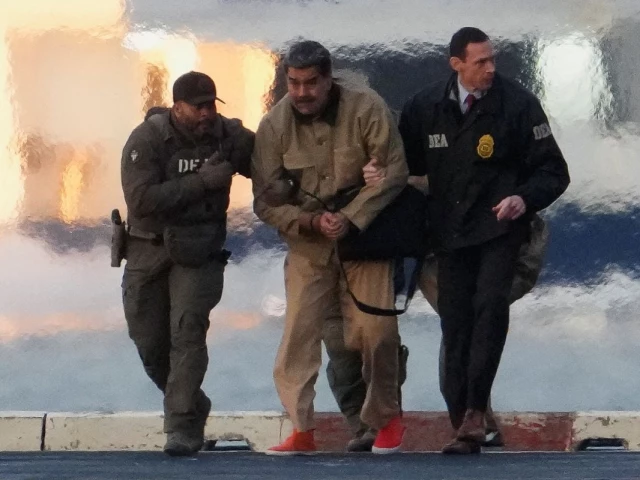
Toppled Venezuelan President Nicolas Maduro pleaded not guilty on Monday to charges of narco-terrorism after President Donald Trump's stunning capture of him rattled world leaders and left officials in Caracas scrambling to respond.
Maduro, 63, pleaded not guilty in New York federal court to four criminal counts, including narco-terrorism, cocaine importation conspiracy, and possession of machine guns and destructive devices.
"I am innocent. I am not guilty. I am a decent man. I am still president of my country," Maduro said through an interpreter, before being cut off by US District Judge Alvin Hellerstein.
Maduro's wife, Cilia Flores, also pleaded not guilty. The next court date was set for March 17.
Maduro is accused of overseeing a cocaine-trafficking network that partnered with violent groups including Mexico's Sinaloa and Zetas cartels, Colombian FARC rebels, and Venezuela's Tren de Aragua gang. He has long denied the allegations, saying they were a mask for imperialist designs on Venezuela's rich oil reserves.
While world leaders and US politicians grappled with the extraordinary seizure of a head of state, an emergency order in Venezuela, published in full on Monday, instructed police to search for and capture anyone who supported Saturday's US operation.
Also on Monday, the UN Security Council debated the implications of the raid, which was condemned by Russia, China, and leftist allies of Venezuela. UN Secretary-General Antonio Guterres raised concerns about instability in Venezuela and the legality of Trump's strike — the most dramatic US intervention in Latin America since the 1989 Panama invasion.
Maduro, wife appear, plead not guilty
On Monday morning, Maduro — his hands zip-tied — and his wife Cilia Flores were escorted by armed guards from a Brooklyn detention center to a helicopter bound for court. The judge began the hearing at 12:02 p.m. (1702 GMT) in Manhattan federal court by summarizing the charges in the indictment. Maduro, in orange and beige prison garb, listened on headphones through an interpreter.
Judge Hellerstein asked Maduro to stand and confirm his identity. He replied in Spanish. The judge informed the couple of their right to notify the Venezuelan consulate of their arrests.
Prosecutors say Maduro has been involved in drug trafficking since he served in Venezuela's National Assembly in 2000, continued as foreign minister, and later became president in 2013 following Hugo Chavez's death. Federal prosecutors in New York first indicted him in 2020 as part of a long-running narcotics case against current and former Venezuelan officials and Colombian guerrillas. An updated indictment made public on Saturday added new details and co-defendants, including Cilia Flores.
The US has considered Maduro an illegitimate dictator since his disputed 2018 re-election. Experts in international law have questioned the legality of the raid, with some condemning Trump's actions as a challenge to a rules-based international order.
Trump asserts oil aspirations
In Caracas, senior officials from Maduro's 13-year-old government remain in charge of the South American oil producer, first showing defiance then pivoting toward possible cooperation with the Trump administration. US oil companies' shares jumped on Monday, fueled by the prospect of access to Venezuela's vast oil reserves.
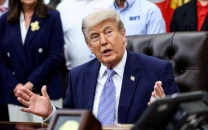
Trump has openly stated he wants a share of Venezuela's oil wealth. "We're taking back what they stole. We're in charge," he said on Air Force One. Venezuela holds the world's largest oil reserves — about 303 billion barrels — though production has declined from mismanagement, under-investment, and US. sanctions, averaging 1.1 million bpd last year, a third of its 1970s peak.
Acting Venezuelan president urges cooperation
After initially denouncing Maduro's capture as a colonial oil-grab and "kidnapping," Venezuela's acting president, Delcy Rodriguez, softened her stance on Sunday, calling for respectful relations with Washington.
"We invite the US government to work together on an agenda of cooperation," Rodriguez said. "President Donald Trump, our peoples and our region deserve peace and dialogue, not war."
Trump also warned of further strikes if Venezuela does not cooperate on opening its oil industry and stopping drug trafficking. He threatened Colombia and Mexico, adding that Cuba's communist government "looks like it's ready to fall."
It remains unclear how the US would work with a post-Maduro government, composed of ideological enemies. Rodriguez, praised as a "tigress" by Maduro, is also seen as a pragmatist with strong private sector connections and belief in economic orthodoxy.
Global consternation
Washington's allies, most of whom did not recognize Maduro due to vote-rigging claims, have remained muted, emphasizing dialogue and adherence to law. Trump's raid has sparked a political storm in the US., with opposition Democrats claiming they were misled. Secretary of State Marco Rubio was expected to brief top lawmakers on Monday.
While some conservative figures criticized the Venezuela operation as a betrayal of Trump's "America First" pledge, most supporters praised it as a swift, effective action.
Inside Venezuela, Maduro opponents have held back celebrations as his allies remain in power. There is no sign of military opposition, though insiders are suspected to have aided Saturday's operation.
Also Read: China condemns US capture of Maduro, says countries cannot act as 'world judge'
“We invite the US government to work together on an agenda of cooperation,” Rodriguez said. “President Donald Trump, our peoples and our region deserve peace and dialogue, not war.”
Rodriguez, 56, a prominent member of the ruling Chavista movement, is regarded as both a fierce loyalist and a pragmatic figure with strong private-sector ties and an inclination toward economic orthodoxy.
Trump has warned of further strikes if Venezuela does not cooperate in opening its oil industry and curbing drug trafficking. He also issued threats toward Colombia and Mexico and said Cuba’s communist government “looks like it’s ready to fall.”
International reaction
Global reaction has been sharply divided. Russia, China and leftist allies of Venezuela condemned the US raid, while Cuba—long rumored to oversee Maduro’s security—said 32 of its military and intelligence personnel were killed during the operation.
Washington’s allies, many of whom do not recognize Maduro due to allegations of election fraud, responded more cautiously, calling for dialogue and adherence to international law.
“Judging by the reactions from European leaders to date, I suspect that US allies will equivocate exquisitely in the Security Council,” said Richard Gowan, an analyst at the International Crisis Group.
Switzerland announced it had frozen assets held by Maduro and his associates.
Maduro held in notorious jail
Maduro, a former bus driver, union leader and foreign minister handpicked by Hugo Chavez to succeed him in 2013, is expected to be held at New York’s Metropolitan Detention Center. Inmates there are typically confined to their cells for 23 hours a day.
The facility has previously housed Ghislaine Maxwell, associate of convicted sex offender Jeffrey Epstein, as well as hip-hop mogul Sean “Diddy” Combs. Former Honduran President Juan Orlando Hernandez, convicted on drug charges before receiving a presidential pardon, was also detained there.
Trump has justified Maduro’s capture as a response to a surge in Venezuelan migration and to decades-old nationalization of US oil assets.
“We’re taking back what they stole,” Trump said on Sunday. “U.S. oil companies will return to Venezuela. We’re in charge.”
Venezuelans uneasy about future
Inside Venezuela, opposition supporters have tempered celebrations as Maduro’s allies remain in power and there are no signs the military is breaking ranks. Many Venezuelans have begun stockpiling food and medicine amid fears of instability.
Financial markets reacted sharply. Venezuela’s defaulted government bonds surged, oil prices edged higher and global equities rose, with defense stocks gaining as geopolitical concerns intensified.
Trump has dismissed the idea of opposition leader and Nobel Peace Prize winner Maria Corina Machado assuming power, saying she lacks sufficient support. Machado, barred from the 2024 election, has said her ally Edmundo Gonzalez won decisively and holds a mandate to rule.
The raid has also sparked political backlash in the United States, with opposition Democrats saying they were misled. Secretary of State Marco Rubio was scheduled to brief lawmakers later on Monday.
While some conservative figures criticized the operation as contradicting Trump’s “America First” pledge, most supporters praised it as a swift and decisive victory.
Venezuela moves to cut oil output due to US export embargo
Venezuela’s state-run oil company PDVSA has begun cutting crude production as it runs out of storage capacity due to an ongoing US oil blockade that has reduced exports to zero, piling pressure on an interim government struggling to remain in power amid US threats of further military action.
Caracas is in political crisis under an interim government after President Nicolas Maduro and his wife were captured by US forces on Saturday. Oil exports, Venezuela’s main source of revenue, have come to a standstill following a US blockade on tankers under sanctions and the seizure of two oil cargoes last month.
Cargoes operated by Chevron and bound for the United States had been an exception because the company holds a license from Washington. However, shipping data showed on Sunday that even those movements stopped on Thursday.
As part of his announcement of Maduro’s detention and a US-overseen government transition, US President Donald Trump said on Saturday that an “oil embargo” on Venezuela was fully in force.
Read More: Trump: second strike in Venezuela possible if government does not cooperate
PDVSA’s response includes shutting down oilfields and well clusters as onshore stocks mount and the company runs short of diluents needed to blend Venezuela’s heavy crude for export. According to sources, PDVSA has requested output cuts at joint ventures including China National Petroleum Corporation’s (CNPC) Petrolera Sinovensa, Chevron’s Petropiar and Petroboscan, and Petromonagas. Petromangas, previously operated with Russia’s Roszarubezhneft, is now run solely by PDVSA.
PDVSA and CNPC did not immediately respond to requests for comment. Chevron said on Sunday it continues to operate “in full compliance with all relevant laws and regulations,” without providing details.
At Sinovensa, workers were preparing on Sunday to disconnect up to 10 well clusters at PDVSA’s request after an accumulation of extra-heavy crude and a shortage of diluents. The wells could be reconnected quickly if conditions improve, a source said. Part of Sinovensa’s output is typically shipped to China as debt repayment, but two China-flagged supertankers that had been heading to Venezuela halted their approach at the end of December, according to LSEG shipping data.
At Petromonagas, workers began reducing output late last week until diluent supplies resume through pipelines, another source said.
Chevron has not yet cut output, as it still has some storage capacity—particularly at Petropiar—and tankers continue to load. However, Chevron vessels have not left Venezuelan waters since Thursday, and limited storage at Petroboscan could eventually force production cuts, a source added.



This material may not be published, broadcast, rewritten, redistributed or derived from. Unless otherwise stated, all content is copyrighted © 2026 The Express Tribune.




COMMENTS (2)
Comments are moderated and generally will be posted if they are on-topic and not abusive.
For more information, please see our Comments FAQ