Govt cuts jet fuel price by Rs23 per litre amid easing Middle East tensions
Updated 3 hours ago

Minister calls for a shift towards innovation, commercialisation, and industry linkages
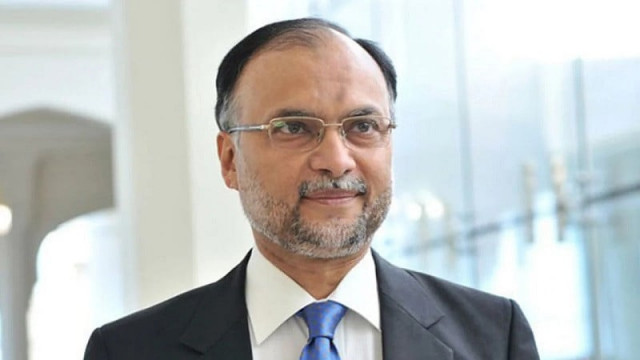
Minister for Planning, Development and Special Initiatives Professor Ahsan Iqbal on Thursday stressed the urgent need to transform Pakistan’s higher education system into a driver of national development, innovation and economic growth, asking that universities must move beyond paper-based research to produce solutions with real-world impact.
In his opening remarks at the National Leadership Dialogue – From Knowledge to Impact, organised by the Pakistan Institute of Development Economics (PIDE), the minister said Pakistan’s development visions, including Vision 2010, Vision 2025, and now Uraan Pakistan, reflected a consistent resolve to build human capital, despite repeated disruptions.
“We tried to move forward through Vision 2025, but it was disrupted. Now we are once again trying to move in that direction through Uraan Pakistan,” he said, adding that earlier initiatives had nevertheless laid the foundations of today’s higher education system.
Recalling his tenure during Vision 2010, Ahsan Iqbal said Pakistan faced an acute shortage of qualified faculty. “At that time, there were only around 350 PhDs in science and technology, and nearly 65 to 70% were close to retirement,” he noted.
To address this, he said, the government approved two major initiatives, including the overseas scholarship scheme for 5,000 PhDs and the indigenous PhD scholarship programme for another 5,000 scholars.
“These 10,000 PhDs today form the backbone of our human resource base on which the system stands,” he said, adding that continuity of policy was critical for long-term gains.
Read: Dow University awards degrees to 2,894 graduates
The minister said higher education funding was also significantly enhanced during Vision 2025. “When we took charge, the Higher Education Commission was practically shut down, and its development budget was around Rs10 to 11 billion. We raised it to Rs45 billion and introduced major reforms to make higher education inclusive and competitive,” he said.
Explaining the reform agenda, he said a two-tier university system was envisaged: one focused on broad-based access and success, and another “premier league” of universities competing globally in advanced research and academic excellence.
He added that national centres in emerging fields such as artificial intelligence, cybersecurity, big data, cloud computing, quantum computing and nanotechnology were also initiated.
Highlighting international collaboration, Ahsan Iqbal said programmes like the US-Pakistan Knowledge Corridor and the UK-Pakistan Knowledge Gateway were launched to bridge Pakistan’s human resource gap. “Our higher education participation rate is only 13 per cent, compared to 25 per cent in Bangladesh and 60 per cent in China. This gap is holding back our expansion,” he said.
The minister expressed concern that much of Pakistan’s research remained confined to academic journals. “We suffer from what I call academic inflation. Papers are published, but ideas that can contribute to national development are missing,” he said, calling for a shift towards innovation, commercialisation and industry linkages.
Read more: HEC announces scholarships for Balochistan students
He stressed that universities must become “innovation engines, startup launchpads and policy think tanks,” capable of addressing national challenges in agriculture, industry and technology, while also producing ethically grounded and socially responsible citizens.
Ahsan Iqbal said the government was developing a seven-pillar performance audit framework for universities, covering academic excellence, research and innovation, industry linkages, community contribution, technology enablement, governance and quality of graduates.
“Our universities must transition into institutions of national development, and this transition has to be made in emergency mode,” he said.











This material may not be published, broadcast, rewritten, redistributed or derived from. Unless otherwise stated, all content is copyrighted © 2026 The Express Tribune.




COMMENTS
Comments are moderated and generally will be posted if they are on-topic and not abusive.
For more information, please see our Comments FAQ