Pakistan Navy conducts successful live firing of indigenous anti-ship missile
Updated 45 minutes ago

Steel and stone structures tell forgotten tale of engineering brilliance
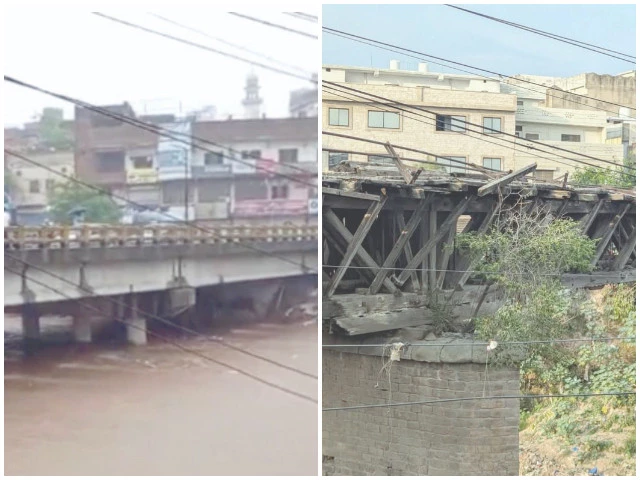
For generations, Nullah Leh — infamous for its destructive monsoon floods — has carved a path through the heart of Rawalpindi, effectively dividing the city into two. To reconnect the urban fabric on either side, a network of bridges has spanned this watercourse, many of which stand as remarkable relics of colonial and pre-colonial architecture. Today, the 16-kilometre stretch of Nullah Leh is crossed by a dozen bridges — both major and minor — many between 135 and 160 years old.
These bridges, with lengths ranging from 500 to 700 feet and widths of 40 to 80 feet, are elegant fusions of Mughal, indigenous, and British design. They connect Rawalpindi's core areas — linking the historic city to the Cantonment — and, before Partition, Rawalpindi to the rural settlements that now form Islamabad's periphery. Though some bridges have fallen into disrepair or disappeared entirely, others still bear the hallmarks of their era — with carved stonework, iron trusses, and wooden beams echoing long-lost craftsmanship.
Following the British annexation of Punjab in 1849, Rawalpindi was designated a key military garrison. By 1851, it had become the headquarters of the British Northern Command. Infrastructure followed swiftly, and in 1890, the colonial authorities constructed the first iron lattice (truss) bridge at Ganjmandi. It connected the growing city to the military barracks and railway quarters in Westridge. Across the bridge lay Serai Bally Ram — an area once likened to Lahore's Heera Mandi — a thriving colonial-era bazaar that remained active for nearly 35 years. While the market has since given way to workshops and light industry, the name still lingers in local memory.
In 1976, a new dual-carriageway concrete bridge was constructed alongside the Ganjmandi truss bridge, rendering the older iron structure obsolete. Today, the old bridge, built from solid iron and native deodar wood, survives as an architectural artefact — sturdy enough to support the weight of a small vehicle.
CitySaddar Road Bridge: Arguably the oldest surviving crossing, originally wooden and pre-dating British rule. Rebuilt multiple times over the last 150 years, it now lies in a dangerously dilapidated state. Originally constructed to provide officers and their families easy access to Raja Bazaar, it remains an important — albeit structurally compromised - link between the Cantonment and the old city.
Gawalmandi Bridge: Constructed in 1899 to connect Liaquat Road with Gawalmandi in the Cantonment, this bridge was rebuilt after the 1950 and 2001 floods. It now serves as the central monitoring point for Nullah Leh during flood emergencies, with its own dedicated system installed.
Dhok Ratta Bridge: Built during the colonial period in 1899, originally from wood and iron. It was reconstructed in concrete in 1951. This bridge links Raja Bazaar, Dhok Ratta, Transit Camp, and Westridge.
Dhok Charag Din Bridge: Originally a rudimentary rope-drawn palanquin crossing, it was later replaced with wood and metal, then upgraded to a reinforced concrete two-lane bridge in 2004.
While some of these bridges have been maintained or rebuilt over the decades, others have been neglected or entirely replaced. Ironically, the colonial-era bridges — built from hand-forged steel and native hardwood — have proven more resilient than many modern structures. Wooden planks remain un-rotted, iron joints unsullied by rust. In stark contrast, several newer Pakistani-built bridges have required repeated rebuilding due to flood damage and structural failure.









This material may not be published, broadcast, rewritten, redistributed or derived from. Unless otherwise stated, all content is copyrighted © 2026 The Express Tribune.












COMMENTS
Comments are moderated and generally will be posted if they are on-topic and not abusive.
For more information, please see our Comments FAQ