Three die in British navy helicopter crash
Updated 6 hours ago

Funerals begin for Jewish victims as pressure mounts over firearm access and extremist warning
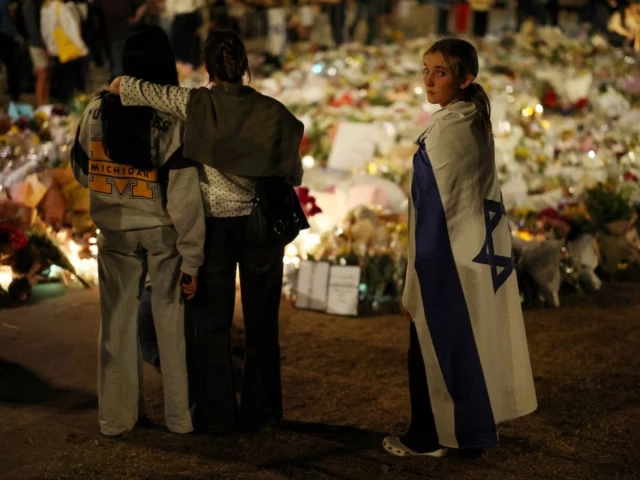
The leader of Australia’s New South Wales (NSW) state said on Wednesday he will recall parliament next week to pass wide-ranging reforms of gun and protest laws, days after the country’s deadliest mass shooting in three decades.
The alleged father-and-son perpetrators opened fire on a Jewish Hanukkah celebration on Sydney’s famed Bondi Beach on Sunday, an attack that shook the nation and intensified fears of rising antisemitism and violent extremism.
Funerals of the Jewish victims began on Wednesday, amid anger over how the gunmen — one of whom was briefly investigated for extremist links — were allowed access to powerful firearms.
NSW Premier Chris Minns told a news conference that parliament would return on December 22 to hear “urgent” reforms, including capping the number of firearms a single person can own and making certain types of shotguns harder to access.
The state government will also consider reforms to make it harder to hold large street protests after terror events to prevent further tensions.
Read: Bondi Beach attack suspect travelled on Indian passport
“We’ve got a monumental task in front of us. It’s huge,” Minns said. “It’s a huge responsibility to pull the community together. I think we need a summer of calm and togetherness, not division.”
Surviving alleged shooter to be charged
Sajid Akram, 50, was shot dead by police at the scene. His 24-year-old son, Naveed Akram, emerged from a coma on Tuesday afternoon after also being shot by police.
Prime Minister Anthony Albanese said earlier on Wednesday the surviving gunman would be charged within hours. However, NSW Police Commissioner Mal Lanyon said police were still waiting for medication to wear off before formally questioning him.
Akram remains in a Sydney hospital under heavy police guard.
Australian police said the attack appeared to be inspired by Islamic State. The accused men had travelled to the southern Philippines — a region long plagued by Islamist militancy — weeks before the shooting.
US President Donald Trump told a Hanukkah event at the White House late on Tuesday that he was thinking of the victims of the “horrific and antisemitic terrorist attack”.
“We join in mourning all of those who were killed, and we’re praying for the swift recovery of the wounded,” he said.
Funerals begin
A funeral for Rabbi Eli Schlanger, an assistant rabbi at Chabad Bondi Synagogue and a father of five, was held on Wednesday.
Schlanger was known for his work for Sydney’s Jewish community through Chabad, a global organisation fostering Jewish identity and connection. He travelled to prisons and met Jewish residents in Sydney’s public housing communities, Jewish leader Alex Ryvchin said earlier this week.
Albanese is facing criticism that his centre-left government did not do enough to prevent the spread of antisemitism in Australia during the two-year Israel-Gaza war.
“We will work with the Jewish community. We want to stamp out and eradicate antisemitism from our society,” Albanese told reporters.
The government and intelligence agencies are under pressure to explain why Sajid Akram was allowed to legally acquire the high-powered rifles and shotguns used in the attack. The government has already promised sweeping reforms to gun laws.
Akram’s son was briefly investigated by Australia’s domestic intelligence agency in 2019 over alleged links to Islamic State, but there was no evidence at the time that he posed a threat, Albanese said
Man praised as hero to undergo surgery
Albanese said Ahmed al-Ahmed, 43, who tackled one of the shooters to disarm his rifle and suffered gunshot wounds, was due to undergo surgery on Wednesday.
Al-Ahmed’s uncle, Mohammed al-Ahmed, speaking from Syria, said his nephew left his hometown in Idlib province nearly 20 years ago to seek work in Australia.
“We learned through social media. I called his father and he told me that it was Ahmed. Ahmed is a hero, we’re proud of him. Syria in general is proud of him,” he told Reuters.
Read More: Bondi Beach attack suspect travelled on Indian passport
The family of 22-year-old police officer Jack Hibbert, who was shot twice and had been on the force for just four months, said he had lost vision in one eye and faced a “long and challenging recovery”.
“In the face of a violent and tragic incident, he responded with courage, instinct and selflessness, continuing to protect and help others whilst injured, until he was physically no longer able to,” the family said.
Health authorities said 22 people remained hospitalised across Sydney.
Holocaust survivor among victims
Other victims included a Holocaust survivor, a husband and wife who first approached the gunmen before they started firing, and a 10-year-old girl named Matilda, according to officials and media reports.
Matilda’s father told a Bondi vigil on Tuesday night he did not want his daughter’s legacy forgotten.
“We came here from Ukraine … and I thought that Matilda is the most Australian name that can ever exist. So just remember the name, remember her,” local media quoted him as saying.
On Wednesday, swimmers gathered at Bondi Beach and observed a minute’s silence.
“This week has obviously been very profound, and this morning I definitely feel a sense of the community getting together,” said Archie Kalaf, a 24-year-old Bondi resident. “Everyone’s grieving, everyone’s understanding and processing it in their own way.”








This material may not be published, broadcast, rewritten, redistributed or derived from. Unless otherwise stated, all content is copyrighted © 2026 The Express Tribune.

COMMENTS (1)
Comments are moderated and generally will be posted if they are on-topic and not abusive.
For more information, please see our Comments FAQ