Textile, mining ties pitched to Chinese firms
Updated 4 hours ago

Tax authority pauses rates raised by up to 1,250% over fairness concerns
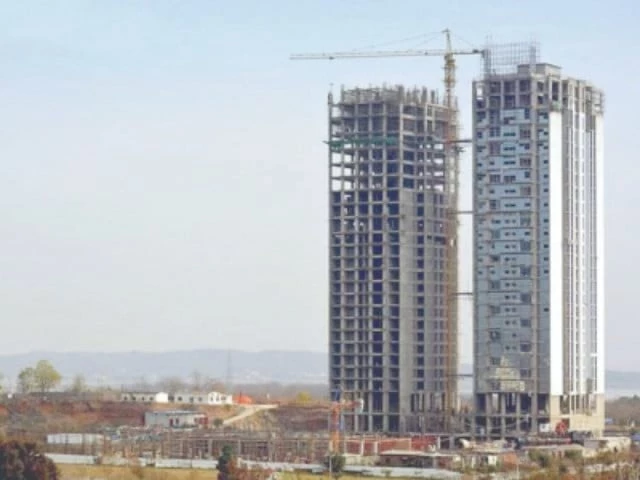
The Federal Board of Revenue (FBR) on Tuesday suspended the fresh property valuations for the collection of withholding taxes in the Islamabad Capital Territory (ICT) after taxpayers raised a hue and cry over increases of up to 1,250% in valuations, which they said lacked any rational basis.
The development comes on the heels of Rs103 billion in income tax collection from the real estate sector during the first five months of the current fiscal year, which is 18% higher than the last fiscal year, despite depressed market conditions. The FBR had to put on hold its one-week-old statutory regulatory order (SRO), which had again abnormally increased property valuation rates for Defence Housing Authority (DHA) projects by up to 168%, after hiking them barely a year ago.
"The SRO 2392 dated 8.12.2025 is hereby held in abeyance till 31.1.2026 or issuance of a revised SRO notifying fair market values of immovable properties of Islamabad, whichever is earlier," according to an announcement by the FBR. The FBR determines property valuations for the purpose of collecting federal taxes. It collects withholding tax ranging from 4.5% to 11.5% on the sale of property and from 2.5% to 18.5% on the purchase of property. Heavy taxation, coupled with a slow market, has pushed investors away from the real estate sector.
According to provisional figures, the government collected Rs71.5 billion from the sale of properties during the July-November period, up by Rs28 billion, or 66%, over the same period last year. It also collected Rs31.3 billion from the purchase of properties, which was down by Rs12 billion, or 28%.
Details showed that in last week's notification, the FBR had abnormally increased valuations, particularly for residential and commercial areas under development. Valuations were raised by up to 900% for the C-sector, while those for the B-sector were increased by up to 150%.
In the F-sector, which is the posh area of Islamabad, valuations were jacked up by up to 1,250% in one go.
In DHA areas, the government had increased valuation rates in November last year as part of a notification issued for the Rawalpindi region. However, within a year, rates for DHA projects were again increased in the range of 87% to 168%. The FBR statement said that real estate associations and other stakeholders approached the tax authority to revisit the valuation table, as certain areas reflected values higher than actual market prices. The FBR said it examined some cases and found that "the objections raised by the real estate associations were found to be correct". Therefore, it decided to re-evaluate the valuation table for District Islamabad.
The statement further said that valuation tables had been revised for the whole of Pakistan in November last year, except for District Islamabad due to a pending Federal Tax Ombudsman complaint. Subsequently, SRO 2392 was notified last week for the fair market values of immovable properties in Islamabad.
The FBR is facing serious challenges in achieving its targets despite handing over 1,000 cars to its officers and increasing their salaries by up to 400% based on performance. The FBR chairman informed the prime minister last week that the downward tax collection target may be missed by over Rs560 billion if the Attorney General of Pakistan did not help settle Rs200 billion worth of court cases.
Its inability to meet targets, despite taking advice from foreign consultants, is now placing a burden on existing taxpayers. The national coordinator of the Special Investment Facilitation Council, Lt General Sarfraz Ahmed, has said that existing taxpayers, particularly industrialists, are facing an undue burden. Ahmed advocated lowering tax rates to ease the problems of existing taxpayers.
Pakistan has already committed to the International Monetary Fund (IMF) that it would introduce a mini-budget in case of a revenue shortfall during the first half of the current fiscal year. The agreed contingency measures would again put pressure on existing classes of taxpayers, including farmers and bank depositors.
However, FBR Chairman Rashid Langrial said last month that despite reaching an understanding with the IMF, there would be no need for a mini-budget.







This material may not be published, broadcast, rewritten, redistributed or derived from. Unless otherwise stated, all content is copyrighted © 2026 The Express Tribune.














COMMENTS (1)
Comments are moderated and generally will be posted if they are on-topic and not abusive.
For more information, please see our Comments FAQ