Oil prices dip, most stocks rise on lingering Iran peace hopes
Updated 56 minutes ago

As early sowing is about to begin, seed tax continues to haunt farmers
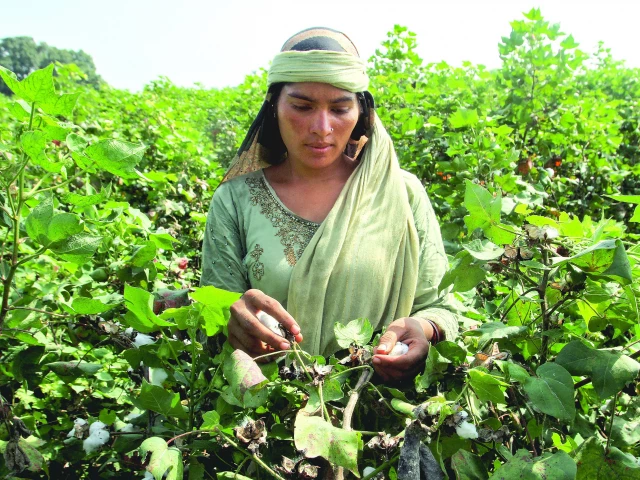
As early cotton sowing is expected to kick off within a few weeks across South Punjab and Sindh, farmers are heading into the fields carrying more than seeds. They are bearing a tax burden that many say could determine whether they should plant cotton in the upcoming Kharif season.
This tax pressure, however, is not the only concern in their minds, they have also to bear high input costs, which have now become a new normal, and after completing the crop cycle, they will once again have to sell their crop in the market or to the middleman with the apprehension of not getting a fair price. Many farmer lobbies are consistently demanding that the federal and provincial governments establish a mechanism to save the declining cotton crop and are asking for different waivers, one of which is scrapping the 18% general sales tax (GST) on locally produced cotton and oilcakes.
"The Ministry of Finance and the Federal Board of Revenue should immediately issue a Statutory Regulatory Order to remove the 18% GST on locally produced cotton seeds and oilcakes," said Pakistan Business Forum Punjab President Malik Talat Suhail. The demand comes at a time of acute urgency, when the Punjab government has set an early cotton cultivation target for 0.7 million acres. It has also made various promises like turning the Bahawalpur Division into a cotton valley by launching a project worth Rs2 billion. The scale of last season's failure was alarming.
The Federal Committee on Agriculture (FCA) had set overall production target of 10.18 million cotton bales from plantations over 2.2 million hectares for the 2025-26 season, but actual output came in at 6.85 million bales, which was 34% below the target.
Suhail argued that the timing of relief matters as much as the relief itself. "If the government truly intends to revive cotton and meet the national production target, it must immediately issue the SRO to withdraw GST. This step will directly support farmers and encourage increased cultivation," he said.
The GST burden falls at the worst possible time in the production cycle, adding to input costs when farmers are most financially stretched. Farmers warned that cotton was the lifeline of Pakistan's economy and the country could not afford to treat it as a secondary priority any more. The continued decline in domestic production is already pushing the textile industry, which depends on cotton as its primary raw material, towards expensive imports. For growers in the cotton belt, this is not an abstract policy debate. Muhammad Aslam, a cotton farmer from South Punjab who cultivates around 20 acres, said they were being taxed on the seed before it was even planted in the ground.
"Last year, we lost money despite working the entire season; yes flood was also one of the reasons. If the government does not help us now, many of us will switch to sugarcane production or leave the land idle. Cotton farming is becoming a punishment," he remarked. The farmer community thinks the crisis in cotton is not simply due to changing weather patterns; it is due to deeper structural failures, weak pest surveillance systems, poor seed quality, inadequate mechanisation and the politically driven expansion of sugarcane cultivation into prime cotton acreage. In Punjab alone, the decline in cotton cultivation has coincided with a 22% increase in the area under alternative crops such as sugarcane, rice, maize and sesame.
The PBF also called on seed regulatory authorities to fast-track the approval of new, high-yielding and climate-resilient cotton varieties. The National Biosafety Committee has recently approved a triple-trait genetically engineered cotton variety, a development that could improve pest resistance and yields if adoption is scaled up quickly.
Suhail stressed the need for a centralised governance framework backed by reliable data to guide cotton policy, warning that without structural reform and consistent policy direction, restoring economic resilience to the agriculture sector will remain extremely difficult.
The government, he said, must reset agricultural priorities and break the grip of vested interests that had long favoured sugarcane at the expense of cotton.













This material may not be published, broadcast, rewritten, redistributed or derived from. Unless otherwise stated, all content is copyrighted © 2026 The Express Tribune.









COMMENTS
Comments are moderated and generally will be posted if they are on-topic and not abusive.
For more information, please see our Comments FAQ