Alerts
 
< >

A simple solution to Pakistan’s economic conundrum

Published: June 17, 2012

All our efforts should push for policies that help realise our growth potential.
KARACHI: 

An emerging economy, by definition, has the potential to grow more significantly than a developed economy. If Pakistan is one, then, logically speaking, all our efforts should push for a proper policy framework that will help us realise this underlying growth potential.

During the 2008 global supply shocks, concerns over the dollar to rupee exchange rate depreciation and inflationary pressures were pushed to centre stage in Pakistan. These became a source of fear to policy makers, who clung to the general mantra of curbing inflation. The prescribed antidote was monetary tightening, which has since been complemented by calls from the IMF to withdraw subsidies.

The prescription was more ad hoc than well thought out, since it fundamentally failed to achieve what it set out to do – ie, attract more foreign exchange so that foreign exchange reserves were adequately replenished to support the value of the rupee and restrain the second bout of inflation that would have been caused by its depreciation.

This is an apt example of how inert economic theory can be in achieving economic targets, when implemented in true word and spirit. Even at a discount rate of 15%, real interest rates in Pakistan remained negative. In addition to that, unusual increases in interest rates can also have the signalling effect of economic distress; something far from helpful for any economy.

Let’s walk through a simple example of a hypothetical company with high financial leverage to see what can be presumed to have happened. The company records sales of Rs10 billion; assets of Rs12.5 billion (based on an asset turnover of 0.8, which is usual for a manufacturing concern); interest rate (pre-monetary tightening) 10%; interest rate (post-monetary tightening) 15%; debt to assets ratio of 50% (within State bank’s limit of up to 80%); an earnings before interest and taxes (EBIT) margin of 12%; and a tax rate of 35%. The result is given in Table One above.

The interest rate hike substantially decreases net profitability and the interest coverage ratio, making the company less palatable not only for an equity investor but also for debt providers. Given this, it is not surprising that not only did FDI, but private sector credit growth also has gradually dried up since the central bank took a hawkish monetary policy stand.

Now complement this with another policy: that of withdrawing energy subsidies. Withdrawal would have the effect of reducing gross and EBIT margins, pushing companies even more out of profitability. Any adjustments in prices charged to consumers would result in inflationary pressure. Perhaps these are some of the reasons why core inflation in Pakistan has been stubborn and remained in double digits.

A very simple solution to Pakistan’s economic revitalisation is that of combined monetary and fiscal stimulus. Obviously, the delicate balance between the much-needed stimulus and extravagance will need to be managed with extreme caution, finesse and responsibility.

Having lower interest rates seems to be a good means to breaking the pervasive economic stupor. The solution, however, seems too obvious to be believable. Let us see how it would work: the results are summed up in the flow-chart above.

A simple hypothetical example in Table Two illustrates the type of relationship between M2, productivity and inflation that is being proposed here. Velocity of money is assumed to be 1, so M2 is equal to Nominal GDP.

M2 is a category within the money supply that includes all physical money such as coins and currency demand deposits, in addition to all time-related deposits, savings deposits, and non-institutional money-market funds.

The calculations in Table Two are under a scenario where the home currency is not appreciating as a result of increased economic growth and FDI; in which case the real GDP growth would sustain at a higher level and inflation would tend to fall earlier. The GDP per capita would grow five times by the end of the fifth year, bringing Pakistan into the mid-level per capita income bracket.

This seems to be quite an achievable feat. A feat that is going to transform the entire perception of Pakistan on the global economic landscape, and which may catapult Pakistan into a vibrant growth story.

Caveats

Policy to focus on value addition ie  import of raw material, value addition in Pakistan, and export of value added finished products. In order for economic growth to be sustainable, such an economic transition is extremely important.

Extremely strong regulatory framework to keep speculative activity in check, especially in assets whose supply is naturally limited; eg real estate.

Pakistan should not choke gas supply to industries. The estimated recoverable gas reserves are 27 trillion cubic feet. The annual consumption is 1.2 trillion cubic feet, at which rate the reserves can last for almost two decades. Isn’t that enough to plan and arrange supply of alternate fuels?

THE WRITER IS A CORPORATE FINANCE AND ADVISORY MANAGER IN THE INVESTMENT BANKING GROUP OF SAMBA BANK LIMITED

Published in The Express Tribune, June 18th, 2012.

on Twitter, become a fan on Facebook

Reader Comments (34)

  • Jun 17, 2012 - 8:31PM

    Energy is the number one issue for Pakistan’s economy today.

    Energy costs have had a huge impact on Pakistan’s economy. Its heavy dependence on imported oil has been a big contributor to balance of payments crises in the past. In 2008, for example, the oil prices jumped from less than $50 a barrel to $150 a barrel and forced the country to seek IMF bailout. Pakistan oil import bill has increased from about $7 billion in 2007 to over $12 billion in 2011. Energy shortages have also put a significant dent in Pakistan’s GDP growth.

    Instead of addressing different pieces of the energy puzzle in an ad hoc fashion under multiple ministries and bureaucracies fighting turf battles, Pakistani policy makers need to look at the big picture for the sake of the nation’s future. Nothing short of a holistic approach with a comprehensive energy policy formulated and implemented under a competent and powerful energy czar will do.

    http://www.riazhaq.com/2012/06/comprehensive-energy-policy-for.html

    Recommend

  • Jun 17, 2012 - 8:33PM

    Among all the politicians and dictators Musharraf has earned high regard not because of economic growth but due to giving Media Freedom, development in social sector, introducing local Government system and restoring Pakistan’s credibility in International world.

    Recommend

  • obaid
    Jun 17, 2012 - 9:46PM

    A very simple solution to Pakistan’s economic revitalisation is that of combined monetary and fiscal stimulus

    Fiscal or monetary stimulus with all the supply constraints would only fuel inflation. How can a government that is running deficits even manage a fiscal stimulus. To undertake a stimulus It would have to borrow or print money which could lead to crowding out of private investment and stagflation. Deficit financing is not the answer nor it is sustainable.

    Pakistan should not choke gas supply to industries
    Needless to say

    Policy to focus on value addition ie import of raw material
    Needless to say

    WHAT ABOUT THE TAX REVENUES?

    Recommend

  • Rebel
    Jun 17, 2012 - 10:37PM

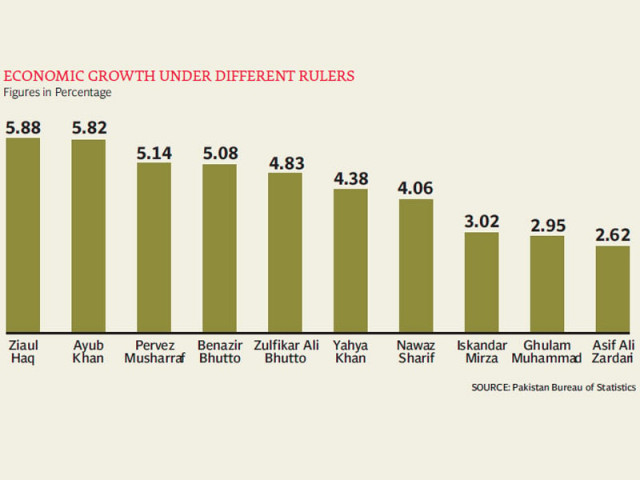
    Looking at the chart it seems that dictators are the best solution for our country’s falling economy…….simples …. (:

    Recommend

  • Nadir
    Jun 17, 2012 - 10:48PM

    Errr…where are Tables 1 and 2 you refer two? All these napkin calculations are well in good, but thats about it, all good in numbers alone.Recommend

  • Arnold
    Jun 17, 2012 - 10:56PM

    where are the tables you are referring to ?

    Recommend

  • Pak Liberal
    Jun 17, 2012 - 11:12PM

    but “democracy” and civilian rule is more important. I can’t define either, but just trust me, i know english.

    Recommend

  • Pakistani
    Jun 17, 2012 - 11:26PM

    We as a nation must come out of strategic fevers ,and give full focus on Economy first then Education and research

    Recommend

  • Munir
    Jun 17, 2012 - 11:27PM

    Guys, where are the CHARTS??? A little professionalism plz

    Recommend

  • left
    Jun 17, 2012 - 11:56PM

    On the note about dictators: Economic growth doesn’t always mean prosperity or a raise in Human Development Indicators nor does it mean a raise in income for the lowest class. Economic growth doesn’t account for political oppression or violence that takes place.

    Recommend

  • Parvez
    Jun 18, 2012 - 12:20AM

    One has to have a counter for political expediency if economic growth has to take place.

    Recommend

  • S
    Jun 18, 2012 - 2:03AM

    We need to put the focus on economy, education and research. But one thing we should not forget that today all/most of our system is based on interest, we need a transition from this to Islamic banking (it arguable how Islamic it is, but still a lot better then conventional banking). We cannot progress until we follow Islam and Sunnah. We do things highly forbidden in Islam (from alcohol to interest) and hope for help from ALLAH. we need to think and decide!

    Recommend

  • fus
    Jun 18, 2012 - 2:58AM

    @ Left, my friend that is true, but even all the factors that you have mentioned ctually improved more during the time of dictators not democratic govt.

    Recommend

  • Arjun
    Jun 18, 2012 - 5:41AM

    the oil prices jumped from less than $50 a barrel to $150 a barrel and forced the country to seek IMF bailout.

    Oil prices only increased for Pakistan?

    Recommend

  • Fahad
    Jun 18, 2012 - 6:05AM

    We should distribute all money of budget on laptop and benazir income support programme.No need of dams,hospital,factories,roads,schools,electricity,gas etc. Just distribute free money,beautiful laptops,mobiles,free food etc to temprarily get more votes from people. How country can progress by distribution of mobiles,laptops,free money. Invest those money in factories and dams and give those people jobs

    Recommend

  • unbeliever
    Jun 18, 2012 - 8:36AM

    @Rebel:
    if your current democratic government starts getting aid for free from international powers then even it can take your growth rate beyond your expectations…so blaming democracy and praising dictators is not the way out.
    will you try to look for the aid to gdp ratio during these dictators rule….

    Recommend

  • saud
    Jun 18, 2012 - 9:00AM

    2.62 growth rate by current government seems like an inflated number…it should have been 0.62 percent.

    Recommend

  • Pinto
    Jun 18, 2012 - 9:06AM

    The problem with pak is that all the people sitting in the parliament is currept.you need few honest,intelligent people both in parliament and govt

    Recommend

  • Jun 18, 2012 - 9:25AM

    To each problem, there is a neat and simple solution, which is the wrong one. Calling in discretionary measures instead of rules driven policy environment is a recipe of disaster, not solution. To manage an economy is already a step towards central planning, and no agency has the ability to understand and manage a real economy. Growth is where we need to go, but must ensure a rise in average incomes along the way, and that can be achieved when there is minimal and responsible government.

    Recommend

  • saleem
    Jun 18, 2012 - 10:41AM

    A good effort,can we have the writers email for further study

    Recommend

  • Imad
    Jun 18, 2012 - 11:09AM

    but democracy was there !

    Recommend

  • no economist
    Jun 18, 2012 - 1:16PM

    the writer is not an economist yet he is offering solutions to economic conundrum.

    what insights does he have that all other trained economists with phd do not have?Recommend

  • H.A. Khan
    Jun 18, 2012 - 2:51PM

    What Pakistan really needs is a good Financial team to steer it out of this mess.
    Tax base not only needs to be broadened but also deepened.
    FBR has become dysfunctional and it needs to be massively changed

    Recommend

  • Sohail
    Jun 18, 2012 - 7:29PM

    We have paid the price of having democracy.

    Recommend

  • Hasan Ansari
    Jun 18, 2012 - 7:40PM

    It was 7% during musharraf era.

    Recommend

  • raw is war
    Jun 18, 2012 - 8:28PM

    @ Hasan Ansari

    7% population growth?

    Recommend

  • ImnIndian
    Jun 18, 2012 - 8:32PM

    a simpler solution is to make friendship with india :)

    Recommend

  • Sebastian Samuel
    Jun 18, 2012 - 11:49PM

    @obaid:
    Please have the courtesy to read articles before you post your comments. If you go through the tables and charts you can see and understand how I have argued monetary and fiscal stimuli will not actually lead to sustained inflation. If you can prove otherwise, I’ll be happy to listen to you.

    What does “needless to say” mean? My arguments can either be right or wrong. Please articulate which arguments have you found to be wrong and why?Recommend

  • Sebastian Samuel
    Jun 19, 2012 - 12:22AM

    @Nadir:
    “All these napkin calculations are well in good, but thats about it, all good in numbers alone”.

    Though numbers give objectivity to an idea being postulated, it seems (please correct me if I am wrong) you have certain scenarios in your mind where they actually don’t. Can you please share with us, for our edification, some of those scenarios? And then let’s have a discussion.

    And do you mind elaborating what actually you mean by “napkin calculations”?

    Recommend

  • Sebastian Samuel
    Jun 19, 2012 - 12:41AM

    @Nadir:

    “All these napkin calculations are well in good, but that’s about it, all good in numbers alone”.

    Though numbers give objectivity to an idea being postulated, it seems from your comment above that you have some scenarios in your mind in which the calculations I’ve made will not lend objectivity. Can you please share those scenarios and complete your argument? And then, if you want to, let’s have a discussion.

    Recommend

  • Jun 19, 2012 - 1:16AM

    @Sebastian Samuel:
    unusual increases in interest rates can also have the signalling effect of economic distress

    I dont think anyone would disagree that Pakistan economy is in dire conditions, ESPECIALLY its currency. I raised the same question in my article for TheNews that who is SBP competing against with 12% rates? And the answer is – to hide the Federal Govt’s cockroaches. Recent ONGOING devaluation is proof that even 12% isnt enough to support the Rupee. Deficit spending in an enviroment of depleted savings will never produce sustained growth.

    Till this federal black-hole deficit spending isnt stopped, interest rates, OMO by SBP, shorting NFA, nothing.. NOTHING will make a sizable ding.

    Recommend

  • Jun 19, 2012 - 4:09PM

    @Ali Salman:
    To manage an economy is already a step towards central planning, and no agency has the ability to understand and manage a real economy

    CLASSIC! Ali. Ever thought about the existence of a “Banks/Central Banks” from the prism of moral hazard?

    Recommend

  • Sebastian Samuel
    Jun 19, 2012 - 9:50PM

    @Asif:

    Tribune truncated some very important paragraphs that showed why high interest rates have been ineffective in supporting PKR. But does CAPM ring a bell?

    Also, one of the ideas I posit is that printing money will not lead to sustained inflation in a country like Pakistan which is operates at less than full/optimum employment. The tables show that for such an economy printing money is correlated with GDP growth. And once Pakistan has unlocked the GDP growth, everything else that is good for the economy is going to follow – despite leakages which can only be absent in a utopian scenario.

    Recommend

More in Business