
Beyond boundaries: ‘Pak-EU relations have moved beyond trade, aid’
Outgoing EU ambassador insists country needs to find a solution to its problems.
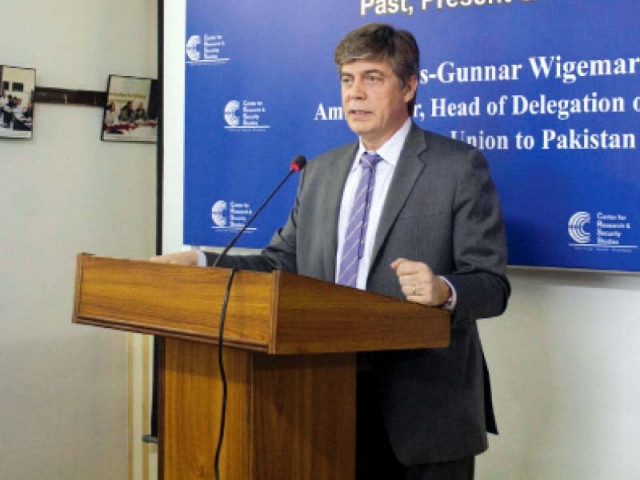
Ambassador Wigemark speaking at the discussion. PHOTO: EXPRESS
Wigemark is about to complete his four-year tenure in Pakistan.
Addressing an exclusive gathering at a roundtable discussion at the Centre of Research on Strategic Studies (CRSS), “My take on Pakistan, Past, Present, Future,” the ambassador spoke about issues pertaining to governance, the EU-Pakistan relationship, and the way forward.
He stressed that security, governance and the judicial system were important pillars of society, and that solutions for Pakistan’s problems must spring from within.
“It was important to ensure that people now are aware of the European Union with a prominent representation in Pakistan”.
Speaking about the relationship between the EU and Pakistan, he said that apart from providing Pakistan with humanitarian assistance during the floods, the union has also added Pakistan to the world’s largest trading block by giving it GSP plus status.
He added that while the GSP plus status faced severe criticism, in reality, the arrangement was “never intended to be a longer term measure”.
He said the volume of trade between the EU and Pakistan was around €1 billion in 2014, owing to autonomous trade measures.
“We cannot be blamed for all of the delays. We were stuck in the WTO for almost a year,” Wiegmark remarked.
“We do not expect miracles here…from the government’s prospective, they take it seriously and established provincial offices. The government has identified individuals and provincial GSP plus committees such as that in Punjab and they are covering a broad range of issues including women and minorities.”
The ambassador further said that the EU had developed a more strategic relationship and engagement with Pakistan since 2011- 2012. Being the largest trading block, EU has used its status to link political agendas and governance issues.
Speaking of some of his observations about Pakistan, he said that the country was suffering more due to the lack of confidence that the country has in its own institutions.
“Parliament is the centre of democracy, but it is often bypassed using executive orders and All Parties Conferences (APCs).Often this results in critical issues not being debated in parliament. It reinforces the people’s distrust of their representative prime institution.”
On the upcoming local elections, he said that the matter of local government was still not resolved. “After the elections of 2008, the EU gave 86 recommendations to help improve transparency in the elections, while 50 more recommendations were given in 2013.
He urged that change had to come from within political parties who must in turn agree on a blueprint.
Local government is absolutely essential so that MPs can focus on policy and government performance. The solutions for Pakistan’s multiple problems must spring from within, and be devolved all the way down to grassroots levels.
Regarding human rights violations, he said the EU was concerned with the lifting of the moratorium on the death penalty, cases of torture by police officials, and missing persons cases, but added that the EU is ready to engage with Pakistan in all three areas.
Published in The Express Tribune, March 18th, 2015.
LATEST
CDF Munir meets US secretary of state, German leaders on sidelines of Munich Conference
Govt decides to move Imran to hospital, constitute medical board as TTAP sit-in enters day 2

Several arrested, injured as Karachi police clash with JI protesters near Sindh Assembly

Onus on India to shake hands in T20 World Cup clash, skipper Agha says
Five raised at Punjab Child Protection Bureau Lahore begin new chapter with marriage
Pakistan, India brace for high-stakes clash
MOST READ
Gold rises Rs7,000 in Pakistan, $70 on world markets

LHC declines to stay net metering reversal
Jeffrey Epstein: Polio work, intelligence briefings and a shadowy presence in Pakistan’s tribal belt
President Zardari, PM Shehbaz congratulate BNP on landmark election victory in Bangladesh
Strategic opportunity for Pakistan



COMMENTS
Comments are moderated and generally will be posted if they are on-topic and not abusive.
For more information, please see our Comments FAQ