
No detour from economic ties with Kabul, Dehli: PM
World Bank’s managing director recognises country’s efforts, urges reform.
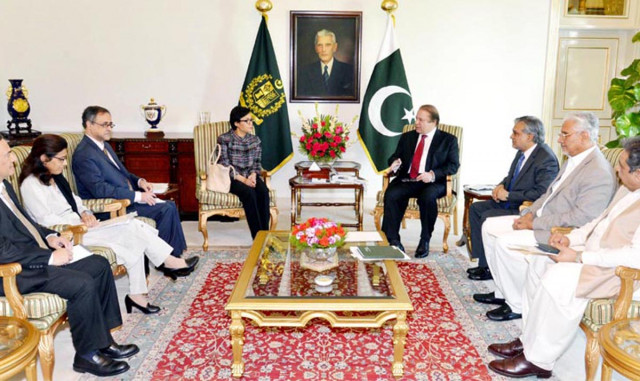
Prime minister Nawaz Sharif meeting with World Bank Chief Operating Officer Sri Mulyani Indrawati in Islamabad on Saturday. PHOTO: PID
Pakistan is keen to maintain its deepening economic relations with India and Afghanistan for a prosperous South Asian region, said Prime Minister Nawaz Sharif on Saturday while discussing his foreign policy priorities with the visiting managing director of World Bank.
PM Sharif’s comments came at a time when, despite having a strong desire to normalise trade ties with archrival India, the efforts appeared unsuccessful due to opposition by the military establishment.
Sri Mulyani Indrawati, the MD and Chief Operating Officer of the WB, met the premier and discussed her agency’s cooperation with Pakistan. The WB, the country’s second largest lender after the Asian Development Bank, is also supporting efforts to promote intra-regional trade and investing in infrastructure projects to ensure a smooth movement of goods across the borders.
Indrawati urged that despite the recent surge in the country’s foreign exchange reserves the government should stay focused on implementation of the reforms programme agreed with international lending agencies.
Pakistan’s reserves got a big boost following Saudi Arabia’s decision to release $1.5 billion in grant.
“Pakistan wants to have good relations with India regardless of whoever is in power,” read an official handout of the PM’s Office, quoting the premier as saying. PM Sharif further told Indrawati that his government believed in good relations with Afghanistan and India.
Indrawati appreciated Pakistan’s role in regional cooperation agreements on power connectivity with neighboring India, and the recently-approved transformative power transmission project, Central Asia-South Asia (CASA-1000).
PM Sharif’s efforts to normalise trade ties with India hit a snag at the eleventh hour when he had to postpone a scheduled March 20 federal cabinet meeting due to objections raised by the military establishment. According to media reports, which have not been clarified yet, a few cabinet ministers had visited General Headquarters to brief the military establishment about the plan to grant Most-Favoured Nation status to India.
The PM told Indrawati that his government has identified priorities for the next five years including plans for the energy and Infrastructure sectors. “Assistance of the WB in the priority areas would help Pakistan in achieving its development targets,” PM added.
The WB is set to approve $1.7 billion concessionary loan in May including $1 billion programme loans linked with reforms in energy and taxation areas, the two most problematic, restricting the country’s national output.
“The WB group stands ready to help Pakistan through lending, private sector involvement and knowledge support,” Indrawati was quoted as saying in a press release issued by the WB office. She said the use of $1.7 billion from IDA, the World Bank’s fund for the poorest, is part of its support to the country.
Indrawati said the money will be used for policy reforms in the energy sector, revenue mobilisation, governance, social sectors, and investment in hydropower. She said the WB’s engagement in Pakistan will continue to be guided by its principle of selectivity, operational policy, and areas of comparative advantage.
PM Sharif said that due to the rational and pragmatic economic and monetary policy of the government, the economy of Pakistan has stabilised. “We expect that foreign exchange reserves will be around $16 billion by end of this year,” the PM added.
According to the WB handout, Indrawati recognised that, despite a difficult economic situation, the government’s reforms were pointing in the right direction. “Pakistan is facing a set of very tough challenges. We see good progress in the pace and quality of the government’s action,” she said.
“Increase in the country’s reserves was a good sign. But what is critical now is to stay focused on the implementation of the reform programme and create fiscal space to sustain social protection programmes that support the poorest and most vulnerable sections of society.”
Published in The Express Tribune, March 30th, 2014.
Like Business on Facebook, follow @TribuneBiz on Twitter to stay informed and join in the conversation.




MOST READ

PIA flight lands after 21-hour delay
Trump warns of 'eliminating' Iranian ships as US naval blockade on Strait of Hormuz begins
Trump thanks Pakistan for hosting talks, announces US Navy blockade of Hormuz

Petrol drops, fares play catch-up
Trump orders naval blockade of Hormuz








COMMENTS
Comments are moderated and generally will be posted if they are on-topic and not abusive.
For more information, please see our Comments FAQ