US targets India with forced labour tariff amid talks on trade pact
Updated 7 hours ago

Current account deficit hits $1.07b as imports jump nearly 10%, FDI falls to $982m
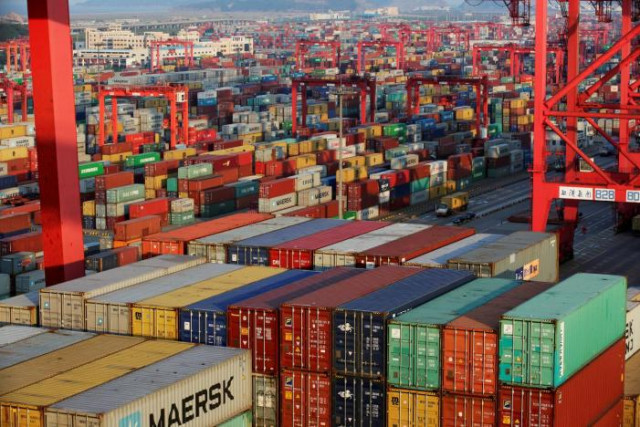
Pakistan's external account remained under pressure in the first seven months of FY2025-26, as a widening trade deficit and rising import bill outweighed gains in services exports and workers' remittances, according to the State Bank of Pakistan's (SBP) latest balance-of-payments (BoP) data released on Tuesday.
The current account posted a deficit of $1.07 billion during July-January FY26, reversing a surplus of $564 million recorded in the same period of the previous fiscal year. The deterioration reflects a sharp expansion in the goods trade gap, as imports accelerated faster than exports amid a gradual recovery in domestic demand and easing of administrative controls on inbound shipments.
Pakistan's goods trade deficit widened to $18.4 billion in Jul-Jan FY26, compared with $14.1 billion a year earlier. Exports of goods stood at $18.26 billion, slightly lower than $19.33 billion in the comparable period, while imports jumped to $36.66 billion from $33.38 billion.
The data show that export momentum weakened after a modest rebound last year, while imports rose nearly 10% year-on-year as purchases of industrial raw materials, energy products and capital goods recovered from compressed levels during the stabilisation phase.
The broader goods and services trade deficit expanded to $20.47 billion in the first seven months of FY26, compared with $15.88 billion in the same period last year. This widening gap remained the principal driver of external imbalance, despite some resilience in services exports.
Pakistan's services sector continued to show gradual improvement. Services exports rose to $5.66 billion in Jul-Jan FY26, up from $4.77 billion a year earlier, led by telecommunications, computer and information services, as well as business services.
Within services, IT and IT-enabled services remained the largest export category, reaching $2.61 billion during the period, reflecting steady global outsourcing demand and continued digitalisation of Pakistani firms.
However, the services surplus was insufficient to offset the much larger goods deficit. Services imports also increased to $7.73 billion from $6.59 billion, driven by higher transport and travel payments as economic activity picked up and overseas travel normalised.
Workers' remittances, Pakistan's largest source of external financing, rose to $23.20 billion in JulJan FY26, compared with $20.85 billion in the same period last year, according to SBP's BoP tables. These inflows lifted the secondary income surplus to $24.73 billion, providing a crucial buffer against the widening trade and income deficits.
Pakistan's primary income deficit, which includes profit repatriation by foreign investors and external debt servicing, stood at $5.33 billion in Jul-Jan FY26, slightly narrower than $5.55 billion a year earlier. The modest improvement reflects contained profit repatriation amid subdued foreign investment inflows, although interest payments on external debt remained elevated.
Combined with the goods and services gap, the balance on goods, services and primary income recorded a deficit of $25.8 billion during the period.
On the financing side, the financial account posted a net outflow of $1.35 billion in JulJan FY26, compared with an outflow of $756 million in the same period last year, indicating continued external financing constraints.
Foreign direct investment (FDI) inflows fell to $982 million in the first seven months, down from $1.66 billion a year earlier, reflecting cautious investor sentiment and slower project execution. Portfolio investment also remained negative, with net outflows of $463 million, largely due to external debt security repayments exceeding new inflows.
Other investment flows, mainly loans and deposits, showed a net outflow of $1.02 billion, highlighting continued reliance on official financing and debt rollovers rather than private capital.
Despite the current account deterioration, Pakistan's overall balance recorded a deficit of $653 million in Jul-Jan FY26, significantly narrower than the $1.39 billion deficit in the same period last year, reflecting financing inflows and valuation adjustments.
As a result, SBP's foreign exchange reserves rose to $17.44 billion by end-January FY26, up from $12.67 billion a year earlier. Net SBP reserves, excluding certain adjustments, reached $16.16 billion, indicating improved external liquidity.
The reserve buildup was supported by multilateral and bilateral disbursements as well as improved current transfers. Government external loan disbursements totalled $3.32 billion during Jul-Jan FY26, exceeding amortisation of $2.83 billion and generating a net positive flow.














This material may not be published, broadcast, rewritten, redistributed or derived from. Unless otherwise stated, all content is copyrighted © 2026 The Express Tribune.






COMMENTS
Comments are moderated and generally will be posted if they are on-topic and not abusive.
For more information, please see our Comments FAQ