
Inspiring: Inquisitive minds transcend boundaries
Speaker advises students to follow footsteps of giants of physics, mathematics.
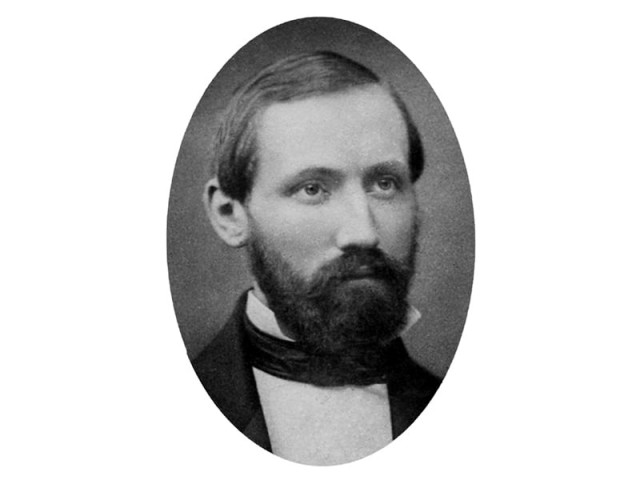
Friedrich Bernhard Riemann
For some curious people who have the ability to stretch the boundaries of their minds to its limits, scientific and mathematical discoveries come naturally. They might not even need to spend loads of cash on, our so called, formal education — provided they are consistent.
This was the crux of a lecture delivered at the Pakistan Academy of Sciences on Tuesday by Dr Zafar Iqbal, an adviser at the Physics Department of COMSATS Institute of Information Technology (CIIT). The lecture titled “Shoulders of the Giants — Lives of some of the all time greats in Maths and Physics” was aimed at shedding light on the life of legendary mathematicians and physicists to inspire the students in attendance.
Talking about the life of Carl Friedrich Gauss, Iqbal informed the participants that the ‘Prince of Mathematics’ was not born with a silver spoon in mouth. The lecture gradually moved towards other legends in the field. Georg Friedrich Bernhard Riemann’s journey towards becoming a member of Berlin Academy in 1959, and his discovery of prime numbers and The Riemann Hypothesis also came under discussion.
“He investigated the Riemann zeta function and established its importance for understanding the distribution of prime numbers. Besides he also made a series of conjectures about properties of the zeta function — one of which is the well-known Riemann hypothesis,” informed Iqbal who then moved on to share the life and ideas of Johannes Diderik van der Waals.
The Dutch physicist and Nobel laureate, who did not even make it through tenth grade, famously worked out an equation on the state of gases and liquids. “He did not have any education in the Greek and Latin Languages — something that was mandatory to get into a university — but keeping his promising talents in view, the University of Lleida in Spain took him in,” he stated.
At the time when the existence of molecule was still a disputed affair, Waals not only wrote on their existence but also asserted that they are of finite size and attract each other, according to the lecture.
About English theoretical physicist Paul Adrian Maurice Dirac, the CIIT Physic adviser said due to the post-war depression he was unable to find work as an engineer until he shared his celebrated work of Dirac Equation and Seminal Distinction which led to prediction of positron.
The last giant of physics in the lecture was Richard Phillips Feynman who was unable to utter a word till his third birthday. “His father Melville encouraged him to ask questions to challenge orthodox thinking in 20th centaury. Later, he established a laboratory at home and would be delighted in repairing radios,” Iqbal narrated while explaining how Feynman Diagrams cleared the path for Integral formulation of Quantum Mechanics. “He was also fond of cracking safes of senior army staff at a project in Mexico.”
These people changed the perception of research and progress in the fields of physics and mathematics and earned both, name and fame because of their dedication to work and a love for their skills, Iqbal said before concluding with a phrase universally true: “It always pays to be a hard worker.”
Published in The Express Tribune, December 25th, 2013.
LATEST

Pakistan 'always ready' for India despite late green light: Agha
Mohsin Naqvi briefs PM Shehbaz on national, Islamabad security

Babar Azam urges calm as Pakistan brace for high-stakes India clash

Treaty breaches erode global law, says Yousaf Raza Gilani

Second marriage without consent makes husband liable for full dower, LHC rules

Petrol, diesel prices likely to increase from February 16
MOST READ

Gold steady in global, local markets as silver gains
PMDC issues show-cause notices to 12 institutions charging fees beyond Rs1.8m cap

Is another judicial murder in the making?

Pakistan successfully launches its second indigenous Earth Observation Satellite

Bangladesh's BNP wins historic parliamentary election







COMMENTS
Comments are moderated and generally will be posted if they are on-topic and not abusive.
For more information, please see our Comments FAQ