US-Iran deal vital to easing global financial crises: Turkish foreign minister
Updated 14 minutes ago

Bahrain demands UN action, compensation for Iranian attacks
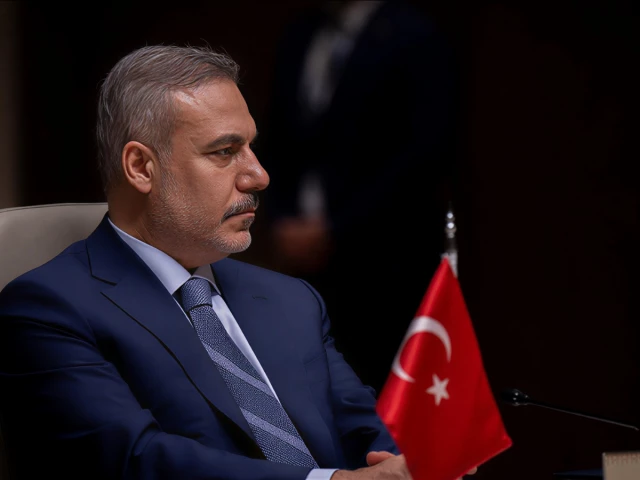
Turkish Foreign Minister Hakan Fidan said on Saturday that a potential agreement between Washington and Tehran carries critical weight for alleviating global economic strain beyond reopening the Strait of Hormuz.
"Hopefully it will succeed. We are also doing everything we can. A US-Iran agreement is not only important for opening the Strait of Hormuz. In fact, it is important in the sense of rolling back global financial crises somewhat," Fidan told Turkish broadcaster TGRT Haber.
Warning that the fallout from the Iran war threatens international markets, Fidan said: "The economic burden brought by this war and lack of resolution is getting harder every day for many countries. It is heading toward having very destructive effects."
He said diplomatic efforts around the Strait of Hormuz, a strategic waterway vital to global energy shipments, remain active, with messages and demands passing between the parties even though the process currently seems deadlocked.
Confirming that mediation efforts are continuing, Fidan noted that he recently discussed the crisis with Qatari Prime Minister and Foreign Minister Mohammed bin Abdulrahman Al Thani.
Fidan also outlined a two-track framework for addressing disputes involving Iran, arguing that questions surrounding Tehran's nuclear program can be handled within the US and UN frameworks.
Other regional issues tied to Iran, however, should be addressed directly by regional countries rather than outside actors, he said.
Saying that in the past resolving regional disputes was left to hegemonic powers, Fidan stressed the importance of regional states developing the political will to find solutions to their own problems.
Bahrain demands UN action, compensation for Iranian attacks
Bahrain demanded early on Sunday that Iran be held accountable and pay full compensation for attacks on the kingdom, urging firm action by the UN Security Council.
In a statement, the Foreign Ministry rejected Tehran’s justification for the attacks, saying that an industrial facility recently hit was civilian.
It accused Iran of using disputes with other countries as a pretext to attack Bahrain, endanger civilians. and violate the Gulf state’s sovereignty.
Bahrain reserves the right to defend itself, alone or with its allies, at a time and place of its choosing, said the ministry.
Bahrain says Iranian attack hits industrial facility as air defences intercept attacks
Bahrain said on Saturday that an Iranian attack had hit a civilian industrial facility, causing a fire but no injuries, while Iran's Revolutionary Guards said they launched a missile-and-drone attack on US military positions in the kingdom, home to the US Navy's Fifth Fleet.
The incidents were the latest escalation of regional hostilities since the US and Israel attacked Iran in February. Since then, Gulf Arab states have been drawn into the conflict, and there have been repeated Iranian attacks across the region.
Civil Defence teams were working to contain the fire at the industrial facility, the ministry said in a post on X. It gave no details on the location or nature of the site.
Bahrain's interior ministry initially issued an alert urging residents to move to the nearest safe location because of a potential threat, without providing details. It later issued an all-clear before sending a second alert.
Later, Bahrain's Defence Force said its air defences had intercepted a number of Iranian aerial attacks. Shrapnel from the interceptions caused material damage but no casualties, it said, adding that Tehran was continuing its "systematic hostile approach" towards the kingdom.
The Revolutionary Guards, in a statement carried by Iranian state news agency IRNA, said their aerospace forces had launched a combined missile-and-drone attack on US positions at the Al-Riffa and Awali bases "in retaliation for ongoing aggression and repeated violations of Iranian airspace."
US Central Command did not immediately respond to a Reuters request for comment on the Guards' account.
Qatari defence minister, CENTCOM chief hold talks in Doha amid regional tensions
Qatari Deputy Prime Minister and Defence Minister Sheikh Saoud bin Abdulrahman Al Thani met with Adm. Brad Cooper, chief of the US military’s Central Command (CENTCOM), in Doha on Saturday to discuss issues of mutual interest, said Qatar’s Defense Ministry.
No further details on the meeting were provided.
The visit followed Cooper’s talks in Riyadh with Saudi Crown Prince Mohammed bin Salman and Defense Minister Khalid bin Salman on defense cooperation and regional developments.
Cooper’s visits come amid continuing tensions between the US and Iran, with negotiations stalled on disagreements on navigation through the Strait of Hormuz.
Meanwhile, hostilities have escalated between Saudi Arabia and Yemen’s Houthi group, whose missile and drone attacks have targeted the kingdom’s energy facilities and other sites.














This material may not be published, broadcast, rewritten, redistributed or derived from. Unless otherwise stated, all content is copyrighted © 2026 The Express Tribune.






COMMENTS
Comments are moderated and generally will be posted if they are on-topic and not abusive.
For more information, please see our Comments FAQ