Minister schools Indian media over 'terror mantra'
Updated 17 minutes ago

FO rebuffs Delhi over mineral wealth
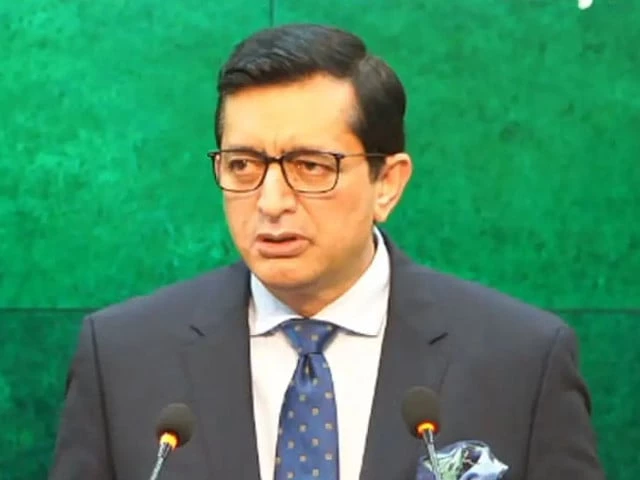
Pakistan on Friday strongly rejected India's remarks at a recent United Nations Security Council Arria-formula meeting on natural resources, describing them as an attempt to interfere in its internal affairs.
Responding to India's criticism, Sajjad described the remarks as "undiplomatic and irresponsible" and said they had already been effectively rebutted by Pakistan's representative at the meeting.
"Such baseless accusations merit no attention and were instantly and effectively rebutted by the representative of Pakistan during the same meeting," Foreign Office spokesperson Sajjad Haider Khan said during his weekly news briefing.
"Such diatribe, so typical of India, can only be rubbished," he added.
Sajjad said India's hostility towards Pakistan's development of its mineral resources was reflected in its persistent efforts to undermine the country's stability.
He said India was sponsoring terrorist activities in Balochistan and Khyber Pakhtunkhwa to disrupt development and deprive local populations of the benefits of their natural resources.
Sajjad also linked the Indian remarks to the longstanding dispute over the Indus Waters Treaty, saying New Delhi was weaponising shared resources.
Referring to the August 31, 2026 ruling by the Court of Arbitration constituted under the treaty, he said the court had unanimously ruled that the agreement remained binding and fully in force.
He said India's refusal to accept the ruling raised serious questions about its commitment to international law and treaty obligations.
The spokesperson also called on India to implement UN Security Council resolutions on Jammu and Kashmir, reiterating Pakistan's position that the dispute should be resolved through a UN-supervised plebiscite.
On regional cooperation, Sajjad said Pakistan wanted Afghanistan to become a peaceful, stable and prosperous country and eventually integrate fully into the Economic Cooperation Organisation (ECO).
However, he said Afghanistan's membership remained suspended and its participation in ministerial-level meetings was subject to the host country's discretion.
Explaining why Afghanistan was not invited to the 30th ECO Council of Ministers meeting held in Islamabad on November 15-16, he said Pakistan had not recognised the incumbent Afghan regime.
He added that meaningful regional cooperation required the Afghan authorities to address neighbouring countries' legitimate security concerns, particularly terrorism emanating from Afghan soil.
On the ongoing tensions in the Middle East, the spokesperson said Pakistan remained actively involved in mediation efforts between Iran and the United States.
He said the recent visit of Iranian Foreign Minister Abbas Araghchi to Islamabad included meetings with the country's leadership, including Prime Minister Shehbaz Sharif and Chief of Defence Forces Field Marshal Asim Munir.
"Pakistan continues to be an active part of the mediatory efforts," he said.
Sajjad also acknowledged that implementation of the Islamabad Memorandum of Understanding, signed electronically by Iran and the United States, remained stalled despite Pakistan's efforts to bring the two sides to the negotiating table.
"The foundation for a peaceful region has already been established," he said, expressing hope that both sides would find ways to resolve their differences on the basis of the MoU.
Separately, Pakistan condemned Israel's latest military incursion into central Gaza, describing it as a serious violation of the ceasefire agreement.
The spokesperson said continued Israeli military action was undermining international efforts to consolidate peace and called for the protection of Palestinian civilians and unhindered humanitarian assistance.
He reiterated Pakistan's support for the Palestinian right to self-determination and a two-state solution.
The spokesperson also welcomed the meeting of the leaders of the United States, China and Russia in Shenzhen, describing it as a positive development that could help ease tensions among major powers and promote global peace.
He said Pakistan greatly appreciated the engagement, noting that dialogue among major powers was in the interest of all countries, particularly developing nations.
"This is a positive development because what we have witnessed in recent decades is an increase in confrontation among major powers," he said.
"As a result, it is becoming increasingly difficult for smaller powers to align themselves or maintain a balance," he added.
He said it was encouraging that leaders of major global powers were sitting together to discuss their differences and explore peaceful solutions.
"When these important global powers sit together and discuss issues, or resolve to address their differences peacefully, it is good news for all countries, including Pakistan," Sajjad said.
The spokesperson was responding to questions about the high-profile trilateral meeting in Shenzhen, China, involving US President Donald Trump, Chinese President Xi Jinping and Russian President Vladimir Putin. The meeting has drawn international attention amid growing geopolitical tensions and concerns about the risk of a wider confrontation among major powers.
Asked how Pakistan could benefit from the emerging engagement among the three powers, Sajjad said Islamabad had traditionally maintained good relations with all major global players.
"Even today, and prior to this trilateral meeting, Pakistan enjoys excellent relations with the United States, while China remains our strategic partner," he said.
He added that any positive outcome from discussions among the major powers would benefit developing countries, as the world needed peace.







This material may not be published, broadcast, rewritten, redistributed or derived from. Unless otherwise stated, all content is copyrighted © 2026 The Express Tribune.





COMMENTS
Comments are moderated and generally will be posted if they are on-topic and not abusive.
For more information, please see our Comments FAQ