46% blame taxes for rising petrol prices
Updated 39 minutes ago

Invites Turkmenistan to join Central Asia-South Asia power transmission project
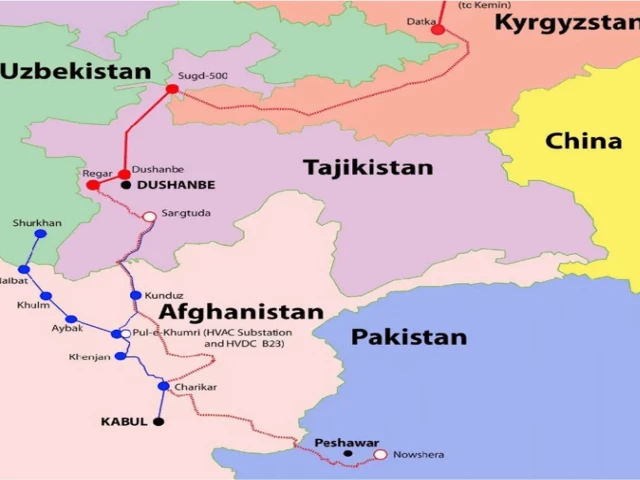
Pakistan has offered Turkmenistan to join the Central Asia-South Asia (CASA) 1,000-megawatt electricity supply project, originating in Tajikistan. Already, Islamabad has given its backing to Tajikistan and Kyrgyzstan for exploring the potential of extending the CASA-1,000 power transmission line to Uzbekistan and Turkmenistan.
The project has been designed to transmit up to 1,300 MW of electricity, mainly during summer months. Of the total, 300 MW will be provided to Afghanistan whereas Pakistan will receive 1,000 MW.
Pakistan, Tajikistan, Afghanistan and Kyrgyzstan are key partners in the project. The transmission line will pass through the Taliban-controlled Afghanistan. Tajikistan has already built a transmission line for electricity import by Afghanistan and the CASA project will supply additional electricity to Kabul.
According to the World Bank's January 2026 update, infrastructure development in Pakistan, Kyrgyzstan and Tajikistan has largely been completed. Afghanistan remains the critical missing link where construction resumed in December 2024.
In a meeting on Monday, Federal Minister for Power Division Awais Ahmad Khan Leghari invited Turkmenistan Minister of Energy Annageldi Saparov to join the CASA-1,000 project. Both sides held detailed discussions on bilateral cooperation in the energy sector and regional grid connectivity. The Turkmenistan-Afghanistan-Pakistan (TAP) power transmission project was a key focus of the meeting.
Leghari shared that Pakistan had encouraged Tajikistan and Kyrgyzstan to explore the possibility of extending the CASA-1,000 transmission line to Uzbekistan and Turkmenistan. He noted that future industrial and commercial activities in Gwadar would spark an extraordinary surge in electricity demand, for which additional electricity would be required.
He proposed that Iran and Turkmenistan could evaluate the potential of enhancing the electricity transmission capacity for Gwadar through the Iranian grid. A joint group of experts from both countries can deliberate on this proposal.
The Power Division minister stated that Pakistan was committed to integrating regional energy markets and providing affordable electricity. He emphasised that economic and financial viability was essential for the success of projects like TAP and CASA-1,000. "This approach ensures that end-consumers get the direct benefit."
The federal minister highlighted that currently Pakistan's power generation was in surplus and it was introducing a competitive energy market. He pointed out that CASA-1,000 was operating on a one-way electricity flow system. "Converting it into a two-way flow will enable the power exchange during times of need. It will also make the project more economically and financially sustainable."
Regarding the TAP project, Leghari stated that seven fundamental technical datasets were required for progress. Pakistan has already provided three datasets; however, the exchange of requisite technical information from Turkmenistan needs to be expedited. He proposed convening a meeting of technical working groups of both countries, which would help chalk out a clear roadmap within a few weeks.
On the occasion, Turkmenistan Minister of Energy Annageldi Saparov reiterated his country's firm resolve to complete the TAP power transmission project. He pointed out that the project would provide electricity to over 300 million people in the region, adding that Turkmenistan had already completed the transmission line up to Afghanistan.
The remaining phases and feasibility assessment of a 1,150-kilometre-long, 500-kilovolt (1,200MW capacity) project from Afghanistan to Quetta will be taken forward through the technical working group.
He gave assurances that Turkmenistan would share the requisite data soon and he would personally oversee the resolution of matters related to the TAP project. Both sides agreed to maintain regular online and in-person contact between their focal persons. These interactions will help resolve technical issues, complete the feasibility study and materialise the project.
Bilateral trade, investment
Federation of Pakistan Chambers of Commerce and Industry (FPCCI) President Atif Ikram Sheikh and Turkmenistan Chamber of Commerce Chairman Gurdov Mergen Meretdurdyevich agreed to strengthen bilateral trade and economic relations through enhanced business cooperation, investment partnerships and regular exchanges of business delegations, adds APP.
The understanding was reached during a meeting at the FPCCI House, which focused on exploring new avenues of trade, investment and institutional collaboration between the business communities of the two countries. Both sides agreed to enhance cooperation between the FPCCI and the Turkmenistan Chamber, with particular emphasis on establishing stronger institutional linkages, facilitating business-to-business contacts and promoting joint investment initiatives.








This material may not be published, broadcast, rewritten, redistributed or derived from. Unless otherwise stated, all content is copyrighted © 2026 The Express Tribune.






COMMENTS
Comments are moderated and generally will be posted if they are on-topic and not abusive.
For more information, please see our Comments FAQ