UK police question Nato-assigned US soldier
Updated 41 minutes ago

.
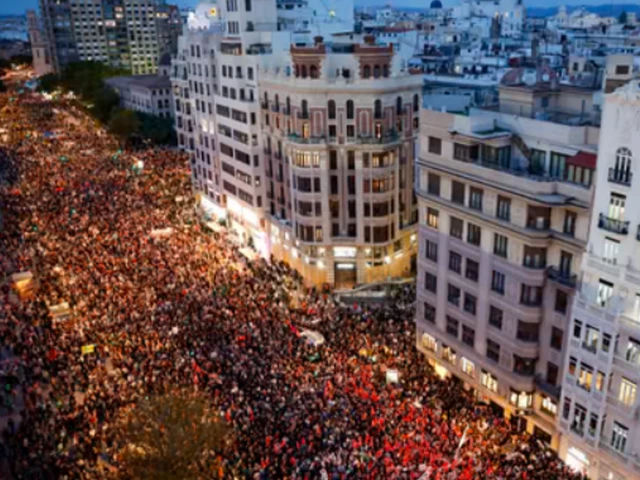
Tens of thousands of protesters marched across Spain on Wednesday during a general strike over housing affordability and purchasing power just weeks before an early general election.
Unions reported a significant response in some sectors in Spain's first nationwide 24-hour stoppage since 2012, but business leaders played down the participation.
Braving pouring rain, some 120,000 demonstrators marched through central Madrid carrying placards shaped like houses and chanting "We have no home" as they called for more affordable housing, according to an estimate by the authorities.
"People work a lot and it isn't enough to pay the rent, to pay for a house," Paula Diaz, a 25-year-old theatre technician who lives with her parents, told AFP at the Madrid protest.
"I hope a government that benefits us comes to power, especially the working class," she added, referring to the November 29 election.
In Barcelona, where the authorities estimated 55,000 people marched through the city's luxury Passeig de Gracia commercial thoroughfare, Maria Pinana told AFP "the law of supply and demand does not apply to housing".
"The price of rents should be regulated," said the 34-year-old microbiologist, who lives with friends in a flat where parts of the ceiling have collapsed.
Thousands more attended smaller protests held in other cities across Spain.
The size of the demonstrations was seen as an indicator of public discontent before the snap election, where the right-wing opposition is predicted to defeat Socialist Prime Minister Pedro Sanchez.
Some incidents of violence broke out after the Barcelona rally, where AFP journalists saw groups of hooded and masked protesters hurl projectiles at police and burn rubbish bins.
In Madrid, where many shops opened as normal, demonstrators earlier on Wednesday blocked some roads, picket action that was replicated across the country.
Public transport suffered disruption even with the implementation of minimum service requirements for commuter trains, metros and buses, especially in and around Barcelona.
In contrast, Madrid's metro reported that 93 percent of its trains ran in the early morning, although passenger numbers were down by around half.
UGT union leader Pepe Alvarez told public broadcaster RTVE that the participation was "massive", with a "total" stoppage in some regions making the strike "a huge success".
But his union acknowledged participation was "uneven", with large mobilisation in the car manufacturing, petrochemicals and meat sectors and in coastal regions.
The CEOE organisation, which represents business leaders, called the strike "a failure", adding in a statement that activity had gone ahead normally in most sectors.
Electricity demand had fallen by around five percent, "significantly lower" than in previous strikes, the CEOE said.
The main UGT and CCOO unions called the strike following a wave of nationwide protests over access to housing, sparked by the eviction in September of an 87-year-old Madrid pensioner.
Valeria Racu, spokeswoman for the Madrid Tenants' Union which has been at the forefront of protests for weeks, vowed to "put an end to the housing business in this country".
"A new cycle is beginning with trade unionism and conflict at its centre. This day of strikes has been a resounding success," she said. AFP












This material may not be published, broadcast, rewritten, redistributed or derived from. Unless otherwise stated, all content is copyrighted © 2026 The Express Tribune.







COMMENTS
Comments are moderated and generally will be posted if they are on-topic and not abusive.
For more information, please see our Comments FAQ