Hina Altaf shares uncomfortable experience during flight, calls out man for repeatedly staring at her
Updated 51 minutes ago

The actor said Zaryab’s changing relationship with faith is her choice, not a cue to judge other women either
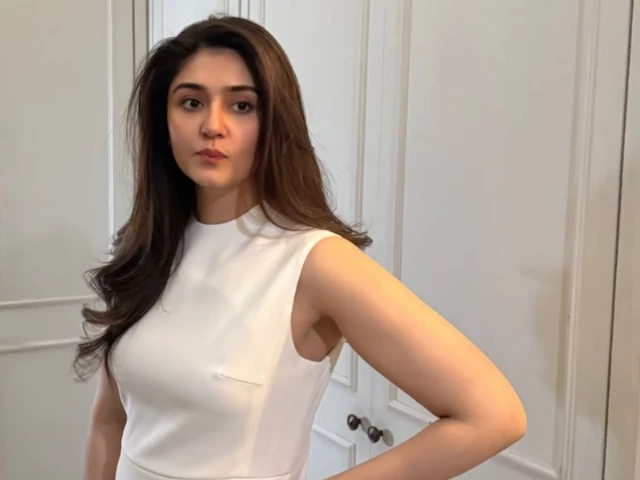
Durefishan Saleem has a message for those questioning Zaryab's latest clothing decision in Dar-e-Nijaat: a woman's right to choose what she wears must extend in every direction. Whether she finds comfort in sleeveless outfits or chooses to dress more modestly, neither decision should become an invitation for public scrutiny.
The actor took to Instagram to address the conversations surrounding the drama's recent episode, sharing a photograph of herself in a sleeveless outfit alongside a series of slides explaining Zaryab's decision. Making it clear that the character's choice was neither imposed by her husband Abu Bakr nor a declaration about how other women should dress, Saleem emphasised that it was simply part of Zaryab's personal journey.
In her caption, she wrote: "Knew Zaryab long before you all did. Maybe that’s why she was both the easiest and the most difficult character I’ve ever played <3"
Beginning her note with her understanding of faith, Saleem explained that spirituality, to her, is fundamentally an internal process.
"I have always believed that the truest form of faith begins with an internal transformation. It is about what changes within you, how you see the world, how you treat people, the values you begin to hold yourself accountable to, and the relationship you build with Allah," she wrote.
She added that faith was as much about working on one's inner self as it was about everything practised outwardly. Sometimes, she explained, that internal transformation naturally begins to reflect in a person's external choices, including the way they dress.
Saleem then addressed the apparent contrast between her personal wardrobe and Zaryab's decision, clarifying that she herself wears sleeveless clothes and has always been comfortable doing so. However, shorter dresses and certain other styles make her personally uncomfortable.
"That's my personal relationship with modesty, and someone else's may look very different to it," she explained.
"But that doesn't give me the right to question or judge their choices. What I wear, what makes me comfortable and what I may choose to change someday are all part of my own internal journey and my relationship with Allah. It doesn't make their choices wrong, nor does it make mine right", she added.
She also stressed that Zaryab's decision should not necessarily be interpreted as a declaration about anyone else's choices.
"What I find important here is that Zaryab's choice is not necessarily a declaration about anyone else's choices. It is a reflection of something she may have felt within herself. Perhaps her understanding of faith is evolving, perhaps her priorities are changing, or perhaps she has simply reached a point where this is what feels right to her",
Saleem went on to make a point about the selective nature of conversations around women's freedom.
"We spend so much time defending a woman's right to choose how she dresses, but that freedom must extend in every direction. It must include the woman who chooses to dress freely and the woman who finds comfort in not wearing a sleeveless. Neither woman should have to justify herself to the other", she said.
"The issue has never been whether a woman chooses to dress freely or modestly. The issue arises when we begin questioning, scrutinising or judging her choices instead of simply respecting them," she added.
Acknowledging that viewers are entitled to their own interpretations of the character, Saleem said audiences could look at Zaryab's choices through their own moral lens, disagree with them or question their timing.
"That's your perspective, and you're entitled to it".
She also suggested that perhaps audiences could take a step back from treating every fictional character's personal decision as a matter requiring a public verdict.
"And perhaps we can take a little break from treating every fictional character's personal decision as a matter requiring a national referendum. Not every character arc needs a panel discussion, a jury and a final verdict from the internet."
Concluding her note, Saleem reminded viewers that they did not have to agree with Zaryab or relate to her experiences to respect her journey.
"You don't have to agree with Zaryab, you don't have to relate to her, and you certainly don't have to make her journey your own. Not every story has to become a lesson for us. Sometimes, it is simply someone else's story", she said.
The discussion follows a recent episode of Dar-e-Nijaat, in which Zaryab declines to wear a sleeveless outfit for a family gathering, explaining that she no longer feels comfortable dressing that way. The moment prompted mixed reactions from viewers, with some appreciating it as a reflection of her evolving relationship with faith, while others questioned the implications of the storyline.
Starring Durefishan Saleem as Zaryab Habib alongside Sheheryar Munawar as Abu Bakr, the drama explores faith, relationships and personal transformation. Written by Umera Ahmed and directed by Saqib Khan, the series follows Zaryab's emotional and spiritual journey, including the ways in which her experiences shape her understanding of herself and her relationship with Allah.
But perhaps the conversation surrounding this particular episode says as much about audiences as it does about the character.
A woman choosing to dress modestly should not have to defend that decision any more than a woman choosing to wear sleeveless clothes. And when either woman changes her preferences, she should not suddenly find herself answerable to an entire comment section.
Durefishan's point is not that viewers must agree with Zaryab. It is that disagreement should not become an excuse to police another woman's choices.
Perhaps the simplest takeaway is also the most difficult one for social media to accept: not every woman's decision needs our approval, and not every fictional character's journey needs our verdict.






This material may not be published, broadcast, rewritten, redistributed or derived from. Unless otherwise stated, all content is copyrighted © 2026 The Express Tribune.



COMMENTS
Comments are moderated and generally will be posted if they are on-topic and not abusive.
For more information, please see our Comments FAQ