Turkish parliament approves Makkah defence pact with Pakistan, Saudi Arabia
Updated 43 minutes ago

Lawmakers endorse measure by 279 votes to 119, with 398 of chamber’s 592 members taking part in ballot
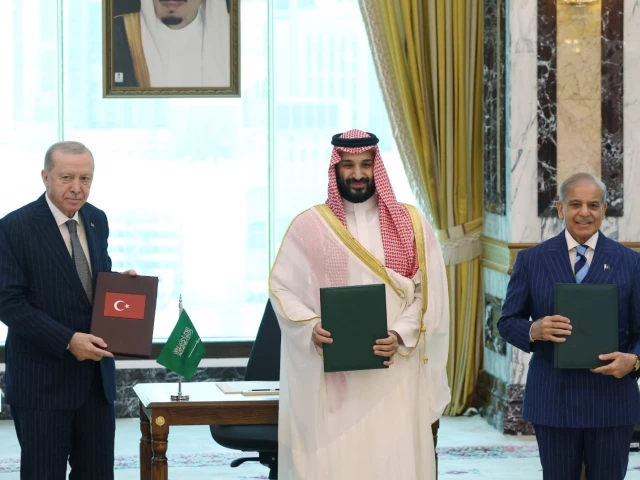
The Turkish parliament on Thursday approved a bill ratifying the Makkah Agreement on Joint Defence between Turkiye, Pakistan and Saudi Arabia, clearing the way for the trilateral security pact to take effect.
Lawmakers endorsed the measure by 279 votes to 119, with 398 of the chamber’s 592 members taking part in the ballot.
The measure, formally titled the Bill on the Approval of the Makkah Agreement on Joint Defence between the Turkiye, Pakistan and Saudi Arabia, passed after a lengthy debate among parties.
📜 Turkish parliament approves Mecca Joint Defense Agreement with Pakistan and Saudi Arabia, clearing way for trilateral pact to take effect
— Anadolu English (@anadoluagency) November 5, 2026
🤝 Signed on Aug. 7 in Mecca, agreement aims to strengthen collective security, expand defense cooperation and prevent regional conflicts… pic.twitter.com/RTdeZuMUib
During the debate, ruling Justice and Development (AK) Party lawmaker Ziya Altunyaldiz stressed that the agreement aims to expand security cooperation in the region. He emphasised that it contains no approach against any third country and that its main goal is to prevent conflicts rather than escalate them.
Opposition speakers raised reservations about the pact’s scope and oversight. Mehmet Guzelmansur of the Republican People’s Party (CHP) said clear rules are needed so the agreement does not contradict Türkiye’s other international obligations.
Read: Turkish parliament adopts first article of Makkah defence pact bill
On October 20, Turkiye had submitted the pact to its parliament for ratification. Turkiye's constitution requires separate permission from parliament to deploy troops abroad regardless of any international agreement.
On September 23, the government appointed Lt Gen Mahmood as the first secretary general of the Makkah Joint Defence Agreement (MJDA).
The appointment was the first major institutional development since Pakistan, Saudi Arabia and Turkiye signed the pact, and his appointment gives Pakistan the responsibility of establishing and leading the alliance's first secretariat during its formative three-year period.
The decision was taken at the inaugural meeting of the Strategic Political and Defence Committee, held under the MJDA, which brought together the foreign and defence ministers and military chiefs of the three countries in Istanbul on August 31.
Under the arrangement agreed in Istanbul, the secretary general would head the alliance's General Secretariat, based in the Saudi capital and tasked with overseeing implementation of the agreement, coordinating joint activities among the three militaries and supporting expanded defence-industrial cooperation.
For Islamabad, the role also provides an opportunity to shape the working structure of the new defence arrangement as Pakistan, Saudi Arabia and Turkiye move from the political commitment announced in Makkah towards a more organised mechanism for defence coordination.
Significance of the Makkah Joint Defence Agreement
Pakistan, Turkiye and Saudi Arabia signed the defence agreement at a trilateral summit in Makkah on August 7, pledging to strengthen collective security, deepen defence cooperation and promote peace and stability in the region and beyond.
The MJDA was the latest step in longstanding military and strategic cooperation between Pakistan, Saudi Arabia and Turkiye. The pact establishes a framework for collective deterrence and stipulates that an armed attack on any one of the three countries would be considered an attack on all three, while providing for wider cooperation across defence.
Read More: Pakistan, Saudi Arabia, Turkiye sign joint defence pact in Makkah
The agreement followed nearly a year of negotiations and came amid heightened instability across the Middle East. Turkiye and Pakistan had sought closer regional security cooperation, while Saudi Arabia had faced growing security concerns as conflicts spread across the region, threatening its territory, energy infrastructure and ambitious economic development plans.
The three countries already had extensive military links. Pakistan had provided training and technical assistance to Saudi forces for decades, while Islamabad and Ankara had maintained close defence ties through military training, naval cooperation and defence equipment. In 2023, Saudi Arabia agreed to purchase Turkish drones in what Ankara described as its largest defence export contract.







This material may not be published, broadcast, rewritten, redistributed or derived from. Unless otherwise stated, all content is copyrighted © 2026 The Express Tribune.





COMMENTS
Comments are moderated and generally will be posted if they are on-topic and not abusive.
For more information, please see our Comments FAQ