Defiant petrol pumps face licence axe
Updated 27 minutes ago

Seeks report on areas not requiring army deployment Hundreds of PTI workers' detention cases affected Lawyers
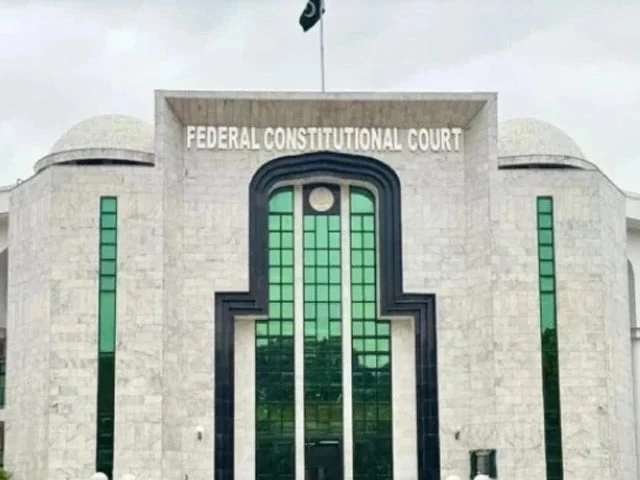
The Federal Constitutional Court (FCC) has suspended proceedings before the Peshawar High Court (PHC) in cases instituted under Article 199 of the Constitution on or after October 12, following the deployment of armed forces in Khyber-Pakhtunkhwa to act in aid of civil power in a development that affects challenges to the preventive detention of hundreds of PTI workers under the Maintenance of Public Order Ordinance (MPO).
A division bench comprising FCC Chief Justice Aminuddin Khan and Justice Aamir Farooq issued the four-page order while hearing a petition filed by the K-P government challenging interim orders of the PHC directing executive authorities to release hundreds of PTI workers detained under the MPO.
The court also directed the Advocate General K-P to submit a report within seven days identifying areas where the armed forces were no longer required to act in aid of civil power, saying it would consider modifying the order after examining the report.
"Since the Armed Forces have been called to act in aid of civil power in the entire Province of Khyber Pakhtunkhwa pursuant to the order dated 11.10.2026 issued under Article 245 and office memorandum of the Ministry of Defence dated 12.10.2026, the proceedings before the learned Peshawar High Court instituted under Article 199 on or after 12.10.2026 shall, in terms of clause (4) of Article 245, remain suspended," the order stated.
The FCC also issued notices to the respondents in the case. Noting that important constitutional questions were involved, the bench directed that a notice also be issued to the Attorney General for Pakistan under Order XXVII-A of the Code of Civil Procedure, 1908.
During Thursday's hearing, the Advocate General K-P argued that the high court had disregarded the express provisions of Article 245 by entertaining petitions after the deployment of troops under the constitutional provision on October 12.
He submitted that, under clause (3) of Article 245, the PHC could not exercise jurisdiction under Article 199 in areas where armed forces were acting in aid of civil power.
The advocate general further argued that the high court had rendered a valid law, the MPO, redundant, although the legislation specifically provided for preventive detention to maintain public order and tranquillity.
He also contended that the high court had granted final relief at the interim stage, which was otherwise impermissible.
The FCC observed that the points raised by the Advocate General required serious consideration.
"Prima facie, clause (3) of Article 245 is not an ouster clause in the nature as it appears elsewhere in the Constitution, such as Article 236(2), where despite an ouster, the courts have examined the constitutionality of any proclamation issued under Part X of the Constitution."
The order further observed that clause (3) of Article 245 addressed a particular situation that was emergent but temporary in nature. Consequently, the restriction on the exercise of judicial jurisdiction would remain in force for as long as the armed forces continued to act in aid of civil power.
The court said these and other questions raised in the proceedings required careful examination and an authoritative pronouncement by the FCC.
Lawyers question constitutional implications
Reacting to the order, Barrister Sarwar Muzaffar Shah described it as astonishing and worrying, arguing that it had far-reaching implications for the enforcement of fundamental rights in the province.
"It has suspended the implementation of all fundamental rights in the entire province of Khyber Pakhtunkhwa," said Barrister Sarwar Muzaffar Shah.
"In these 3-MPO cases, the court was required to primarily examine only one of the fundamental rights, namely Article 10, which guarantees safeguards against arrest and detention, among the many fundamental rights guaranteed by our Constitution."
"However, with one sweeping order, the FCC has effectively suspended the implementation of all fundamental rights, including the right to education, inviolability of dignity, equality of citizens, freedom of speech and expression, freedom of association, freedom of trade, freedom of movement, freedom of assembly, the right to information, and others," he said.
"Even military dictators of the past could not achieve what today's order of the FCC has achieved," he added.
He also pointed to another possible implication of the order, saying it could make it easier for the incumbent regime to submit its response to petitions concerning the alleged disappearance of Chief Minister Sohail Afridi and Speaker Babar Saleem Swati.
He said the government could simply maintain that the two had been detained under the 3-MPO law, thereby arguing that the PHC was barred from hearing the petitions.
Advocate Abdul Moiz Jaferii said the reasons behind the federal government's successive constitutional measures against the K-P government were becoming increasingly apparent.
"Emergency with governor rule on top, followed shortly thereafter by the governor asking the army to act in aid of civil power under article 245," he added.
Jaferii further argued that constitutional provisions intended to protect emergency military action from judicial review were now being used to shield the actions of commissioners and the bureaucracy under colonial-era laws.
"And right on cue, the FCC steps in to stop the Peshawar High Court from doing the little that it was doing: undoing the colonial-era MPO detentions where they didn't make any sense," he added.
Advocate Maha Raja Tareen said the FCC order barring the PHC from hearing petitions under Article 199 was unfortunately reminiscent of the "doctrine of necessity" under the garb of which courts had been usurping the fundamental rights of Pakistan's population.
However, lawyer Hafiz Ehsaan Ahmad Khokhar said the order raised substantial constitutional questions concerning emergency governance, military deployment, preventive detention and judicial oversight.
He said the FCC's intervention provided an important opportunity for an authoritative interpretation of the constitutional relationship between Articles 232, 234, 245 and 175E(5), alongside the statutory framework of the MPO.
Ultimately, constitutional restrictions must be given effect according to their precise language and scope, he said, adding that judicial review of jurisdictional illegality and violations of mandatory legal safeguards must remain available wherever the Constitution permits.









This material may not be published, broadcast, rewritten, redistributed or derived from. Unless otherwise stated, all content is copyrighted © 2026 The Express Tribune.







COMMENTS
Comments are moderated and generally will be posted if they are on-topic and not abusive.
For more information, please see our Comments FAQ