Hello Kitty maker Sanrio cuts ties with TV spy show after China backlash
Updated 2 hours ago

Actor says Abu Bakr’s people-pleasing and saviour complex shape his choices in 'Dar-e-Nijaat'
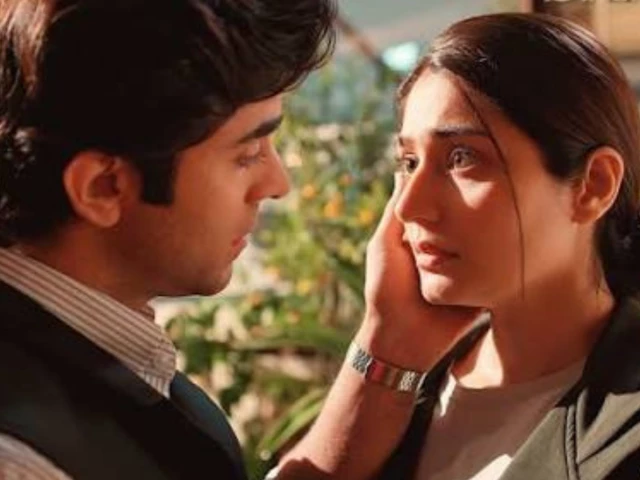
Sheheryar Munawar believes Abu Bakr’s desire to do the right thing does not make him a perfect man. The actor sees people-pleasing and a saviour complex as two of the character’s biggest flaws in Dar-e-Nijaat, offering a more complicated reading of his relationship with Zaryab and the choices he makes.
As the drama continues to spark conversations about love, heartbreak, morality and redemption, Munawar explained in an interview with BBC Asian Network that Abu Bakr’s behaviour is shaped by years of emotional attachment, ingrained expectations and the pressure to live up to what he believes is right.
“He’s not perfect. No, nowhere is this guy perfect,” Munawar said. “Do I feel like Abu Bakr has flaws? Yes, I do.”
For the actor, Abu Bakr’s good intentions do not make him immune to mistakes. His tendency to please others and his compulsion to rescue those around him create their own complications, making him a character whose intentions and actions must be considered separately.
Munawar also explained that Abu Bakr’s feelings for Zaryab were never as straightforward or as recent as they might appear on screen. “Abu Bakr has always loved Zaryab. That’s how I’ve played it,” he said.
According to Munawar, Abu Bakr’s affection had been present long before it became apparent in the story. The actor interpreted the character as someone who had quietly observed Zaryab over time, even as he tried to convince himself that she was not the kind of person he should want.
“They’ve been going to the house and he was probably sneaking a few looks here and there, always. His heart is probably in a certain manner, but his mind tells him that this is not the girl, and that’s where we have that scene where he says, ‘I don’t want a girl who’s like this’,” he said.
For Munawar, the conflict between Abu Bakr’s heart and mind is central to the character. His feelings are already there, but he struggles to reconcile them with his own ideas of what he should want. “And he’s got it on his fingertips because he’s thought about it,” the actor said, adding, “In his heart, he’s always liked this girl.”
Munawar pointed to the first time Abu Bakr and Zaryab went out for lunch as an example of how the drama had hinted at his feelings. “The first time they go out for lunch, he’s like, ‘You like pasta, right?’ She says, ‘How do you know?’ He says, ‘Khishwar Khala had mentioned it once’,” he recalled.
For the actor, the exchange was a deliberate clue to the history of Abu Bakr’s affection, suggesting that he had paid attention to Zaryab in ways he might not openly acknowledge. “Why would I remember if I didn’t like this girl?” he said. “I’ve thrown these hints everywhere, and that’s how it makes sense.”
Munawar’s explanation offers another way to read the relationship. What might initially appear to be a sudden romantic development is, in his interpretation, the culmination of feelings that have quietly existed in the background.
However, emotional sincerity does not automatically make Abu Bakr uncomplicated or beyond criticism. Munawar identified people-pleasing as one of the character’s most significant flaws, describing the burden it places on those who struggle to disappoint others.
“He’s a people pleaser, and I think that’s huge. I mean, imagine what a person has to live with, the kind of burden that person has to live with. Some people are people pleasers. I’m a people pleaser, and I know that I have a tough time saying no,” he said.
The admission added a personal dimension to the actor’s interpretation. By acknowledging his own difficulty with saying no, Munawar drew a distinction between wanting to help others and feeling compelled to meet their expectations.
For Abu Bakr, however, the problem runs deeper than an inability to disappoint people. Munawar also attributed the character’s behaviour to a saviour complex, which he linked to his upbringing and the values instilled in him by his mother.
“It’s also saviour complex. That’s what he suffers from because the mother brought him up in a certain way where she’s always ingrained in him that this is the right thing to do. That you have to act like this. Abu Bakr has to act like this. Abu Bakr has to save this person. Abu Bakr has to be there for that person,” he said.
The distinction is significant. Abu Bakr’s desire to help people may appear admirable, but Munawar suggested that it also placed him under constant pressure to fulfil a particular role. He was not simply choosing to be there for others; he had been taught that he must be. “Imagine the pressure this man lives under,” the actor said.
Munawar’s comments came amid wider discussions about Dar-e-Nijaat and the complicated emotional journeys of its central characters.
Last month, Durefishan Saleem, who plays Zaryab, said she hoped her character would continue her studies at Harvard University rather than focus on redemption and marriage. Earlier, Nameer Khan, who plays Zamil, had also discussed his character’s mistakes, highlighting accountability and the consequences of treating women poorly.
These conversations have extended the drama’s appeal beyond its romantic storyline, bringing questions of personal responsibility, relationships and moral judgement into the discussion.
Munawar’s interpretation adds another dimension to that conversation. Rather than presenting Abu Bakr as the “perfect man”, the actor invites viewers to consider the emotional pressures behind his behaviour. His flaws do not necessarily negate his good intentions, but they complicate them — and that is precisely what makes the character worth examining.
The final part of Munawar’s interview with BBC Asian Network will be released on Monday.











This material may not be published, broadcast, rewritten, redistributed or derived from. Unless otherwise stated, all content is copyrighted © 2026 The Express Tribune.






COMMENTS
Comments are moderated and generally will be posted if they are on-topic and not abusive.
For more information, please see our Comments FAQ