New 'dwarf planet' identified orbiting beyond Pluto
Updated 1 hour ago

Opposition left with difficult path to oust Israeli PM
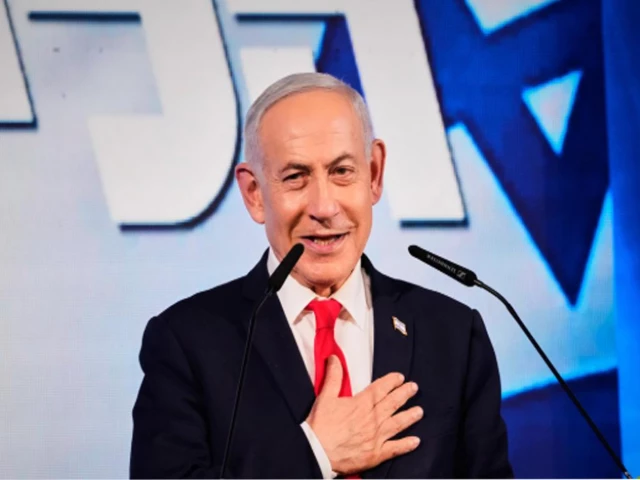
Benjamin Netanyahu looked set to remain Israel's caretaker prime minister after unexpectedly strong backing among Jewish voters left his opponents little apparent prospect of unseating him, despite his right-wing bloc losing its parliamentary majority.
With nearly 86% of votes tallied on Wednesday, Israel's three main broadcasters projected Netanyahu's bloc of right-wing, far-right and ultra-Orthodox parties would win 53 seats in the 120-seat Knesset, well ahead of the 48 for rival Gadi Eisenkot's opposition bloc.
Parties representing Arab Israelis were projected to win an unprecedented 19 seats, leaving Eisenkot little realistic path to power without their broad backing, which many Jewish political leaders reject.
The results could still change as counting continued, but Eisenkot's bloc of anti-Netanyahu parties, ranging from the centre-left to the hard right, had fallen short of pre-election polls that forecast a tight race.
Netanyahu would remain caretaker prime minister during any coalition negotiations and potentially until another election next year. While a caretaker government faces some constraints, experts say it retains powers, including over the war with Iran.
The result underscored the rightward shift among Israeli Jews during Netanyahu's years as the country's dominant political figure. The centre-left that dominated Israel for the first half of its history has been reduced to a small fringe.
Nearly all Jewish parties now share Netanyahu's rejection of an eventual independent Palestinian state, the basis of internationally endorsed peace efforts since the 1990s.
The election was Israel's first since Hamas-led fighters killed 1,200 people and took 251 hostages in attacks on October 7, 2023, that plunged the country into wars in Gaza, Lebanon and Iran.
Turnout reached 77.7%, the highest in more than two decades, and was particularly high among Israelis of Palestinian descent, who make up more than a fifth of the population. Many were motivated by what they see as open racism from Netanyahu's cabinet, which includes a party leader convicted of inciting racial hatred against Arabs.
The headquarters of the Joint List, an alliance of several Arab parties, burst into whistles and applause when exit polls were released. "We refuse the occupation and racism, and we will remain here," said Joint List candidate Faten Gattas.
The coalition that last toppled Netanyahu relied on one small Arab party, but Eisenkot's underperformance means the opposition would now need backing from the Joint List itself. Most Jewish leaders have shunned formal alliances with Arab parties since Israel's founding.













This material may not be published, broadcast, rewritten, redistributed or derived from. Unless otherwise stated, all content is copyrighted © 2026 The Express Tribune.






COMMENTS
Comments are moderated and generally will be posted if they are on-topic and not abusive.
For more information, please see our Comments FAQ