Governor's rule to end after six months, NA told
Updated 42 minutes ago

Says 2021 ruling can't be revisited without proper rules
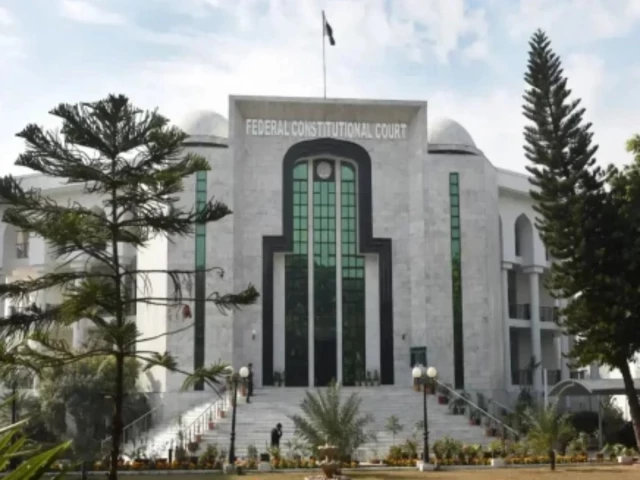
The Federal Constitutional Court (FCC) on Wednesday expressed serious reservations over the Supreme Court bench's handling of a matter that had already been decided, saying the approach raised concerns about judicial discipline, legal norms and institutional propriety.
"The course adopted in the subsequent order, authored by Justice Munib Akhtar, raises serious concerns regarding judicial discipline, legal norms and institutional propriety, particularly when the earlier determination remained operative and was already the subject of review proceedings," FCC Chief Justice Aminuddin Khan observed in his order.
A two-member FCC bench, comprising Justice Aminuddin and Justice Ali Baqar Najafi, heard dozens of review petitions challenging a Dec 28, 2021 Supreme Court ruling that had declined leave to appeal in cases stemming from a 2020 Sindh High Court order on the constitutional validity of the Income Support Levy Act, 2013.
The two-judge Supreme Court bench had ruled that the Income Support Levy Act, 2013, introduced through the Finance Act without following the constitutionally prescribed legislative procedure, could not be considered valid law.
Despite the 2021 ruling and the pending review petitions, a three-member Supreme Court bench, including Justice Akhtar, granted leave on substantially similar constitutional questions on June 21, 2022, while indicating that the earlier ruling could be reconsidered.
The FCC chief justice, in his ruling, also criticised the apex court's subsequent handling of the matter, saying it raised institutional concerns about judicial discipline and consistency in court decisions.
Justice Aminuddin noted that the constitutional validity of the Income Support Levy Act had already been considered by a two-member Supreme Court bench in Commissioner Inland Revenue v Muhammad Mustafa Gigi, in which leave to appeal was declined.
The FCC chief justice subsequently voiced "serious concerns" over the 2022 Supreme Court ruling issued by Justice Akhtar's bench.
"It is a settled principle that coordinate or subsequent benches must accord due regard to earlier judicial determinations and any departure therefrom must conform to the established principles governing judicial precedent and the prescribed institutional procedure," he stated.
Although refusal of leave does not invariably preclude consideration of a distinct petition, a subsequent grant of leave cannot, by itself, operate to review, modify or displace an earlier determination, the FCC ruled.
Judicial independence must be exercised consistently with judicial discipline, restraint and institutional decorum, the FCC chief justice emphasised.
He observed that the course adopted in the subsequent proceedings, insofar as it contemplated reconsideration of the 2021 judgment, "without recourse to the appropriate judicial mechanism, was inconsistent with these requirements".
"We reiterate that adherence to judicial discipline is indispensable to maintaining certainty, consistency and the institutional integrity of judicial adjudication," Justice Aminuddin observed.
Referring to the present review petitions, he noted that the 2021 SC judgment under review does not suffer from any error apparent on the face of the record or other fundamental defect warranting interference in review jurisdiction.














This material may not be published, broadcast, rewritten, redistributed or derived from. Unless otherwise stated, all content is copyrighted © 2026 The Express Tribune.









COMMENTS
Comments are moderated and generally will be posted if they are on-topic and not abusive.
For more information, please see our Comments FAQ