Foreign experts to find K2 Airways' black box
Updated 1 hour ago

.
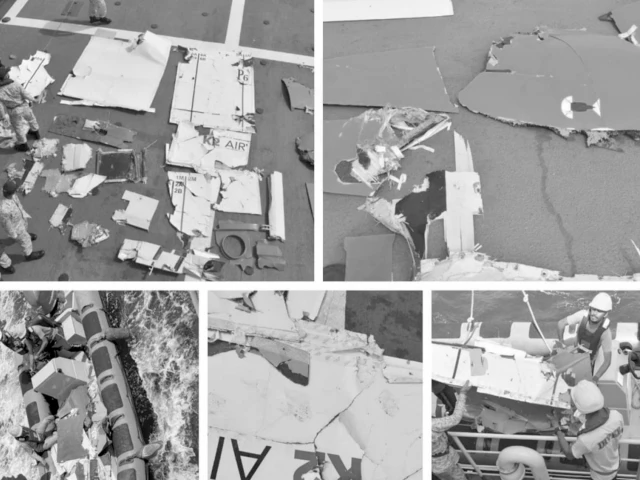
Nearly four months after a K2 Airways aircraft plunged into the sea off Ormara, the search for its black box, wreckage and cockpit crew is entering a new phase, with Pakistan stepping up efforts to enlist international expertise for a deep-sea recovery operation.
With the aircraft believed to lie around 3,000 metres below the surface, the search is expected to draw on advanced sonar systems, autonomous underwater vehicles and remotely operated robots equipped with high-definition cameras and specialised recovery tools.
The government has intensified contacts with foreign experts and several international companies to determine how best to locate and recover the aircraft's remains from the seabed, according to sources. The black box and wreckage are considered crucial to establishing what happened in the aircraft's final moments.
The aircraft belonging to the privately owned domestic cargo operator crashed into the sea on July 7 this year after encountering adverse conditions near Ormara. Sources said the transmitter beacon fitted to its black box stopped emitting signals around a month after the accident, making the search more difficult.
The Pakistan Navy had earlier used specialised equipment and side-scan sonar to identify a possible location of the black box on the seabed. Acoustic signals were used to scan the area at a depth of around 3,000 metres, but further progress now depends on more sophisticated underwater technology and specialised deep-sea salvage expertise.
As part of the proposed operation, a detailed three-dimensional map of the seabed will be prepared using a multibeam echo sounder. The technology can map underwater terrain, measure depths and identify potential obstructions, helping search teams narrow down the area where the aircraft's wreckage may be located.
Autonomous underwater vehicles may also be deployed to survey the seabed using sonar, cameras and other sensors. The data and images collected by these unmanned systems can help identify suspicious objects and pinpoint areas requiring closer inspection.
Remotely operated vehicles (ROVs), controlled from a support vessel, could play an equally important role. Equipped with high-definition cameras, powerful lights and robotic arms, the machines can examine wreckage at close range and, where feasible, retrieve smaller objects or position specialised equipment around the debris.










This material may not be published, broadcast, rewritten, redistributed or derived from. Unless otherwise stated, all content is copyrighted © 2026 The Express Tribune.






COMMENTS
Comments are moderated and generally will be posted if they are on-topic and not abusive.
For more information, please see our Comments FAQ