Ambassador Sheikh urges Pakistani-Americans to drive 'mutually rewarding' economic engagement
Updated 1 hour ago

Tremors also felt in Kalat, Surab as district administration reports no loss of life, property
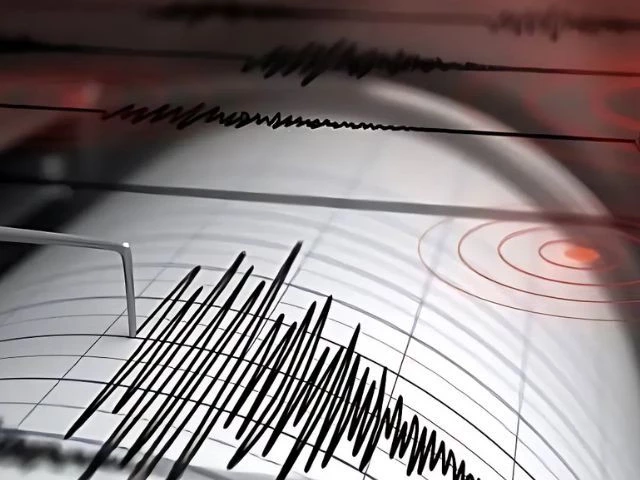
Tremors from an earthquake measuring 5.9 on the Richter scale were felt on Saturday morning in Balochistan's Khuzdar district and the surrounding areas of Kalat and Surab.
According to the Pakistan Meteorological Department, the earthquake's depth was recorded at 25 kilometres, and its epicentre was 48 kilometres northwest of Khuzdar.
The tremors were so strong that people came out of their homes, gathering in open spaces.
According to the district administration, no loss of life or property occurred. However, officials stated that all relevant institutions were put on alert and the situation was being monitored. The administration also appealed to the public to trust only information received from official sources.
In August, an earthquake of magnitude 4.0 jolted Balochistan's Dalbandin. The earthquake was recorded at a depth of 35 kilometres, with its epicentre located 100 kilometres southwest of Dalbandin.
In the same month, a 5.4-magnitude earthquake originating in Afghanistan’s Hindu Kush region jolted parts of Pakistan, with tremors felt in Islamabad, Peshawar and other areas of Khyber-Pakhtunkhwa (K-P). The earthquake was recorded at a depth of 187 kilometres and its epicentre was located in the Hindu Kush region of Afghanistan.
Read: 7.7-magnitude earthquake rattles Panama, damages buildings and halts flights
In July, an earthquake measuring 5.3 magnitude on the Richter scale jolted Islamabad and parts of Punjab and K-P. Tremors were felt in several cities across K-P, including Peshawar, Mardan, and Buner. The quake was also felt in the twin cities of Islamabad and Rawalpindi, as well as adjoining areas.
Earlier in June, three people were injured after earthquake tremors were felt in Balochistan’s Barkhan district and adjoining areas, causing fear and panic among residents.
In May, a series of mild to moderate earthquakes jolted parts of the country, with tremors felt in Islamabad, Khuzdar district and Azad Jammu and Kashmir. No casualties or damage were reported.
Most of the seismic activity affecting Pakistan originates in the Hindu Kush region, lying near the boundary of the Indian and Eurasian tectonic plates. As the Indian plate pushes northward under the Eurasian plate, the resulting friction and pressure often trigger moderate to strong earthquakes.
Seismic activity in this region is common, but the depth of the quake often determines how strongly it is felt on the surface.


















This material may not be published, broadcast, rewritten, redistributed or derived from. Unless otherwise stated, all content is copyrighted © 2026 The Express Tribune.






COMMENTS
Comments are moderated and generally will be posted if they are on-topic and not abusive.
For more information, please see our Comments FAQ