Israeli Democrats leader warns Netanyahu could use new attack on Iran to stay in power
Updated 1 hour ago

Iran’s Revolutionary Guard Navy says oil tanker struck mine in Strait of Hormuz
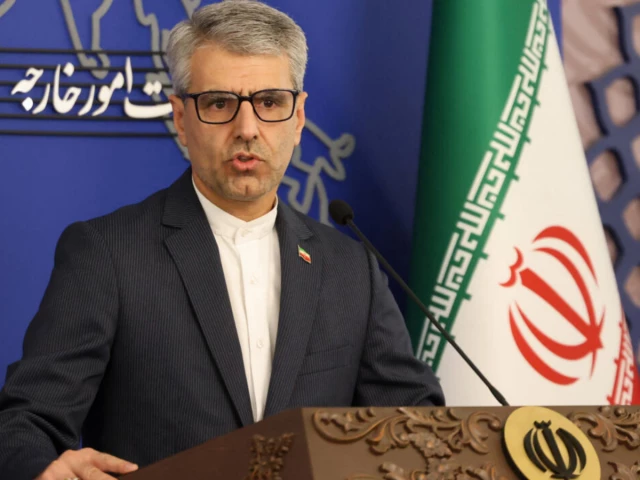
Iran said on Monday that it is reviewing US proposals for negotiations as Tehran and Washington continue to exchange messages through mediators.
Foreign Ministry spokesman Esmaeil Baghaei told his weekly press conference that Pakistan and Qatar continue to play a mediating role between Iran and the US.
“The exchange of messages between Iran and the US through mediators continues,” Baghaei said.
“We are reviewing the Americans’ proposals for negotiations. Iran’s preconditions must be observed for any negotiations,” he added.
Iran dismisses US claims of normalcy in Strait of Hormuz, says they don’t match realityhttps://t.co/h0mRiMzKNK pic.twitter.com/1q2bd4vxPt
— IRNA News Agency ☫ (@IrnaEnglish) October 12, 2026
Baghaei said Russia also continues to play a “constructive” role regarding Iran’s nuclear file, pointing to Moscow’s involvement in the 2015 nuclear agreement.
He said Iranian and Russian relations are based on mutual trust and that Tehran welcomes supportive efforts by friendly countries, but stressed that, “technically and precisely,” mediation between Iran and the US remains in the hands of countries such as Pakistan and Qatar.
Strait of Hormuz
Turning to the Strait of Hormuz, Baghaei said developments there were a direct consequence of US and Israeli attacks on Iran and rejected suggestions that Tehran’s actions were intended to create negotiating leverage.
“What we have seen in the Strait of Hormuz since February 28 was the direct result of the US and the Israeli regime’s attack on Iran,” he said.
“With the current US approach, security will not return,” he added.
Baghaei rejected US assertions that Iran had lost its leverage, saying such claims did not correspond with realities on the ground.
“They can say Iran has lost its leverage, but we are doing our work,” he said, arguing that energy markets were not responding to Washington’s assertions.
Baghaei also expressed “deep concern” over continuing tensions on the Arab Peninsula and said Tehran was ready to facilitate dialogue between Saudi Arabia and the Houthis in Yemen.
“We do not want war and hostilities to continue between two Islamic countries,” he said.
The spokesman said Iran’s consultations with regional countries were continuing and that Tehran had repeatedly offered to help facilitate dialogue and a peaceful settlement.
Strait of Hormuz is part of Iran’s national security: Official
Deputy Foreign Minister for Legal and International Affairs, Kazem Gharibabadi, said the Strait of Hormuz is part of Iran’s national security, and that the country will continue to control the strategic waterway until the United States returns to its commitments, according to IRNA.
Gharibabadi made the remarks at a press conference in Bandar Abbas, the capital of Hormuzgan Province in southern Iran, on Sunday evening.
“The Strait of Hormuz is part of the Islamic Republic of Iran’s national security, and Iran reserves the right to take the necessary measures to protect its national security,” he said, rejecting criticism of Iran’s control of the strategic waterway.
Strait of Hormuz is part of Iran’s national security: Officialhttps://t.co/ArTbzUAM5x pic.twitter.com/SWGY9Uwpob
— IRNA News Agency ☫ (@IrnaEnglish) October 12, 2026
“These control measures will remain in place until the United States, as the main aggressor, concludes that military action is not the solution and returns to its commitments,” Gharibabadi said, adding that Iran’s declared arrangements were being enforced in the strait.
Under these arrangements, warships are barred from passing through, while commercial vessels may transit after completing the required coordination, he added.
“At present, no vessel can pass through the strait without coordination with the Islamic Republic of Iran. Vessels that attempt to do so without Iran’s coordination will violate the arrangements announced by Iran and face punitive measures by our Armed Forces,” he stressed.
The deputy foreign minister also referred to an understanding reached between Iran and Oman on the passage of vessels through the Strait of Hormuz.
“The United States’ return to its commitments is an essential and integral part of the process, and any subsequent action by the Islamic Republic of Iran will be contingent on it,” he said.
Gharibabadi added Iran had always sought good and constructive relations with all its neighbours.
He reiterated Iran’s position that security in the Persian Gulf region can only be ensured by the countries of the region, not by foreign forces.
“During the 40-day war, everyone saw that the presence of foreign forces, particularly the United States, was the main source of insecurity not only for the region but also for countries hosting US military bases and equipment. This is a lesson that must be learned from these recent developments and acts of military aggression,” he said.
Military approach in Yemen will make region’s situation more complicated: Araghchi
Iranian Foreign Minister Abbas Araghchi stressed that insistence on a military approach and ignoring a political solution will make the ongoing regional situation more complex, according to IRNA.
Military approach in Yemen will make region’s situation more complicated: @araghchi https://t.co/seBMGHz7Tu pic.twitter.com/Bn2CSrKwYk
— IRNA News Agency ☫ (@IrnaEnglish) October 12, 2026
Speaking in a telephone call with his Saudi counterpart Faisal bin Farhan late on Sunday, Araghchi expressed concern over the escalation of tensions.
He said that persisting with a military approach while neglecting a political solution will only exacerbate the current situation.
The existing crises in the region have no military solution, he reiterated.
Iran’s Revolutionary Guard Navy says oil tanker struck mine in Strait of Hormuz
An oil tanker struck a mine while attempting to cross the Strait of Hormuz, triggering an explosion in its engine room, Iran’s Islamic Revolutionary Guard Corps (IRGC) Navy said Sunday.
The IRGC Navy said in a statement that the supertanker, capable of carrying around 2 million barrels of oil, was attempting to transit the strategic waterway with its navigation system switched off.
The IRGC Navy: A shuttle tanker (the third oil tanker) laden with 750,000 barrels of crude oil tried to transit through a prohibited route, disregarding the IRGC's repeated warnings. As a result, the vessel struck a sea mine, triggering an explosion and a fierce fire. pic.twitter.com/GZYDkHEIBI
— IRNA News Agency ☫ (@IrnaEnglish) October 12, 2026
The oil tanker is the third vessel to strike naval mines along the prohibited route in the Strait of Hormuz since Saturday, it added.
The statement did not identify the vessel or specify its nationality or flag.
The IRGC Navy renewed its warning that vessels switching off their navigation systems while passing through the waterway would be classified as “hostile vessels.”
The announcement came after the US Central Command (CENTCOM) said in late August that international shipping lanes in the Strait of Hormuz had been reopened following the removal of Iranian naval mines by US forces.
Read: Iran says US response to its proposal to reopen Hormuz was 'insufficient'
Iran announced on July 12 that it had again closed the strait following the resumption of US attacks on July 8.
Tehran has threatened to target vessels using routes other than those designated by Iranian authorities or attempting to cross the waterway without permission.
The US and Israel launched a war against Iran on February 28. Tehran responded with missile and drone attacks across the region and effectively closed the Strait of Hormuz, while Washington later imposed a naval blockade on Iranian ports.
The US and Iran subsequently signed a memorandum of understanding in June concerning freedom of navigation in the strait, but implementation stalled over disagreements related to security in the strategic waterway.
Iran accuses CENTCOM chief of running oil smuggling operations in Strait of Hormuz
A senior Iranian security official accused the head of the US Central Command (CENTCOM) of orchestrating oil-smuggling operations in the Strait of Hormuz with the assistance of the United Arab Emirates military.
Mohsen Rezaei, secretary of the Supreme National Security Council of Iran, made the claim in an interview over the weekend with Iranian state-run Press TV.
Rezaei said Admiral Brad Cooper was directing the operations using the UAE military, with five or six small boats transferring oil to large tankers.
He said Iranian forces had been striking five or six vessels involved in the operations each night over the past two or three months.
Read more: Saudi-led coalition says new attack at Riyadh airport causes fire, day after strike kills 13
There was no immediate comment from the US or the UAE on Rezaei’s claims.
Rezaei also rejected US President Donald Trump’s assertion that the Strait of Hormuz was open, insisting that Iran remained in control of the strategic waterway.
“From now on, therefore, we will maintain control over the management of the Strait of Hormuz. It will remain under our management to ensure peace and security in the region. We will not back down on this issue,” he said.
He said maritime traffic through the strait remained far below prewar levels and accused Washington and its regional allies of using smuggling networks to move oil through the waterway.
Rezaei also warned that Iran could target US-linked technology infrastructure in the region if the United States attacks the country again.
“We have not yet included these assets among our targets. But if war breaks out, many of these cables, data centres, artificial intelligence facilities and numerous other sites will be destroyed,” he said.
He put the value of such infrastructure at more than $2 trillion.
The Iranian official said Tehran was also prepared to deploy additional military capabilities in the event of renewed hostilities.
“Today, we are fully prepared to introduce new capabilities if the war starts again,” he said.
Saudi, Iranian foreign ministers discuss regional escalation
Saudi Arabia's foreign minister discussed the latest regional escalation and efforts to address it with his Iranian counterpart on Sunday, according to a Saudi Foreign Ministry statement.
Saudi Foreign Minister Prince Faisal bin Farhan and Iranian Foreign Minister Abbas Araghchi held the discussions during a phone call initiated by Araghchi, the ministry said in a statement posted on US social media company X.
🇸🇦📞🇮🇷 | Foreign Minister HH Prince @FaisalbinFarhan received a phone call from Iranian Foreign Minister Abbas Araghchi. pic.twitter.com/vrbpBGrS5y
— Foreign Ministry 🇸🇦 (@KSAmofaEN) October 11, 2026
The ministry said the ministers discussed "the recent escalation in the region and the efforts being made to address it."
No further details were provided.









This material may not be published, broadcast, rewritten, redistributed or derived from. Unless otherwise stated, all content is copyrighted © 2026 The Express Tribune.









COMMENTS
Comments are moderated and generally will be posted if they are on-topic and not abusive.
For more information, please see our Comments FAQ