PTI march fizzles out after K-P emergency, arrests
Updated 50 minutes ago

.
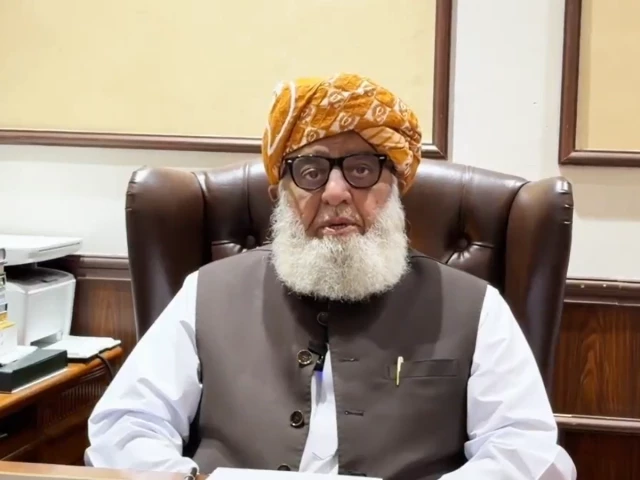
Jamiat Ulema-e-Islam (JUI-F) chief Maulana Fazlur Rehman on Sunday categorically rejected the federal government's move to impose governor's rule and declare an emergency in Khyber Pakhtunkhwa (K-P), accusing the government of reneging on its commitments despite progress in negotiations over Pakistan Tehreek-e-Insaf's (PTI) long march.
Speaking to the media at his residence, Fazl said his party would challenge the decision on every available democratic and constitutional platform, including the courts, parliament and the public.
"The JUI will take this matter to the people and to the courts. We will defend democratic rights and protect the rights of the people in parliament," he said, adding that the party categorically rejected the government's decision.
Recounting the sequence of events leading up to the announcement, Fazl said he had arrived in Islamabad on October 7, when PTI leaders approached him and shared information about the situation.
After hearing their account, he conveyed his assessment that the government had left no avenue open for negotiations.
He said both sides had presented their respective positions and that the PTI was advancing through different stages of its long march in K-P. At the JUI chief's urging, he added, the party had postponed its move towards Islamabad.
Fazl said he subsequently received an invitation from the Prime Minister's Office to attend a dinner with Prime Minister Shehbaz Sharif. Having not met the premier for four months, he consulted his associates on whether he should accept the invitation. His colleagues advised him to meet the prime minister in the interest of the country.
According to Fazl, the prime minister insisted during their meeting that the long march should first be called off. The PTI, meanwhile, was demanding a meeting with its founding chairman, Imran Khan, followed by his transfer to a hospital.
Fazl said the dinner meeting involved a detailed discussion of the matter. He told the prime minister that he first needed to speak to the PTI leadership, as K-P Chief Minister Sohail Afridi was leading the march but had not been in contact with him.
After returning, Fazl said, he reached out to Afridi and other PTI leaders to discuss the situation and explore a way forward.
The JUI-F chief said he contacted the prime minister early on Sunday morning, around the time of the morning prayers, explaining that Sharif usually went to bed early and woke up very early. The prime minister told him that a cabinet meeting was scheduled and that they should speak before it began.
Fazl said Afridi had indicated that the PTI would call off its long march if the government accepted its demands.
He added that Sharif telephoned him at 9pm and said he would place all the matters before the cabinet. However, at 10pm, Deputy Prime Minister and Foreign Minister Ishaq Dar called to inform him that the government was imposing an emergency in the province.
Fazl said he questioned Dar about the rationale for the move. Dar, he recalled, cited the high level of terrorism in K-P.
"I asked him whether there was no terrorism in Balochistan," Fazl said, arguing that the difference lay in the political conduct of the two provincial governments. "The only difference is that the Balochistan government agrees with whatever the federal government says."
Explaining why he had publicly detailed the sequence of events, Fazl said the government had retreated despite having agreed to the proposed course of action.
"Why did the government back out despite accepting the demands? Why did it break its commitment?" he asked.
He also challenged the government's counterterrorism record, arguing that the deterioration of the security situation since the era of former military ruler Pervez Musharraf reflected a failure of policy and strategy.
"If the situation has worsened from Musharraf's time until today, it is their failure - a failure of their strategy," he said. "Tell us what has become of the operations against terrorism that have been under way since 2010."
Citing the situation in Dera Ismail Khan, Fazl alleged that police stations were sometimes left without police personnel at night, with officers staying in houses in nearby neighbourhoods instead of remaining at their posts.
He said the situation was evidence of the security challenges confronting the province.
"If the institutions are fighting a war against terrorism, we, too, are making sacrifices," he said, recalling that he had once had to collect 90 bodies from a single public gathering.
Fazl reiterated that his party would not accept the government's decision, deploring the move as an assault on democracy carried out in its name.
"These are the killers of democracy in the name of democracy," he said.
Questioning whether the proposed intervention was genuinely based on governance and performance, the JUI chief asked why the same standard was not being applied to Balochistan.
"If an emergency is being imposed in K-P based on performance, is the performance of the Balochistan government satisfactory?" he asked.
JI
Condemning the imposition of emergency and governor's rule in Khyber Pakhtunkhwa, Jamaat-e-Islami (JI) chief Hafiz Naeemur Rehman on Sunday said saying the measures would not resolve the province's problems and urged the federal government to withdraw them and resume negotiations.
Addressing a public rally against the petroleum levy in Okara, the JI chief said the government should abandon the path of emergency measures and return to the negotiating table.
He argued that when those in power resort to governor's rule and emergencies to govern, it signals that their political authority is nearing its end.
Naeem accused the parties comprising the Pakistan Democratic Movement (PDM) of pursuing an anti-democratic course since the regime change.
He said the Pakistan Peoples Party (PPP) and Pakistan Muslim League-Nawaz (PML-N) had a history of imposing governor's rule and refusing to respect the public mandate. He also claimed that the political system "established through Form 47" had failed.
Regarding the petroleum levy, the JI chief accused the government of imposing "economic terrorism" on the public, saying people across the country were demanding an end to the burden.
He argued that the levy imposed on petroleum products had no legitimate connection with their prices and amounted to collecting extortion money and "jagga tax".
He alleged that the government was shifting the burden of its corruption and expenditure onto ordinary citizens, making it increasingly difficult for them to make ends meet.
Naeem claimed that the government was providing relief worth as much as Rs27 billion a month in response to Jamaat-e-Islami's protest movement, while collecting Rs150 billion through the petroleum levy.
He said party workers had staged sit-ins simultaneously in 42 cities, adding that the campaign had given people renewed hope.
The JI chief said the long march had been temporarily paused but maintained that party workers remained prepared to resume it.
He also slammed the government's agreements with independent power producers (IPPs), accusing successive administrations of strengthening the companies through unjust agreements. Under the arrangements, he argued, consumers were made to bear the costs of electricity generation and were also required to pay even when electricity was not produced.
Earlier, Jamaat-e-Islami Central Punjab chief Muhammad Javed Qasuri told the rally that the party's movement was directed against the elite, the petroleum levy and an "oppressive system".
Referring to the difficulties faced by farmers, he cited high fertiliser and diesel prices and accused the Punjab government of harming the agricultural sector.
Jamaat-e-Islami women's wing secretary-general Dr Humaira Tariq said the party was struggling to resolve the problems confronting the public.
Pakistan was rich in resources, she said, but the people's living conditions had failed to improve because of the poor performance of those in power.



This material may not be published, broadcast, rewritten, redistributed or derived from. Unless otherwise stated, all content is copyrighted © 2026 The Express Tribune.
1727268465-0/Untitled-design-(42)1727268465-0-208x130.webp "the poor man s burden")
COMMENTS
Comments are moderated and generally will be posted if they are on-topic and not abusive.
For more information, please see our Comments FAQ