Offering talks, PM asks PTI to 'come to its senses'
Updated 7 minutes ago

SC says clarity in service rules essential for good governance
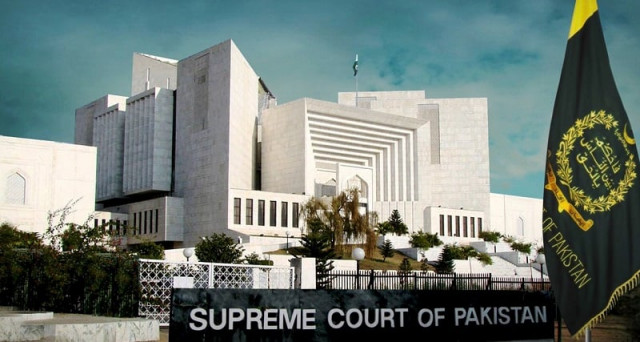
The Supreme Court has emphasised that the government, as the largest public employer, must conduct itself as a 'model employer'.
The SC stressed that questions relating to pay, seniority, promotion and retirement determine the security, progression and dignity of public servants throughout their working lives.
A six-page judgment authored by Justice Ayesha Malik noted that good governance required clarity not only at the policy stage but also in the rule making and its subsequent implementation.
"The government as the largest public employer must conduct itself as a model employer."
"Questions with reference to pay, seniority, promotion and retirement are not administrative inconveniences, they are matters that determine the security, progression and dignity of a public servant throughout their working life," the order noted.
A division bench of the SC, led by Justice Ayesha Malik, set aside the Punjab Service Tribunal's May 24, 2023 order that upheld the Education Department's decision to withdraw a school teacher's promotion.
The court held that the teacher was entitled to all back benefits with reference to his promotion from the date on which the promotion was withdrawn.
The petitioner joined the Education Department on November 22, 1995, as an elementary school teacher (Physical Education Trainer) (EST)(PE). He remained an EST(PE) until his promotion orders were issued in 2020, when he was promoted as Assistant Education Officer (Physical Education) BS-16, AEO(PE), on October 31, 2020.
The order was withdrawn on May 24, 2023, which then became the bone of contention between the petitioner and the Education Department.
The order said that a service structure must therefore provide a clear, predictable career path so that the employee can understand where he or she enters the service, how progression takes place and what conditions govern their advancement.
Where rules do not prescribe coherent promotional tracks or options, the resulting uncertainty leads to failure in governance.
"Its consequence is borne not only by the institution that created the ambiguity but by the employee who then must spend years seeking an entitlement that should otherwise have been provided for in the Rules, in the service structure."
The court further said that such structural gaps are often the consequence of policy developed without adequate data, institutional consultation or understanding of how the service actually functions on the ground.
"They are then aggravated at the implementation stage by an administrative approach that first asks why a benefit should not be given rather than whether it is due and how the governing framework can be fairly made to work."















This material may not be published, broadcast, rewritten, redistributed or derived from. Unless otherwise stated, all content is copyrighted © 2026 The Express Tribune.










COMMENTS
Comments are moderated and generally will be posted if they are on-topic and not abusive.
For more information, please see our Comments FAQ