Vance acknowledges 'failures' in US handling of Iran war
Updated 1 hour ago

US, China agree to lower tariffs on $60 billion of non-sensitive goods, delay wider trade deal to 2027
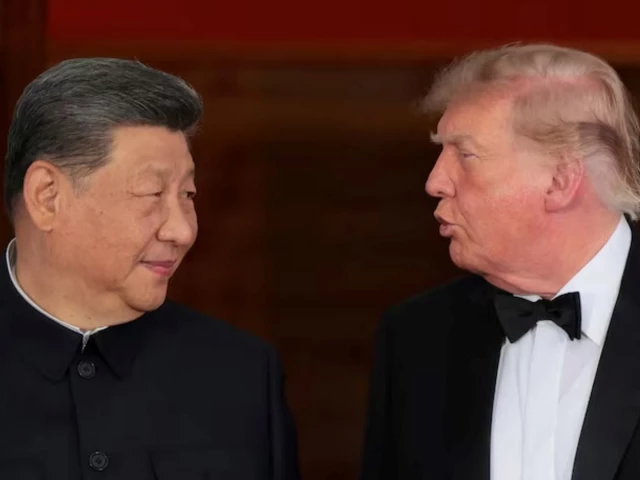
President Donald Trump hoped his pomp-filled summit with Xi Jinping in Washington last week would showcase the strength of his personal relationship with the Chinese leader.
Instead, the limited outcomes showed just how far apart Washington and Beijing remain on key issues, and reinforced a view among analysts that Xi sees little reason to grant Trump major political victories ahead of November's midterm elections.
"The US-China relationship has settled into a managed stalemate," said Craig Singleton, senior director for China at US-based think tank, the Foundation for Defence of Democracies.
"The elaborate pageantry matters precisely because there is still relatively little substantive progress to showcase."
Both sides said they reached consensus on lowering tariffs on a $60 billion batch of non-sensitive goods, but they set no timeline for adoption. At the same time, a deadline for a broader trade accord was pushed into next year.
The absence of a Chinese CEO delegation accompanying Xi also highlighted the challenges of overcoming US suspicion of Chinese investment, casting doubt on the viability of a two-way investment scheme the leaders unveiled at a Beijing summit in May, analysts said.
"The Trump-Xi summit created a positive political atmosphere but did nothing to narrow differences, or reduce mutual suspicions," said Drew Thompson, a senior fellow at the S. Rajaratnam School of International Studies in Singapore.
'PR win' for China
White House officials had tempered expectations before the summit, pointing out that the leaders would also meet at international forums in Shenzhen and Miami before year end.
But while the uneventful meeting capped off a diplomatic week that exposed the limits of Trump's powers, Joe Mazur, geopolitics analyst at Beijing-based consultancy Trivium, said it served as a "PR win" for China.
From the outset, Trump went out of his way to fete Xi — the leader of a country he has previously said is "killing America" with unfair trade practices.
He broke protocol to greet him at the airport, the first time a US president has done so for a world leader in 11 years.
Later, addressing a coterie of top government officials and tech magnates assembled for a lavish state banquet in his honour, Trump said they "had never gotten along better".
"The extraordinary courtesy the Americans extended to Xi Jinping met and far exceeded China's expectations," said Shen Weizhong, a former Chinese foreign ministry official and vice president of Beijing-based think tank Global Governance Institution.
"The Chinese do not feel that a visit necessarily has to result in a specific number of agreements, or in tariff reductions or other such outcomes ... The mere fact that they meet, nod to one another and shake hands speaks volumes."
Xi is also in no rush to make concessions, analysts say.
Read More: China, US agree tariff cuts on $60 billion of goods including agriculture, household items
China's dominance in production of rare earths, minerals critical for sectors from tech to autos and defence, gives it a powerful source of leverage, while its trade with the world has surged despite Trump's tariff threats.
Trump did not come away completely empty-handed, however.
China has proposed cutting tariffs on a range of US agricultural goods, from corn to dairy, a commerce ministry list showed on Monday. In return, the US will reduce levies on Chinese imports such as toys, fireworks and Christmas ornaments.
That will be welcome news for American farmers, who form one of Trump's key voting blocs, ahead of midterm elections that look challenging for his Republican party.
But commodity analysts were also quick to add that soybeans, one of the US' largest exports, did not feature on China's list, leaving those purchases potentially hostage to any deterioration in ties.
Buying time on Taiwan
China also gave little indication it is willing to help Trump end the war in Iran that has dragged the US president's approval rating to the lowest in his political career.
Shortly after Xi's departure, Chinese Vice President Han Zheng pushed back against the US on Iran and its threats against Cuba at a UN General Assembly meeting in New York.
The Chinese leader also did not shy away from pressing Trump on thornier topics such as US support for Taiwan, the democratically ruled island claimed by Beijing.
Trump avoided the subject in his public comments, in stark contrast to the May summit, at which he called a pending $14-billion package of arms sales to Taiwan a "negotiating chip" with Beijing.
Washington has cast the busy summit schedule with Xi as important to keeping ties on even keel between the world's two biggest economies.
But frequent interactions of the leaders also buy Beijing time on unwanted US actions such as the arms sales to Taiwan, said Jeremy Chan, a senior analyst at political risk consultancy Eurasia Group.
"That's a major strategic win for the Chinese and a major loss for Taiwan and a lot of US allies and partners in the region," said Chan, a former US diplomat in China.










This material may not be published, broadcast, rewritten, redistributed or derived from. Unless otherwise stated, all content is copyrighted © 2026 The Express Tribune.





1727268465-0/Untitled-design-(42)1727268465-0-208x130.webp "sisyphus in the land of saviours")
COMMENTS
Comments are moderated and generally will be posted if they are on-topic and not abusive.
For more information, please see our Comments FAQ