Karachi court extends journalist Iqrarul Hassan's physical remand by two days
Updated 1 hour ago

Dr Nergis Mavalvala says curiosity and access to opportunity are key to scientific discovery
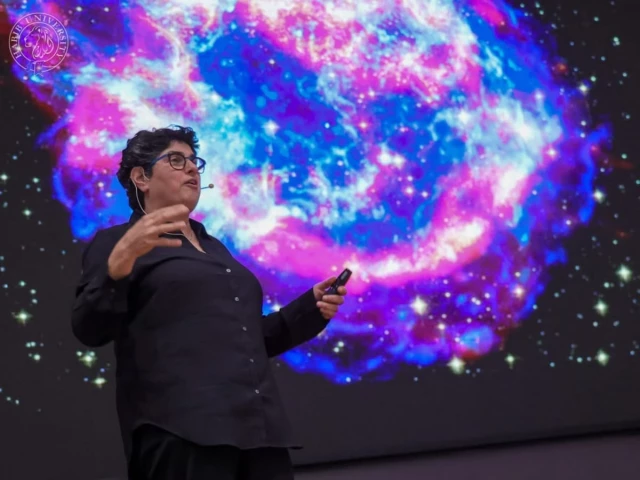
Pakistani-American physicist Dr Nergis Mavalvala has called for greater investment in scientific research, saying curiosity and access to opportunity were central to scientific discovery and that universities had a responsibility to nurture both.
Speaking at Habib University on Thursday, Mavalvala, dean of the School of Science at the Massachusetts Institute of Technology (MIT) and a leading figure in the Nobel Prize-winning LIGO collaboration, said some of humanity’s most consequential discoveries had originated from questions with no immediate practical application.
“Every single person at birth is research-minded,” she said during an extended question-and-answer session following her lecture. “The reason some of us get to do it in adulthood is [access to] opportunity.”
Mavalvala was speaking at the 10th Yohsin Lecture, titled "The Joy of Discovery: Curiosity, Science, and the Pivotal Role of Universities", which drew an estimated 4,000 to 5,000 people to the university campus.
Long queues formed as students, academics, alumni and members of the public gathered to hear the physicist speak about curiosity, scientific discovery and the role of universities in advancing knowledge.
Reflecting on humanity’s longstanding fascination with the universe, Mavalvala said the impulse to explore was not necessarily driven by an immediate practical benefit.
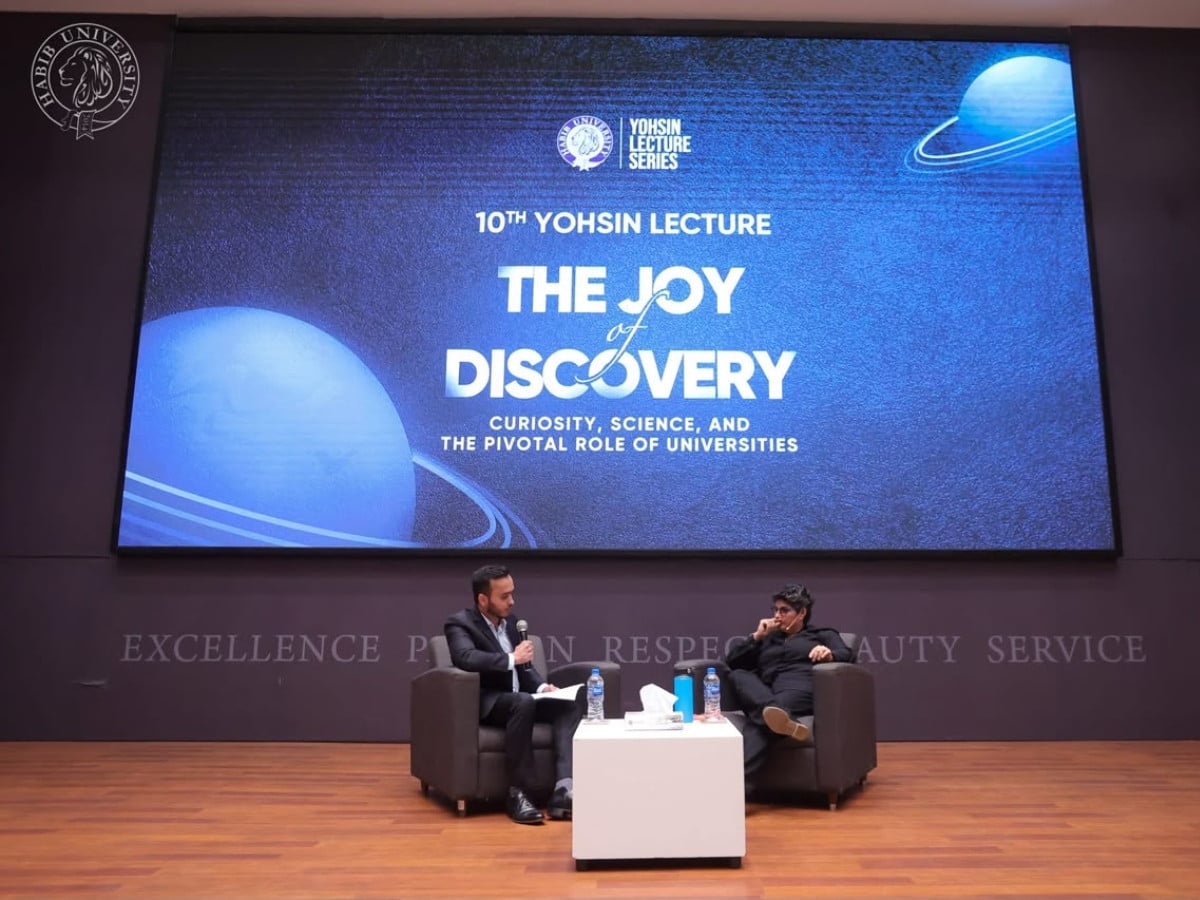
MIT dean Dr Nergis Mavalvala speaks during a panel discussion at Habib University in Karachi on Thursday. Photo: Express
“Even pre-human cultures were looking up at the sky, in part because it was just mysterious,” she said. “A hundred years from now the only thing that will matter is that we’ve opened a new window into the universe.”
She argued that universities should not be viewed merely as institutions for professional training, saying they also had a role in cultivating curiosity, creativity, perseverance and intellectual freedom.
Mavalvala also stressed the importance of public and government investment in science and research.
“Research has shown there is no investment that any government does that has greater return than investment in research and science,” she said.
The lecture followed a two-day visit to Habib University during which Mavalvala met students, faculty, alumni and members of Pakistan’s scientific and business communities.
She held discussions with faculty members on nurturing curiosity in classrooms and met science and humanities students from schools across Karachi. She also participated in sessions with the Entrepreneurs’ Organization and members of the scientific community.
During her interaction with the university’s leadership, discussions also focused on the role of liberal arts education in developing students’ curiosity and the importance of teaching and mentorship.
Habib University President Wasif Rizvi said the public response to the lecture demonstrated the value of making access to knowledge and leading thinkers more widely available.
“This access had not been attempted in Pakistan before. It exists because the community in this room and outside decided that it should,” Rizvi said.
He linked the initiative to the university’s philanthropic model, saying its students demonstrated what private philanthropy could achieve in expanding access to higher education.
Mavalvala, who is known for her work on the detection of gravitational waves, thanked the university’s leadership, board and donors for creating the institution and said her interactions with its students and alumni had impressed her.
“I've met with a number of students and alumni and just have been wowed,” she said.
The Yohsin Lecture Series is based on Habib University’s founding philosophy of Yohsin, described by the institution as the thoughtful cultivation of the self. Previous speakers have included Noam Chomsky, Ashis Nandy, Reza Aslan, Azra Raza and Thomas Blom Hansen.
The event concluded with a reception on the university’s Central Street, where attendees continued discussions sparked by the lecture.













This material may not be published, broadcast, rewritten, redistributed or derived from. Unless otherwise stated, all content is copyrighted © 2026 The Express Tribune.



COMMENTS (1)
Comments are moderated and generally will be posted if they are on-topic and not abusive.
For more information, please see our Comments FAQ